
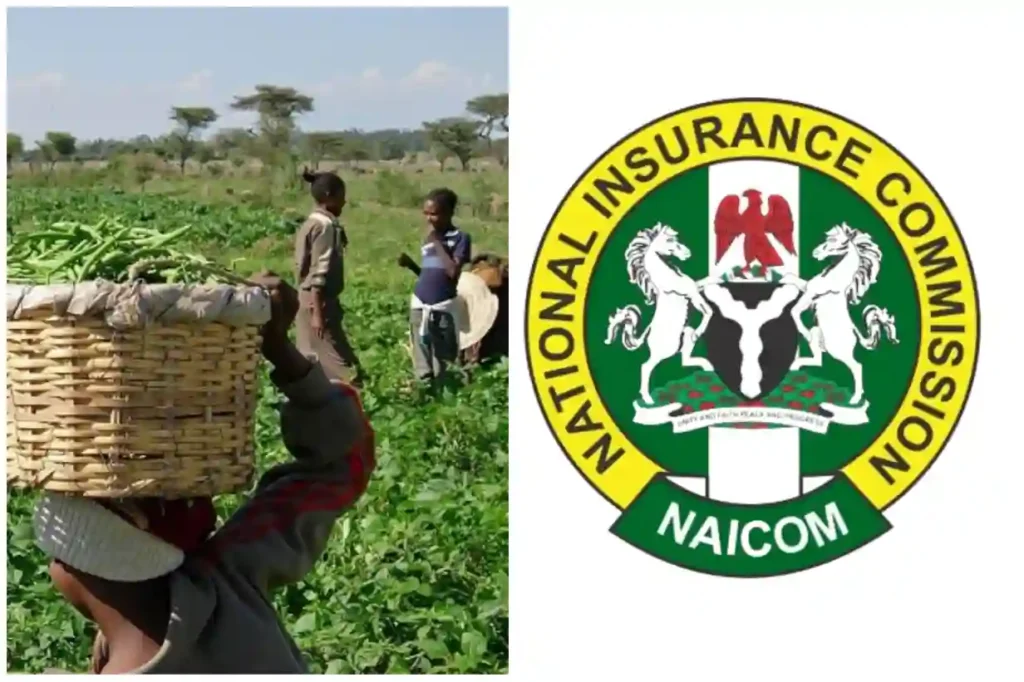
The National Insurance Commission (NAICOM) has announced that over 1.47 million smallholder farmers across Nigeria are now covered under agricultural insurance schemes.
 Follow us on Google News
The Commissioner for Insurance and Chief Executive Officer of NAICOM, Olusegun Omosehin, made this known in Maiduguri during the 2025 stakeholders’ retreat of the House Committee on Insurance and Actuarial Matters. The event was held under the theme “Navigating the New Era of Insurance Regulation—Understanding the Nigerian Insurance Industry Reform Act (NIIRA) 2025.”
According to Mr Omosehin, the agricultural insurance coverage was made possible through the Nigeria Incentive-Based Risk Sharing System for Agricultural Lending (NIRSAL). He explained that the initiative aims to improve resilience and productivity in the agricultural sector, with a target of reaching 3.6 million farmers by 2026.
“Recent statistics show that over 1.47 million smallholder farmers have been covered under NIRSAL’s agricultural insurance schemes, with a target of 3.6 million by 2026,” he said. “In the second quarter of 2025, 250,000 farmers were insured across eight states under federal initiatives.”
Mr Omosehin noted that agricultural insurance has begun to make measurable impacts on productivity among Nigerian farmers. He cited that in North-Central Nigeria, insured rice farmers recorded 11 per cent higher productivity than their uninsured counterparts, averaging 20 bags per hectare compared to 18 bags.
He also pointed out that specific programmes, such as the Kaduna ginger farmers who received payouts under the NAGS-AP scheme after losing more than 90 per cent of their crops, have proven the value of insurance in stabilizing rural livelihoods.
Additionally, livestock and encroachment insurance in Sokoto, Bauchi, Adamawa, and Plateau States has reportedly reduced farmer-herder conflicts. “Insurance provides a vital tool to de-risk agriculture and empower farmers to invest confidently,” Mr Omosehin stated.
He called for closer cooperation among lawmakers, regulators, and industry stakeholders to ensure the smooth implementation of the NIIRA 2025.
Mr Omosehin explained that the NIIRA consolidates previously fragmented insurance laws into a unified framework that strengthens regulation, protects consumers, and supports innovation in Nigeria’s insurance industry.
“The law has been passed, but the real work has just begun. We urge the committee to ensure MDAs comply with compulsory insurance provisions,” he said.
He urged all stakeholders to align legislative, regulatory, and operational efforts to make NIIRA 2025 a key driver of national economic growth.