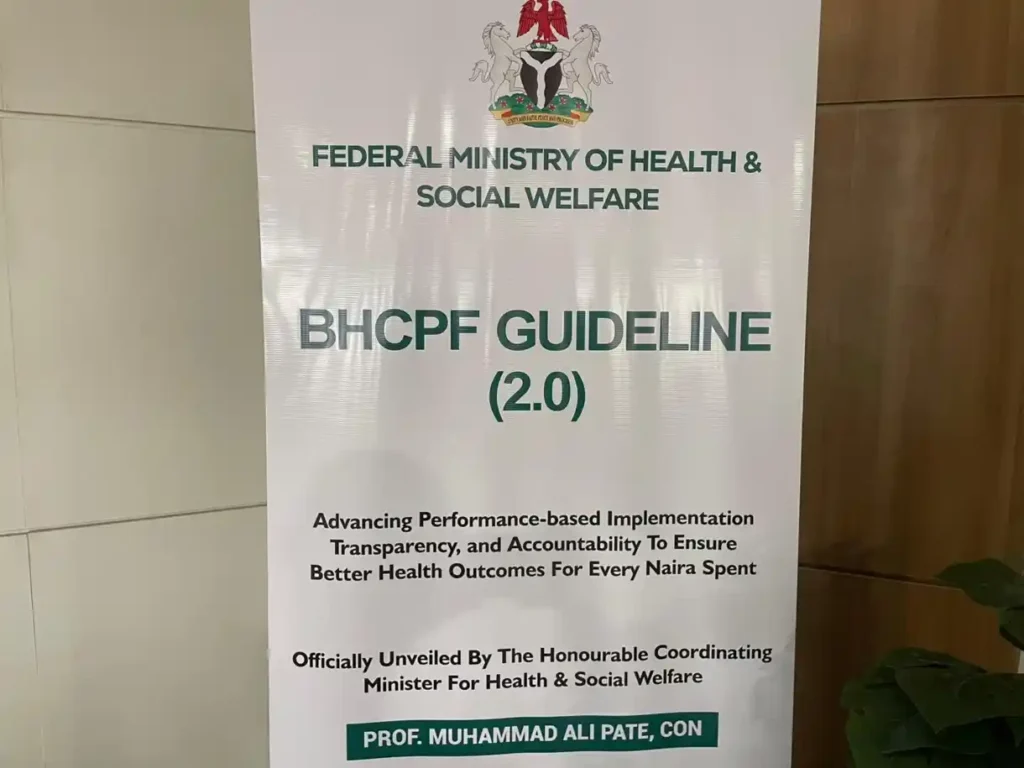
The Federal Government has officially launched the Basic Health Care Provision Fund (BHCPF) Guideline 2.0 to improve transparency, strengthen accountability, and promote performance-based financing in Nigeria’s health system. The launch was announced during the 3rd Quarter 2025 Ministerial Oversight Committee Meeting of the Federal Ministry of Health on the BHCPF in Abuja.
 Follow us on Google News
The Coordinating Minister of Health and Social Welfare, Professor Muhammad Ali Pate, said the updated guideline will guide the disbursement of ₦32.9 billion to states and health facilities across the country before the end of October. He noted that this reform aims to ensure that every naira released through the BHCPF is effectively tracked and used to deliver better health services for Nigerians.
“The BHCPF Guideline 2.0 is designed to ensure that health resources are effectively used to deliver better services to Nigerians,” Professor Pate said. “We launched the BHCPF Guideline 2.0, which institutionalises performance-based financing and accountability and will guide the disbursement of ₦32.9bn to states and facilities before the end of October.”
He stated that the government remains committed to ensuring efficient use of public and partner funds in line with President Bola Ahmed Tinubu’s directive for transparency and accountability in governance.
“In line with President Bola Ahmed Tinubu’s charge for transparency, accountability, and efficient use of public and partner resources, the Expanded Ministerial Oversight Committee for the Health Sector Renewal Investment Initiative met today to review collective progress in strengthening Nigeria’s health system,” he said.
The Minister highlighted that the Health Sector Renewal Investment Initiative (NHSRII), launched in 2023, has aligned federal, state, and partner investments around one shared goal of delivering better health for Nigerians. He revealed that the initiative, operating through a Sector-Wide Approach, has achieved remarkable progress under its four pillars—governance, efficiency, value-chain optimisation, and health security.
“In the first two quarters of 2025, over 80 million visits were recorded at primary health facilities, four times more than in 2023,” he said. “More than 21 million Nigerians are covered under health insurance, over 11,000 pregnant women have received emergency care, 15,000 benefited from obstetric treatment, and more than 500,000 are enrolled in covered maternal care.”
According to him, data from facilities show a 12 percent drop in maternal mortality, while preventive health outcomes have improved nationwide. He said the integrated measles, rubella, polio, and neglected tropical disease campaign targeting 106 million children has achieved 92 percent coverage for measles and rubella, with strong results for polio and NTD interventions, especially in the northern states.
“These gains reflect the determination of governments, partners, and frontline health workers to extend essential services to every community,” he said.
Professor Pate further explained that the number of supported facilities will increase from 8,800 to 13,000, with a pathway to reach 17,000 through the HOPE Programme. Facility allocations have also been raised from ₦300,750 to between ₦600,000 and ₦800,000 per quarter.
He added that evidence shows BHCPF-supported facilities perform better in immunisation, skilled birth attendance, and general service utilisation compared to others. To ensure transparency, he disclosed that a Joint Task Force (JTF) with ICP Nigeria has been activated to monitor fund usage at both facility and community levels.
“Data accuracy and integrity remain central to reform. Instances of overreporting of maternal and child deaths are being addressed through improved verification systems, digital reporting, and integration of NINs into health records,” he explained.
The Minister said the National Emergency Medical Service and Ambulance System (NEMSAS) has continued to grow, serving over 11,000 emergency patients in the last quarter and disbursing ₦470 million for care in 150 local government areas. Nigerians can currently dial 112 in 30 states, with nationwide coverage expected by December 2025.
To confirm ongoing improvements, Professor Pate said a Mini-Demographic and Health Survey will be conducted in 2026 to provide independent data on maternal and child health outcomes.
“Under the visionary leadership of President Tinubu, Nigeria’s health sector is redefining accountable governance, anchored on results, driven by integrity and inclusion, and turning reforms into real improvements in people’s lives,” he said.
He also issued a “Red Letter,” calling on every Nigerian to protect the health of the nation and support transparency in public health financing.
News report updated on October 23, 2025.