
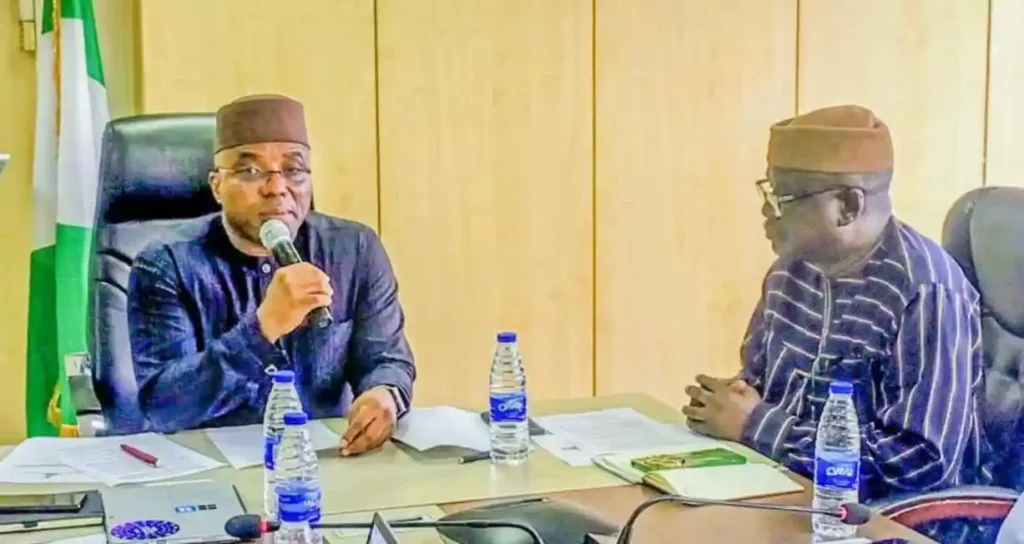
The Federal Government, through the Ministry of Petroleum Resources, has inaugurated a Technical and Steering Committee on the creation and management of the Nigeria Green Climate Fund and Sovereign Carbon Credits. The move is aimed at positioning Nigeria as a major player in global climate finance and energy transition.
 Follow us on Google News
Speaking during the inauguration in Abuja, the Permanent Secretary, Ministry of Petroleum Resources, Dr. Emeka Vitalis Obi, mni, described the initiative as a bold step toward integrating economic growth, energy security, and environmental responsibility.
“We gather at a defining moment where energy security, climate responsibility, and economic resilience must no longer exist in silos,” he said. “This Committee’s work is not mere paperwork; it is economic statecraft, climate diplomacy, and a transition by design, not by external pressure.”
Dr. Obi explained that the Committee was created to design a financial, institutional, and regulatory framework that would enable Nigeria to access global climate capital, monetize emission reductions, and reposition the Ministry as a transition-energy and climate-smart institution as provided for in the Petroleum Industry Act (PIA) 2021.
He stated that the global voluntary carbon market is projected to exceed 50 billion dollars by 2030 and reach one trillion dollars by 2037. However, Africa, which contributes less than three percent of global emissions, receives under five percent of international climate finance. Dr. Obi noted that methane emissions, which are 84 times more potent than carbon dioxide, make Nigeria’s petroleum sector strategically important to global climate solutions.
He emphasized that under Nigeria’s updated Nationally Determined Contributions, the country has pledged to cut emissions by 47 percent by 2030, equivalent to about 60 million metric tonnes, subject to international support. He added that gas flaring has reduced from 2.5 billion standard cubic feet per day in 2000 to about 700 million today, but still emits over 25 million metric tonnes of carbon dioxide equivalent annually.
According to him, if properly captured and traded as carbon credits, this could earn Nigeria more than 500 million dollars every year. He further explained that the Nigeria Energy Transition Plan requires 1.9 trillion dollars in investment by 2060, of which 410 billion dollars must come from climate finance and carbon markets, showing how critical the Committee’s work will be for the country’s future.
Dr. Obi said the Committee will design the institutional framework for the Nigeria Green Climate Fund, establish a sovereign carbon credit registry in line with UNFCCC standards, identify eligible projects such as gas flare capture and renewable energy, and propose sustainable financing and transparent revenue models.
He charged members to deliver their reports within 10 weeks, urging them to prioritize accuracy, patriotism, and institutional focus.
“History will not remember this Committee for the minutes of its meetings but for the systems it builds,” he said. “Let us seize this moment strategically and responsibly for the benefit of future generations.”
Earlier in his remarks, the Director of Midstream and Downstream, Mr. Mohammed Mohammed Abubakar, described the inauguration as a milestone in aligning Nigeria’s petroleum sector with global transition priorities. He said the Ministry, in partnership with Black River Switzerland and other government institutions, is working to design and operationalize a credible carbon credit trading framework for the oil and gas industry.
Mr. Abubakar explained that the partnership brings technical expertise in carbon asset development, emissions accounting, and verification systems to ensure transparency and compliance with international standards. He stressed that collaboration across government, private sector, and sub-national levels will be key to achieving success.
The Committee members drawn from the Ministry of Petroleum Resources include Mr. Mohammed Mohammed Abubakar as Chairman; Tyendezwa T. G, member; and Sharang Aine Jennifer, member.
Others are Mr. Emmanuel Okon, Mr. Chris Ugwuegbulam, Engr. Hozana Onakpoyovwire, Engr. Amamki Ephraim, Engr. Samson Izonfade, Engr. Ibrahim Musa Suleiman, Barr. Sokiepirim Soberekou, Engr. Andrew Uchendu, Amadi Ijeoma, Dr. Kingsley Uranta, Peter Ikpeme, and Luka Timothy Agyo.
From the agencies under the supervision of the Ministry, the members include Afolabi Abioye from the Nigerian Midstream and Downstream Petroleum Regulatory Authority (NMDPRA), Hajara Abdulfatah from the Nigerian Upstream Petroleum Regulatory Commission (NUPRC), Michael Ivonso from the National Council on Climate Change (NCCC), and Ransome Obem from Black River.