
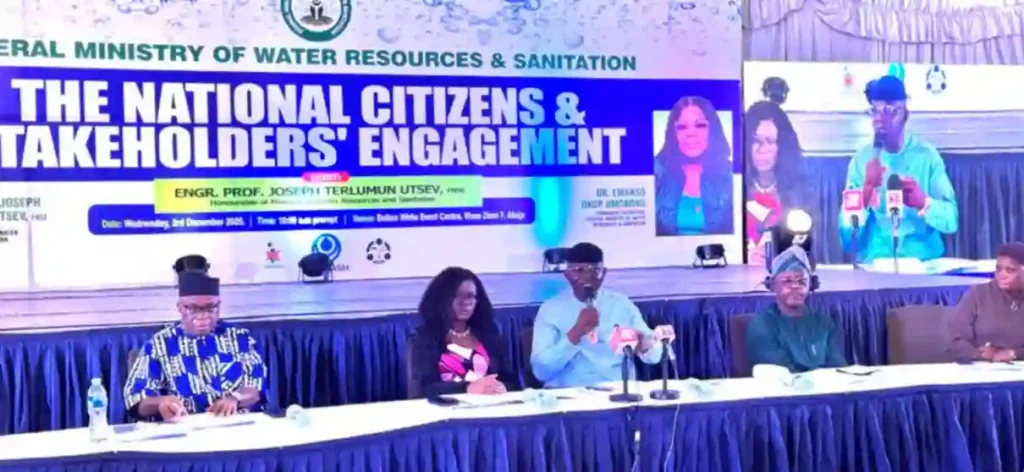
Over two million rural Nigerians now have access to clean and safe drinking water after the completion of hundreds of government water projects, according to Prof. Joseph Utsev, Minister of Water Resources and Sanitation. The minister announced this in Abuja on Wednesday while delivering the keynote address at the Citizens and Stakeholders’ Engagement on the ministry’s achievements. He explained that 500 new installations, including solar-powered boreholes, storage tanks, reticulated pipelines, and water fetching points, have been built across the country to improve rural livelihoods and sanitation.
 Follow us on Google News
Utsev added that sanitation efforts have been strengthened through the Clean Nigeria Campaign, noting that 5,238 public sanitation facilities have been constructed and 162 Local Government Areas have been certified Open Defecation Free (ODF). He stated that the ministry’s achievements received support from UNICEF, the World Bank, and other development partners through programs such as Sustainable Rural Water Supply and Sanitation (SURWASH) and the Partnership for Expanded Water Supply and Sanitation (PEWASH). “These programs provide sustainable Water, Sanitation, and Hygiene (WASH) services across the country, benefiting millions of Nigerians,” he said.
The minister confirmed that two National Water Quality Reference Laboratories in Asaba and Umuahia have been completed to strengthen nationwide water quality monitoring. He stressed that community engagement remains a priority for the ministry, pointing out that Water Users’ Associations have been set up across regions to support farmers and ensure the long-term management of irrigation and WASH infrastructure. According to him, this approach helps empower communities and improves ownership of resources.
Speaking on hydropower and dam development, Utsev reported that the Kashimbilla Multipurpose Dam and its 40-megawatt hydropower plant are fully operational. He noted that the Gurara and Dadin Kowa Dams are also contributing renewable energy to the national grid. He listed other ongoing projects, including Mangu Dam in Plateau State, which is 90 percent completed; Adada Dam in Enugu at 78 percent; Ogbesse Dam in Ekiti at 65 percent; and Farin Ruwa Dam in Nasarawa. “Smaller dams, including Irawo Earth Dam in Oyo and Otukpo Multipurpose Dam in Benue, along with the rehabilitation of Tiga, Challawa Gorge, and Ruwan Kanya reservoirs, are improving capacity and operational efficiency,” he stated.
On irrigation, Utsev explained that the Dadin Kowa Scheme now provides 2,000 hectares of farmland for farmers in Gombe State, boosting productivity and enhancing livelihoods. He said the Middle Rima Valley Project in Sokoto and the Middle Ogun Project in Ogun are operational, adding that they now use solar-powered sprinklers that reduce energy costs for farmers.
The minister said small-scale renewable energy irrigation projects have been completed in Gari, Ipapo, and Duku-Lade, while additional schemes are underway in Kebbi State. He added that river basin development authorities now play an important role in national food security, revitalising dry-season farming schemes that benefit over 1.6 million farmers nationwide.
Utsev also highlighted the maiden National Sanitation Conference, which brought together stakeholders, religious leaders, and traditional leaders to develop strategies to end open defecation. According to him, water security, irrigation, renewable energy, and sanitation remain central to Nigeria’s vision for inclusive growth, public health, food security, and national prosperity. He reiterated government commitment to achieving global targets, saying, “Our government is committed to achieving Sustainable Development Goal 6, targeting universal access to clean water and sanitation by 2030.”
Earlier, Permanent Secretary of the Ministry, Dr Emanso Umobong, stated that the Citizens and Stakeholders’ Engagement was designed to strengthen accountability, transparency, and stakeholder inclusion. She noted that the water and sanitation sector remains crucial to public health, economic development, and national wellbeing. Umobong explained that the forum provides a platform to exchange views on sector performance, challenges, and collaboration. “Close interaction with stakeholders is essential to obtain meaningful feedback and improve service delivery. The Ministry values all contributions, and outcomes of today’s session will help refine policies and enhance programme implementation,” she said.
She added that citizen participation and stakeholder engagement were first introduced through Presidential Executive Order 12 of 2022 before being amended by Executive Order 13 to strengthen coordination and accountability in implementing government priorities.
The Permanent Secretary stated that ministries must hold at least one stakeholder engagement meeting every quarter, chaired by the Minister and supported by officials, development partners, and civil society actors. Highlights of the event included questions and feedback from partners on aligning the Ministry’s mandate and strengthening the water and sanitation sector.