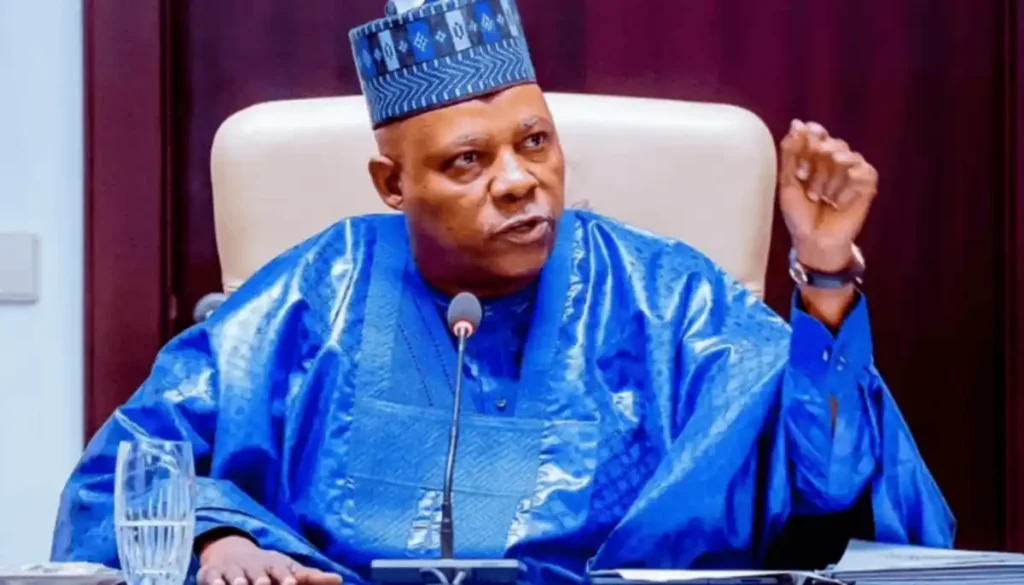
The federal government, through the Vice President of Nigeria, Senator Kashim Shettima, has announced that Nigeria is ready to take the lead in a new era of data-driven disaster preparedness. He made this known on Thursday, 4 December 2025, while revealing that the Federal Government has approved a N166 billion special intervention fund to support anticipatory actions before disasters happen in the coming year. According to him, this step is part of a broader national effort to improve systems, enhance early warnings, and ensure that alerts do not just get issued but are heard, understood, and acted upon in communities.
 Follow us on Google News
Shettima made these remarks at the National Conference on Anticipatory Action in Nigeria, themed Unlocking the Power of Data-Driven Anticipatory Action in Nigeria, organised by International Rescue Committee, Nigeria. Speaking through the Deputy Chief of Staff to the President, Senator Ibrahim Hassan Hadejia, Shettima explained that the Federal Government is investing in key areas such as national data generating agencies, climate-resilient agriculture, flood prediction models powered by machine learning systems including IGNITIA, data-driven disaster management frameworks, and community-led resilience programmes.
He stated that the goal is to build a country where no community is left behind or exposed to rising waters, failed rains, or declining livelihoods. According to him, strengthening national systems is essential so that early warnings become actionable, especially for communities at the last mile. He noted: “A special intervention of N166 billion has been committed by the National Economic Council to fund the National Anticipatory Action Framework in 2026.” He added that Nigeria’s ambition is to become a nation that anticipates rather than reacts.
Shettima emphasised: “The Nigeria we are building will not be one that waits helplessly for rescue. We will be a proactive nation, not reactive, resilient, not vulnerable. A nation where no community is abandoned to rising waters, failed rains, or eroding livelihoods. A nation where innovation meets governance, and data meets compassion.” He stressed that anticipatory action is more than a humanitarian requirement; it is a development strategy and a climate pathway. He described it as a governance strength, positioning Nigeria to respond more intelligently to environmental shocks.
He noted that timely and accurate data remain central to this new vision because it supports reliable early warning systems and proactive financing. He stated: “And it is a moral duty. If we unlock the power of data-driven anticipatory action, we will build a Nigeria that withstands shocks, protects its citizens, and stands as a global model for resilience.” The Vice President reminded participants that the conference was designed to chart a new national direction in anticipating climate-related disasters, including how to prepare and respond effectively.
He pointed out that the climate crisis is no longer distant but already affecting the country. He cited examples such as floods that sweep through over 26 states, droughts reducing agricultural yields in the Northeast and Northwest, rising cases of cholera, meningitis, and vector-borne diseases linked to changing weather conditions, and thousands of displaced individuals yearly.
In Shettima’s words, for affected families, these are not simply climate events but life-altering emergencies that determine whether children attend school, whether families can eat, and whether businesses survive.
He highlighted that the opportunity ahead lies in transforming climate predictability into protection. According to him, global evidence shows that acting before disaster strikes, guided by data, forecasting, and science, saves more lives, protects livelihoods, and reduces economic costs.
He explained that with accurate data, reliable early warning systems and proactive financing, Nigeria can move families to safety ahead of flooding, safeguard farms before drought impacts seedlings, provide cash assistance before families resort to extreme coping strategies, and reinforce local systems before they collapse. He described anticipatory action as common sense, smart economics, good governance, and humane leadership.
Shettima referenced successful collaboration with the United Nations, The International Rescue Committee, donors, and partners in Adamawa State, noting that communities recover faster, cope better, and move forward with dignity when proactive actions are taken. He urged international partners and donors to significantly increase investments in anticipatory action.
According to him, “Now is the time to scale up anticipatory action financing in Nigeria, the window to act is narrow, the need is urgent, And the returns in lives saved and communities protected are extraordinary, Every naira or dollar spent before a crisis saves multiple times that amount after a crisis, This is not charity, this is strategic investment in stability, economic growth, and resilience for Africa’s largest nation.”
The Vice President further called on stakeholders to collaborate in strengthening data collection, expanding hydro-meteorological infrastructure, improving forecasting capabilities through analytics and machine learning, building accessible and reliable early warning systems, scaling climate-resilient agriculture, improving water management, empowering communities with finance and knowledge, and cascading the National Anticipatory Action Framework into states affected by floods and other climate pressures. He warned that the country cannot continue with a response approach where communities only receive support after devastation has happened.
In his opening remarks, the Country Director of International Rescue Committee-Nigeria, Babatunde Ojei, described anticipatory action as more than an innovation but a lifeline. He said it provides the ability to act before a crisis becomes a catastrophe, to protect before families lose everything, and to prevent suffering before it begins.
He noted that the event marks a turning point for Nigeria, where scientific evidence meets leadership and decisive action. According to him, the gathering shows that the country is ready to protect its citizens ahead of emergencies rather than waiting for calamity.
He observed that Nigeria has endured harsh climate realities, including floods, droughts, displacement, crop failures, food insecurity, and loss of livelihoods. He stated that these challenges are not mere statistics but lived experiences affecting farmers, mothers, children, traders, and communities struggling with circumstances beyond their control. He added that the conference brings together intelligence, leadership, and commitment to reshape this reality.