
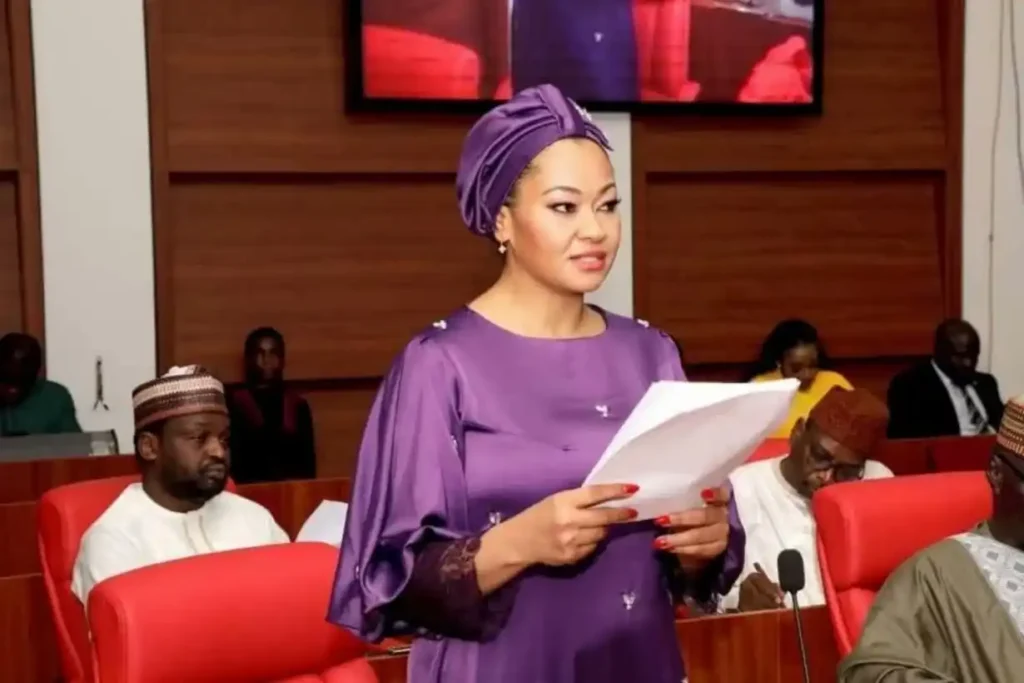
The Nigerian Senate witnessed a heated debate on Thursday during the second reading of the BOFIA Amendment Bill, 2025 (SB 959) as Senator Natasha Akpoti-Uduaghan (Kogi Central) drew attention to what she described as a quiet exploitation affecting young Nigerians earning money through social media platforms. She told lawmakers that thousands of youths who depend on digital content creation for income are being underpaid compared to their foreign counterparts, despite driving massive global traffic and engagement.
 Follow us on Google News
“Our youths are earning 50 cents for content that fetches 10 to 30 dollars per 1,000 views in the U.S.,” Natasha stated. “This inequality must not be ignored as we reform our financial system.” She stressed that social media has become a major source of income for young Nigerians, adding, “I’m speaking for the content creators because, trust me, social media has become a very critical source of income for our youths.”
Natasha argued that the revenue gap undermines Nigeria’s digital economy and poses challenges for financial inclusion. She urged policymakers to consider the realities of the growing online workforce while reviewing the country’s financial laws. The senator called for stronger regulatory engagement with global tech companies, saying Nigeria must demand transparency, fairness, and equitable earning structures for citizens participating in the global content economy. Her submission broadened the debate beyond technical banking reform to include the economic future of millions of Nigerians building livelihoods from digital platforms.
The bill, sponsored by Senator Tokunbo Abiru (Lagos East), seeks to update the Banks and Other Financial Institutions Act by giving the Central Bank of Nigeria power to classify large fintechs as Systemically Important Institutions. This would subject them to increased oversight. Abiru explained that fintechs and mobile-money operators have evolved into essential national infrastructure, rivaling traditional banks in transaction volume while holding vast amounts of customer data, often stored outside Nigeria.
“The law has not kept pace,” he said. “A dominant fintech can now pose as much risk as a bank.” According to him, the proposed legislation would allow the CBN to identify and supervise high-risk fintechs, create a national registry for transparency, expose beneficial ownership, improve consumer protection, safeguard data sovereignty, and close gaps observed during the CBN’s 2024 crackdown on some digital financial firms.
Abiru rejected suggestions for a new fintech regulatory body, insisting such duplication would cause confusion. He argued that global best practice supports strengthening existing institutions rather than setting up fresh agencies.
The bill has been forwarded to the Senate committee in charge, but Natasha’s intervention ensured attention now shifts to the fast-growing digital economy and the millions relying on it for income. Her submission highlighted concerns that financial reforms must reflect modern realities, especially the contributions of young Nigerians engaged in digital enterprise.
Former President of the Nigerian Labour Congress, Senator Adams Oshiomhole, also shared his personal experience with online banking risks, revealing that his accounts were once hacked through a fintech platform. He said the identities of many operators remain unknown, raising accountability concerns. “I know the directors of our regular banks, but I can’t say the same of these fintech banks,” Oshiomhole said. “I don’t know the directors of MoniePoint, Opay and all others.”
He argued that properly regulated digital institutions could better protect Nigerians, adding that an enabling legal framework would ensure online operators serve the public interest more effectively.