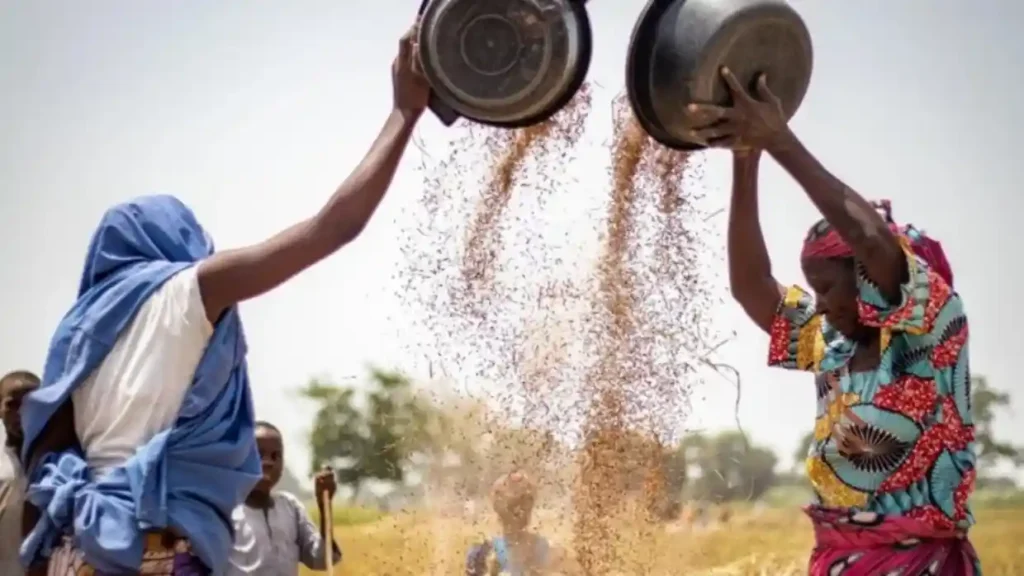
Smallholder farmers across the world are facing growing pressure from rising food demand, climate shocks, and water scarcity, according to a World Bank report that highlights the need for more resilient farming systems. In northern Nigeria, these challenges are being addressed through the World Bank-supported Transforming Irrigation Management in Nigeria (TRIMING) project, which is helping farmers increase yields, raise incomes, and adapt to changing weather conditions.
 Follow us on Google News
In Kano State, farmer Mustapha Adamu recalls how difficult farming was a decade ago. The 6,000-hectare stretch of land he now oversees was once hard to cultivate due to poor access to water, weak soil conditions, and unpredictable rainfall. Each planting season came with uncertainty and losses.
“Things were bad here,” says Mustapha, who leads a Water Users’ Association made up of hundreds of irrigation farmers. “Farming this land was a tough task.”
According to the report, conditions have begun to improve following targeted investments in irrigation and water management. With support from TRIMING, farmers like Mustapha now have better control over water supply, allowing them to plan planting seasons more confidently and farm their land more intensively.
The TRIMING project is led by Nigeria’s Federal Ministry of Water Resources and Sanitation and financed by the World Bank’s International Development Association (IDA). The initiative focuses on modernizing irrigation systems, improving water governance, and upgrading key infrastructure to support long-term agricultural resilience.
Nigeria faces strong economic and demographic pressure. With more than 70 percent of its population under the age of 30, demand for jobs continues to rise. Agriculture contributes nearly one quarter of the country’s gross domestic product and employs over a third of the population, making it central to economic stability. However, climate change has increased risks for farmers through longer dry seasons, frequent flooding, and irregular rainfall patterns.
Despite having available water resources, less than one percent of Nigeria’s farmland is irrigated. As a result, most farmers still rely on rainfall, leaving them highly exposed to climate shocks. The TRIMING project targeted this gap by rehabilitating irrigation systems and training farmers across four major schemes: Kano River, Hadejia Valley, Bakolori, and Dadin Kowa.
In Mustapha’s area of Kano State, irrigated land has expanded to more than 15,000 hectares. The land is now farmed more productively, with improved cropping cycles and better resource use. Canals were cleared, access roads repaired, and communities trained on efficient water use and system maintenance.
A core part of the project was the creation and strengthening of more than 800 Water Users’ Associations (WUAs). These groups help farmers jointly manage water resources, maintain shared infrastructure, and resolve local irrigation challenges.
In Jigawa State, rice farmer Musa Idris says improved irrigation has changed his output levels. “Before the project, we faced many challenges with water,” he says. “We used to get about 15 to 20 bags of rice per acre. Now, we get between 30 and 35 bags. We are preparing the land to plant tomatoes and rice, and after that, we will get ready for wheat.”
Women farmers have also benefited from the changes. Hajiya Ramatu, a farmer and deputy leader of a women’s group, says irrigated farming support was limited before TRIMING began in 2014. “That has changed – women are actively involved now,” she says. “You can see this lane of rice—we are going to make some good money from it.”
Her group expanded its farmland from 22 hectares to 37 hectares. Improved rural roads have also reduced transport challenges, helping farmers move produce to markets faster. Ramatu says the income gains have supported her household, allowing her son to attend university.
Overall, the TRIMING project improved and expanded irrigation across 43,400 hectares. According to the World Bank, the increased production is enough to feed about one million people, mainly farmers and their families. With support from the Global Water Security and Sanitation Partnership (GWSP), the project also strengthened dam safety, improved drainage, reduced sediment buildup, and promoted sustainable water management practices.
Building on these results, a follow-on initiative known as the Sustainable Power and Irrigation for Nigeria project is planned to scale up irrigation development with continued IDA support.
Nigeria’s population is projected to reach 400 million by 2050, increasing pressure on food systems. To respond, the government aims to irrigate 500,000 hectares by 2030 to raise food production, strengthen food security, and improve rural livelihoods.
Globally, smallholder farmers remain on the front lines of rising food demand, climate stress, and water shortages. By 2050, the world population is expected to reach 10 billion, with food demand rising by more than 50 percent. The World Bank says irrigation can increase yields and food supply.