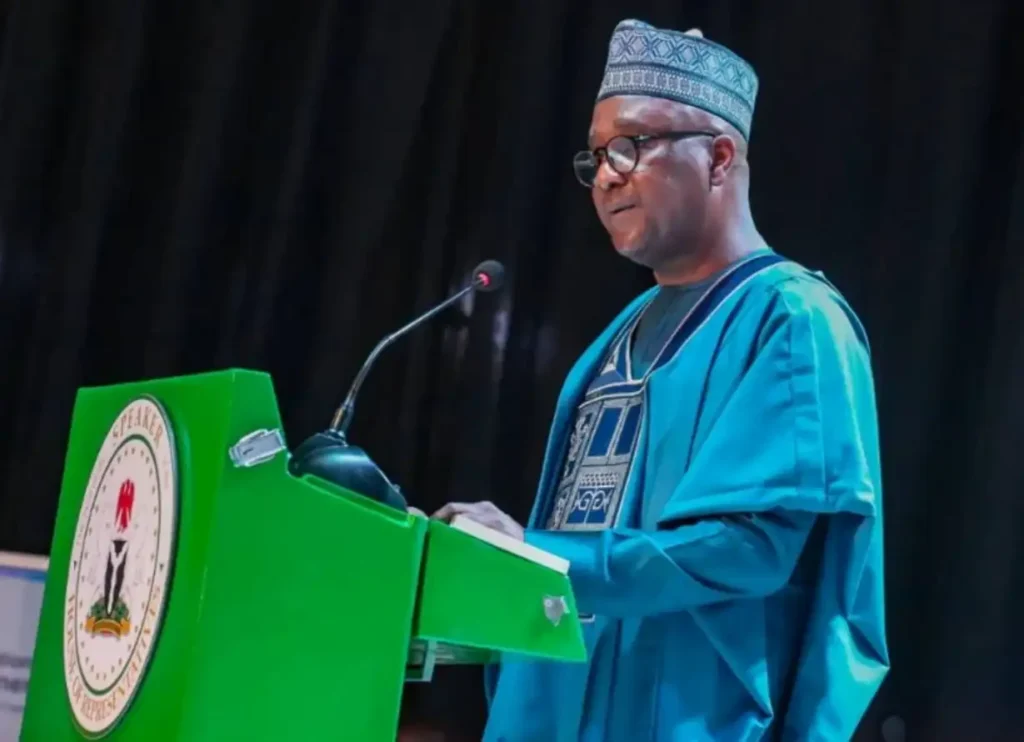
The Speaker of the House of Representatives, Tajudeen Abbas, has urged the Federal Government to prioritise job creation and expand opportunities for Nigerians to achieve their aspirations in 2026, as the country prepares for the next fiscal year.
 Follow us on Google News
Abbas made the call on Friday in his closing remarks at the Joint Session of the National Assembly during the presentation of the 2026 budget proposal by President Bola Tinubu. He described 2025 as a year marked by “challenging global conditions and fiscal headwinds,” and stressed the need for more realistic revenue projections and stronger project execution in future budget cycles.
Reflecting on the outgoing year, the Speaker said Nigeria recorded stability, renewed confidence, and steady progress, despite undergoing a period of economic adjustment. According to him, the economy has now been repositioned for sustained expansion, creating expectations for better outcomes in 2026.
He said, “If 2025 was a year of adjustment and learning, 2026 must be a year of fulfilment. Growth must increasingly translate into jobs, higher incomes, and expanded opportunity.”
Abbas emphasised that fiscal discipline must continue to deliver fairness, efficiency, and visible impact on the lives of citizens. He added that the 2026 budget must be built on credible targets, realistic assumptions, and disciplined implementation to ensure it delivers tangible results.
“This is why there is strong optimism across this chamber that 2026 will be different, not only in intent but in outcomes. The National Assembly receives the 2026 Appropriation Bill with confidence that the lessons of 2025 have been fully internalised, and that this budget is designed to translate reform into tangible progress for Nigerians,” he said.
He reiterated that growth must translate into jobs, higher incomes, and expanded opportunities, while national policy must remain anchored in coherence, predictability, and institutional order. The Speaker called for sober reflection on what went wrong in 2025, urging the government to draw lessons to guide resource management and project execution in 2026.
Abbas noted that some of the challenges faced in 2025 were linked to external factors and overly optimistic assumptions. He said, “2025 also offered important lessons. The year unfolded against the backdrop of challenging global conditions and fiscal headwinds. Some budget assumptions, particularly regarding crude oil prices and exchange rates, proved overly optimistic amid volatility in the international oil market.”
According to him, sharp fluctuations in crude oil prices and external shocks tested projections and exposed the vulnerability of Nigeria’s oil-dependent revenue structure. However, he said these challenges did not weaken the reform agenda.
“Mr President. Rather than weakening the reform agenda, these challenges strengthened it. They reinforced the urgency of realism in budgeting, discipline in execution, and diversification in revenue planning,” Abbas said.
He added that the experience of 2025 sharpened collective understanding that credible budgets must be built on prudent assumptions and resilient frameworks. The Speaker stressed that the gains recorded in 2025 should serve as a foundation for a more deliberate, realistic, and results-oriented 2026 budget.
Citing data from the National Bureau of Statistics, Abbas said Nigeria recorded positive economic growth throughout the year, with real GDP growth approaching 4 percent. He noted that this performance placed Nigeria among the stronger-performing large economies in Sub-Saharan Africa.
The Speaker commended President Tinubu for implementing bold economic policies, noting that visible gains have been recorded in recent months. He also praised the President’s decision to end the practice of running multiple budgets concurrently, describing it as a sign of reform maturity.
“Over recent months, inflationary pressures have significantly eased. Following the rebasing of the Consumer Price Index, headline inflation has trended downwards, while food inflation has decreased due to improved agricultural output, targeted interventions, and more stable supply chains,” he said.
Abbas added that external indicators have also improved, with Central Bank of Nigeria data confirming stronger foreign exchange reserves, resilient remittance inflows, rising export receipts, and greater coherence in the foreign exchange market. He said the World Bank and the International Monetary Fund have recognised these developments as signs of restored macroeconomic credibility and stronger foundations for medium-term growth.
“One of the most reassuring signals of reform maturity in your approach to the 2026 budget is your clear directive that Nigeria must operate with one budget and one fiscal framework,” he said, adding that there should be no parallel budgets or fragmented fiscal authorities.
According to him, the N58.18tn 2026 budget proposal is anchored on sustainable revenue rather than deferred obligations. “It finances progress responsibly. A fair and efficient tax system underpins security funding, sustains social services, and guarantees the timely delivery of constituency projects,” Abbas said.
He pledged the readiness of the National Assembly to consider the Appropriation Bill urgently, stating, “We will support reform that strengthens the national interest, scrutinise spending to ensure accountability, and insist that every naira budgeted by Mr President delivers value to the Nigerian people.”