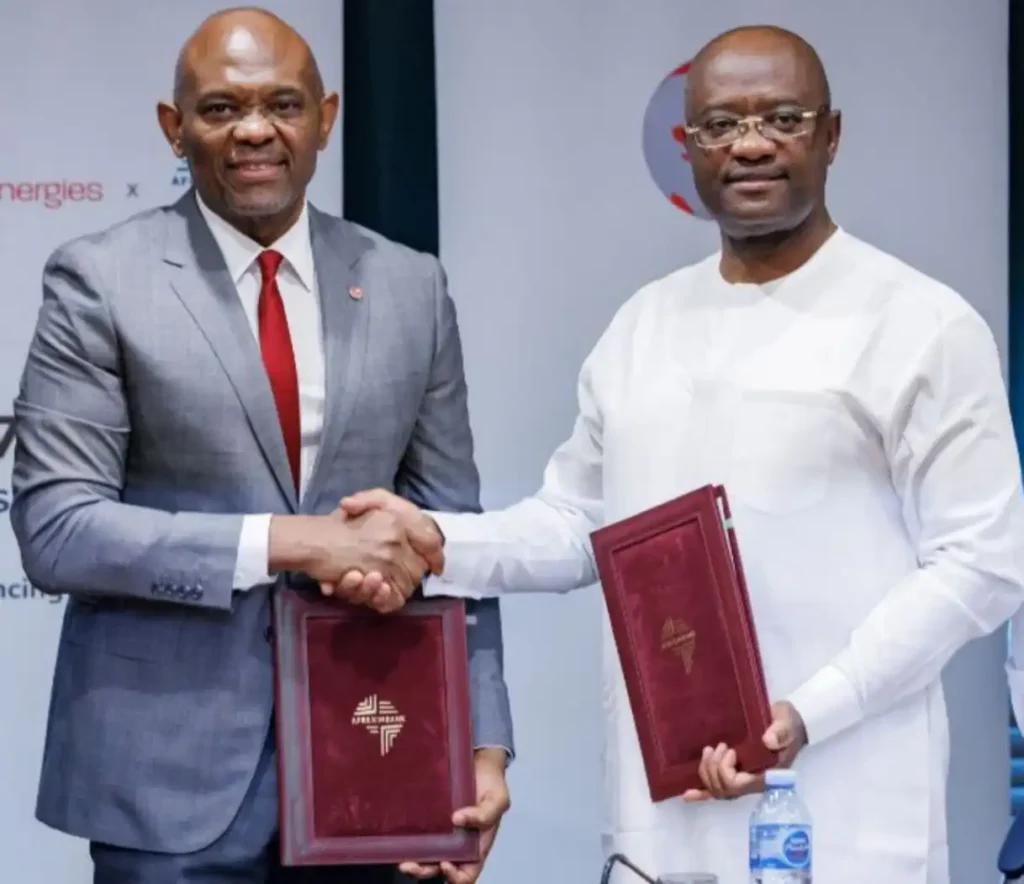
Nigeria’s indigenous energy firm, Heirs Energy, has secured a $750 million financing facility from the African Export-Import Bank to expand its oil and gas operations, with expectations that the deal will significantly raise production levels.
 Follow us on Google News
The facility is projected to increase crude oil output to about 100,000 barrels per day and gas production to roughly 250 million cubic metres. The agreement was signed on Saturday in Abuja and is structured to strengthen Heirs Energy’s upstream operations while supporting Nigeria’s drive for energy sufficiency and industrial growth.
Speaking at the signing ceremony, the Chairman of Heirs Holdings, Tony Elumelu, described the transaction as a strong vote of confidence in African enterprises and financial institutions. He praised Afreximbank for its willingness to back large-scale indigenous projects.
“The most impactful and catalytic finance institution in Africa is Afreximbank. They have grown the capacity and the boldness to support African businesses,” Elumelu said.
He noted that the bank had played a key role in Heirs Energy’s growth journey, adding that the latest financing showed African capital working for African businesses. According to him, Afreximbank’s readiness to restructure existing arrangements and provide room for expansion reflected confidence in the company’s long-term prospects.
“For Afreximbank and others to come together and say, okay, we can restructure this and give you room to scale, it again shows Afreximbank’s belief in us. They started this journey and are now helping us move to the next level,” he said.
Elumelu added that financial support also comes with responsibility, stressing that performance was central to sustaining trust. He disclosed that despite severe challenges linked to oil theft, the company had never defaulted on its financial obligations.
Recounting the acquisition of Oil Mining Lease 17, Elumelu said the transaction faced prolonged delays under the administration of former President Muhammadu Buhari. He explained that the delay was partly due to concerns that the asset was considered too large for private sector ownership.
“Our government at the time refused to approve it because it was considered too big for the private sector, forgetting that Shell itself was a private sector entity,” he said. He added that the delay imposed significant financial costs on the company before the acquisition was eventually concluded.
The President of Afreximbank, Dr George Elombi, said the bank’s support for Heirs Energy aligned with its wider commitment to strengthening Africa’s energy sector, which he described as critical to economic stability across the continent.
“If we did not support the energy sector, about 23 African countries would be in serious trouble,” Elombi said. He disclosed that the bank was preparing additional billion-dollar interventions aimed at stabilising the sector and supporting long-term growth.
Elombi added that Afreximbank’s African ownership strengthened its resolve to remain a dependable partner to businesses during both favourable and challenging periods.
Providing details of the facility, the Executive Director and Chief Financial Officer of Heirs Energy, Samuel Nwanze, said the financing was designed to consolidate recent gains and unlock the next phase of growth for the company.
“Currently, we are producing over 50,000 barrels of oil per day and about 120 million cubic metres of gas. This funding is designed to help us scale to about 100,000 barrels per day and 250 million cubic metres of gas,” Nwanze said.
He disclosed that when the company acquired OML 17 from Shell, Total and Eni, it raised about $1.1 billion, most of which had been repaid after nearly four years of operations.
According to him, the new facility, structured under a five-year reserve-based lending framework, includes refinancing of existing debt as well as fresh capital for expansion.
“One leg is refinancing of existing debt. We are also structuring what we call a reserve-based lending facility. Because we have grown the capacity of the assets, we are getting additional money. The additional money will be used to pursue growth, while part of it will go towards refinancing our existing debt,” he said.
Nwanze said increased gas production from OML 17 had already boosted power generation across Nigeria’s eastern domestic gas network, improving capacity utilisation at plants such as Geometric and Transcorp.
“If we continue growing the business, we believe we can make an even greater impact on energy supply and sufficiency, not just for Nigeria but across the continent,” he said.