
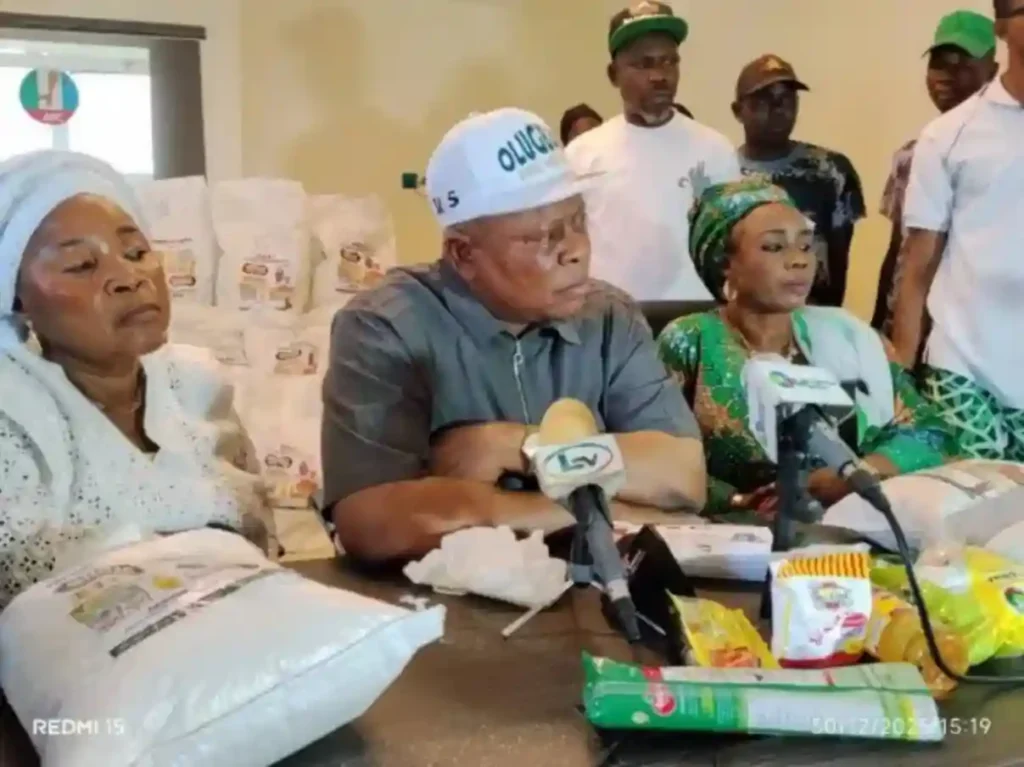
Apapa-Iganmu Local Council Development Area (LCDA) has commenced the distribution of 13,000 food packs and cash support to households across its seven wards under the Ounje Olugbani initiative, marking a major humanitarian intervention aimed at cushioning the impact of economic hardship on residents. The exercise, which kicked off with organised distribution across designated centres, is targeted at ensuring that families at the grassroots have access to basic food items during a period of rising living costs and economic pressure.
 Follow us on Google News
Flagging off the programme, the Chairman of Apapa-Iganmu LCDA, Jimoh Olawale Saliu, said the initiative was deliberately structured to address hunger at the community level while maintaining transparency, equity and orderliness throughout the distribution process. He explained that the council took deliberate steps to avoid overcrowding and disorder that often accompany large-scale palliative exercises.
Saliu disclosed that a total of 14 distribution centres were established across the LCDA, with two centres located in each of the seven wards. According to him, this arrangement was designed to ensure smooth flow of beneficiaries and prevent stampedes. He added that residents selected to benefit from the exercise were pre-issued tickets, which would be exchanged for food items at their designated distribution points.
“We have seven wards and we made it two distribution centres per ward. We are starting from the Anago office. What we are giving out today is about 13,000 food packages, and this is just the beginning,” he said.
The council chairman noted that the ticketing system was adopted to strengthen accountability and enable effective monitoring of the exercise. He said copies of the tickets were deposited with officials in charge of distribution and key community stakeholders to ensure transparency and proper record keeping.
“I have already dropped copies of the tickets with those in charge and with stakeholders. We don’t want stampede or overcrowding. We want the entire process to be orderly and well coordinated,” Saliu added.
Explaining the content of each food pack, the chairman said beneficiaries would receive essential food items including rice, beans, garri, semolina, groundnut oil, seasoning cubes and salt. He added that each pack also contains an envelope with N5,000 cash support, which is intended to further ease the financial burden on households and help them meet immediate needs.
Saliu described Ounje Olugbani as more than a festive palliative, noting that the initiative was inspired by the need to ensure food security for families within the LCDA. He said the programme aligns with the call by President Bola Tinubu for leaders at all levels to prioritise the welfare of the people, especially in challenging economic times.
“Our President has consistently encouraged leaders to look for ways to give back to the people. Let every Nigerian have food on their table. That is why we are following this path. During this season, this intervention will assist families across the LCDA,” he said.
The chairman stressed that unlike previous palliative distributions that focused largely on party leaders and community stakeholders, the current exercise was deliberately designed to reach households directly. According to him, the aim is to ensure that the intervention touches every home within the local council.
“This one is for every house in the local government. I am giving out 13,000 food packs, and it will go round,” he stated.
Saliu assured residents that the programme would not be a one-off intervention. He disclosed that the council has plans to sustain and expand the initiative, with food distribution scheduled to take place during every major festive period, including Ramadan, Easter and Salah. He added that there is a clear strategy to increase the number of beneficiaries as demand grows.
“The next edition will be during Ramadan through Easter, and another during Salah. Every festive period. And there is a clear plan to increase the number of beneficiaries as the demand grows,” he said.
On funding, the council chairman said the initiative was part of his campaign commitment to residents and that funds had been deliberately saved since he assumed office. He explained that food security was treated as a priority alongside other development needs.
“I intended to do this even during my campaign. I have been saving for this since my first day in office. Just as we save for roads and other programmes, we are also saving to make sure we feed our people. An angry man is an angry man,” he said.
Reflecting on the council’s activities since his inauguration, Saliu recalled that the first 100 days in office were largely devoted to infrastructure development. He mentioned projects such as the commissioning of buses and the opening of two roads, noting that the current phase represents a shift towards human welfare.
“We concentrated so much on infrastructure during the first 100 days. This time around, we want to concentrate on the human being—what I call stomach infrastructure—alongside health infrastructure,” he explained.
On monitoring and accountability, Saliu said community structures played a critical role in identifying beneficiaries to ensure that the palliatives reached the intended households. He said the council worked closely with ward chairmen, councillors, community development associations, youth groups and landlords during the planning process.
“We worked with ward chairmen, councillors, community development associations, youth groups and landlords. They know the people in their communities. We even did house counting. I am confident that no household in this community has not been captured,” he said.
He added that while 13,000 households would receive the full food package, supplementary distributions in smaller quantities would be made to reach additional residents. According to him, this approach is meant to extend support beyond the primary beneficiaries.
Saliu also disclosed that the food intervention complements other empowerment programmes currently being implemented in the LCDA. He said more than 1,000 residents who recently completed skills acquisition training would be provided with working equipment in January.
“We trained over 1,000 people during the first 100 days and they have graduated. This January, we are giving them equipment. We are also empowering skilled tailors, shoemakers, makeup artists and hairdressers who already have capacity,” he said.
One of the beneficiaries, Mr Victor Joshua, a native of Cross River State, expressed gratitude to the council chairman for fulfilling his promise to residents.
“The food bag is heavy and I am very grateful. This will go a long way in putting smiles on our faces. The chairman promised to assist residents and he has truly fulfilled his promises. I pray God Almighty to bless and preserve him,” Joshua said.