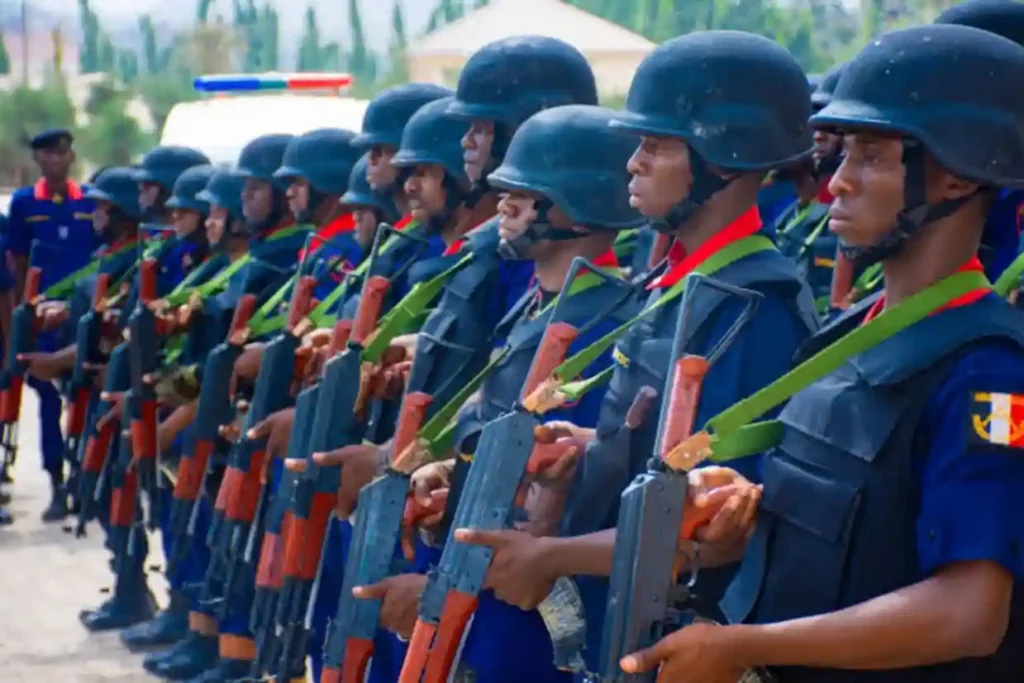
The Nigeria Security and Civil Defence Corps has requested presidential approval to recruit about 30,000 additional personnel, citing rising pressure from its expanding responsibilities, especially in providing protection for Very Important Persons. The request followed a meeting held last month involving President Bola Tinubu, the Minister of Interior, Olubunmi Tunji-Ojo, and the Commandant General of the NSCDC, Ahmed Audi, according to findings by our correspondent.
 Follow us on Google News
Sources said the proposed recruitment is separate from the ongoing nationwide recruitment of 30,000 personnel currently being conducted across paramilitary agencies. The engagement came amid growing demand for VIP escort services across the country after the withdrawal of police officers from such duties, a development that has placed new operational demands on the corps.
Officials within the agency confirmed that increased pressure from VIP protection requests prompted discussions with the President, during which the NSCDC leadership sought approval to boost manpower. An officer familiar with the matter said the President gave assurances that the request would receive favourable consideration.
“The president has given assurances, and plans are underway to recruit about 30,000 new operatives to strengthen the corps,” the officer said. Another officer also confirmed that both the Commandant General and the Minister of Interior met with the President to explain the manpower challenges facing the agency.
“The CG and the minister have met with the president. They explained the need for more personnel, especially with the increasing demand for VIP protection,” the officer said. “The president has given his word that justice will be done to the request, with possible recruitment of about 30,000 personnel.”
A senior security operative within the NSCDC said the withdrawal of police officers from VIP duties led to what he described as a flood of applications for civil defence protection services across states. According to him, this has stretched the corps’ limited manpower.
He said commandants nationwide were deploying available operatives while intensifying in-house training programmes, particularly in weapon handling, to meet rising operational demands. He noted that the situation had exposed manpower gaps that required urgent intervention at the highest level.
The manpower challenge followed President Tinubu’s approval for the recall of 11,566 police officers attached to VIPs. The decision was aimed at redeploying officers to communities affected by kidnapping and violent crimes. The move came as part of broader efforts to strengthen frontline policing nationwide.
The Inspector-General of Police, Kayode Egbetokun, explained that the decision was intended to refocus police operations on crime-prone areas. He also warned against the risk of impersonation during the transition period following the withdrawal of officers from VIP protection.
On November 9, 2025, a report by the European Union raised concerns about police deployment patterns in Nigeria. The report stated that over 100,000 police officers were assigned to VIP protection, a situation it said contributed to inadequate security coverage for ordinary citizens.
According to the European Union Agency for Asylum, the Nigeria Police Force has an estimated strength of about 371,800 officers serving a population of roughly 236.7 million people. The report noted that deploying a large number of officers to VIP duties worsened existing manpower shortages.
Part of the report explained the structure of the police force, noting that it operates under both federal and state jurisdictions and is commanded by an Inspector-General of Police. It listed various formations, including force headquarters, zonal headquarters, state commands, divisions, stations, posts, and village police posts.
The report added that sources dating back to 2007 consistently placed police strength at around 371,800 officers. It said the shortage in personnel was compounded by the assignment of more than 100,000 officers to protect politicians and other VIPs instead of serving the general population.
It further noted that manpower shortages, corruption, and limited resources have contributed to slow emergency responses and left many communities without adequate police presence.
On November 23, 2025, President Tinubu ordered the immediate withdrawal of police officers attached to influential individuals nationwide. The directive followed a security meeting at the State House and came days after a series of attacks that led to the kidnapping of at least 300 people, mostly schoolchildren, across Kebbi, Kwara, and Niger States.
“Henceforth, police authorities will deploy them to concentrate on their core police duties,” a statement signed by the President’s Special Adviser on Information and Strategy, Bayo Onanuga, said.
Onanuga added that VIPs seeking police protection would now request well-armed personnel from the Nigeria Security and Civil Defence Corps. In the same month, the Inspector-General of Police confirmed the recall of officers from VIP duties.
“In line with the President’s directive, we have withdrawn a total of 11,566 personnel from VIP protection. These officers are being redeployed to critical policing duties immediately,” Egbetokun said.
Read also: Nigerian Army recruitment for DSSC 29/2026