
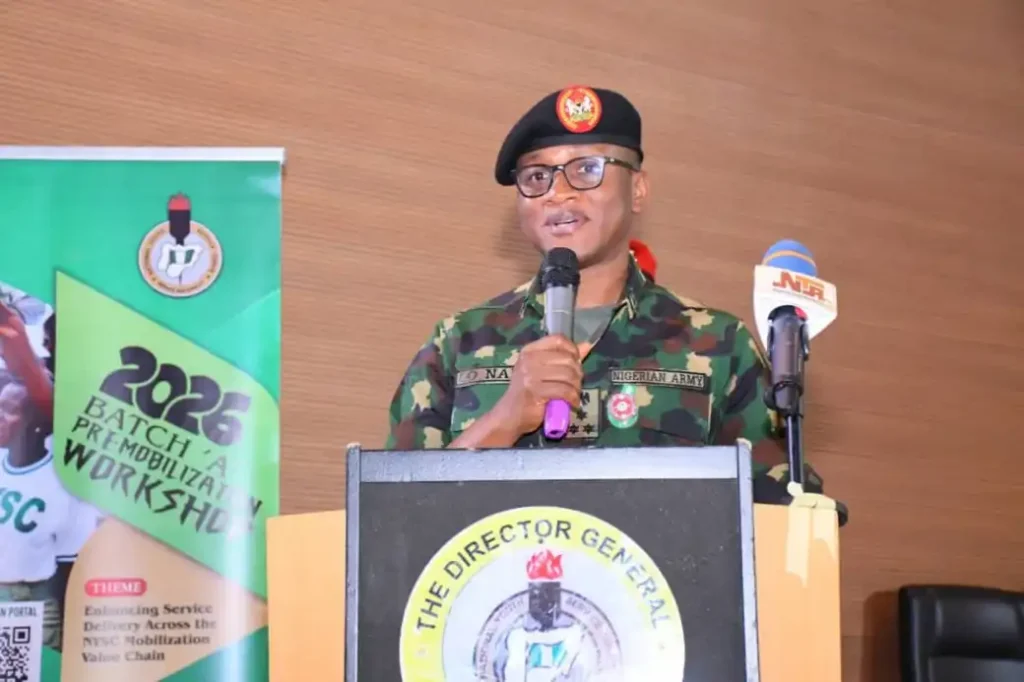
The National Youth Service Corps (NYSC) has called on Corps Producing Institutions across the country to improve their internal data validation systems in order to maintain the credibility of the mobilisation process.
 Follow us on Google News
The Director General of NYSC, Brigadier General Olakunle Nafiu, made the call during the 2026 Batch ‘A’ Pre-Mobilisation Workshop held in Abuja. The event, themed “Enhancing Service Delivery Across the NYSC Mobilisation Value Chain,” brought together key stakeholders to discuss the integrity and efficiency of the mobilisation process.
Brigadier General Nafiu emphasized the importance of institutional oversight in the mobilisation process ahead of NYSC 2026 Batch A, Stream 1. He urged heads of Corps Producing Institutions to pay closer attention to activities related to mobilisation and called for Desk Officers to undergo regular training to stay updated on evolving standards and technologies.
He reaffirmed NYSC’s commitment to its Standard Operating Procedures and the continuous strengthening of collaboration across its Departments, Area Offices, and State Secretariats. He also highlighted the need for improved performance monitoring, evaluation, discipline, professionalism, and ethical behaviour within the Scheme.
Nafiu encouraged stronger inter-agency collaboration, regular stakeholder meetings, and greater use of data-driven decision-making with clearly defined timelines and responsibilities. He assured that NYSC Management would continue to uphold its duties with patriotism and integrity while working with stakeholders to achieve excellence.
“As we look ahead, the NYSC mobilisation process must be repositioned to be efficient, transparent, accountable, and people-focused,” the DG stated. “This involves delivering timely and accurate results, free from undue influence, with clear accountability for actions and inactions, while remaining responsive to the needs of Prospective Corps Members and other stakeholders. Improving service delivery throughout the mobilisation value chain is, therefore, not optional; it is both imperative and urgent.”
The DG described the mobilisation process as a complex system that involves production, validation, mobilisation, deployment, and management of Prospective Corps Members (PCMs). He acknowledged that although the Scheme had made progress in digital mobilisation, there were still challenges, such as poor data quality, inadequate technical skills, resistance to full automation, and weak feedback systems.
He noted that violations of established guidelines, uploading unqualified graduates, inconsistent academic records, data discrepancies, record manipulation, and poor internal verification were issues that continued to affect the integrity of the mobilisation process.
Brigadier General Nafiu warned institutions against fraudulent mobilisation of graduates for national service, stressing that sanctions would be applied to those found guilty of such misconduct.
Earlier, the Director of Corps Mobilisation Department, Mrs. Rachel Idaewor, in her welcome address, urged Student Affairs Officers (SAOs) to carry out their duties with diligence and integrity. She reminded them to ensure that the information they provide accurately reflects the true profiles of their Prospective Corps Members.
Idaewor commended the partnerships between NYSC and critical stakeholders such as the Federal Ministry of Education, Joint Admissions and Matriculation Board (JAMB), National Board for Technical Education, National Universities Commission (NUC), and SIDMACH Technologies. “We should all come together as a cohesive team, drawing inspiration from our past successes while embracing the challenges that lie ahead,” she said.
Participants at the workshop included Student Affairs Officers from various Corps Producing Institutions, representatives from the National Universities Commission, and other stakeholders in the education and mobilisation sectors.