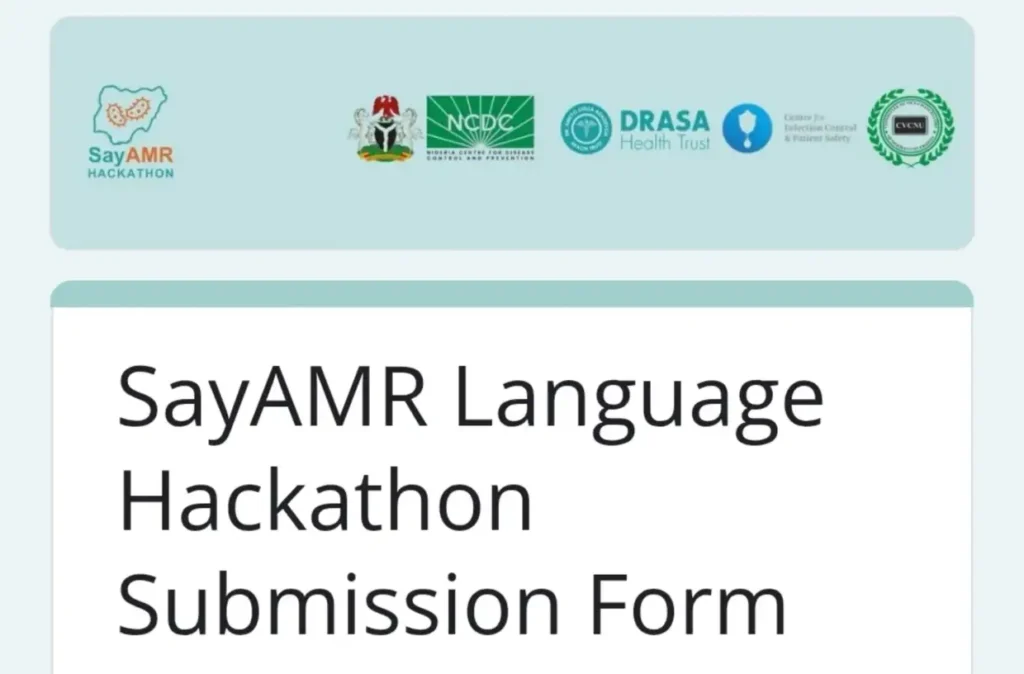
The SayAMR Language Hackathon has been announced as a national innovation challenge aimed at simplifying Antimicrobial Resistance (AMR) concepts by translating them into widely spoken Nigerian languages. The hackathon is organised by DRASA Health Trust in collaboration with the Nigeria Centre for Disease Control and Prevention (NCDC), the Centre for Infection Control and Patient Safety (CICaPS), and the Committee of Vice Chancellors of Nigerian Universities (CVCNU).
 Follow us on Google News
According to the organisers, the initiative is designed to bring together students, linguists, researchers, and public health advocates to address gaps in public understanding of AMR. They explained that by translating technical health information into familiar languages, communities can better understand the risks of drug resistance and adopt safer health practices. The organisers said the project is focused on making AMR information accessible at the grassroots level, where language barriers often limit effective health communication.
Antimicrobial Resistance occurs when microorganisms such as bacteria, viruses, fungi, and parasites evolve and no longer respond to medicines designed to kill them. Health experts note that this resistance makes infections harder to treat and increases the risk of severe illness and death. The organisers stated that AMR is a growing public health threat that affects individuals, families, and health systems.
They warned that without urgent action, AMR could lead to as many as 10 million deaths annually by 2050. They added that prolonged illness, higher medical costs, and reduced productivity linked to resistant infections could push millions of people into poverty. Despite the seriousness of the issue, they said awareness remains low, with many people unaware of how misuse and overuse of medicines contribute to AMR.
The SayAMR Language Hackathon seeks to improve public understanding of AMR by developing accurate and culturally relevant terminologies in Hausa, Igbo, Yoruba, and Nigerian Pidgin. The organisers said breaking language barriers will support grassroots AMR awareness, improve health communication, and strengthen Nigeria’s national AMR response. They described the hackathon as a practical step toward community-focused public health education.
Eligibility for participation is open to teams of four to eight multidisciplinary students from accredited Nigerian universities, including federal, state, and private institutions. Each team must include at least one faculty member from a linguistics department or a closely related department where linguistics is not available. The organisers stated that at least 25 percent of each team must be students from language-focused disciplines such as linguistics, English, Nigerian languages, writing, or translation.
All student participants must be between 18 and 35 years old, and teams are required to obtain formal endorsement from their Vice Chancellor or a delegated authority. Submissions must be made in at least one of the approved languages, which are Hausa, Igbo, Yoruba, or Nigerian Pidgin.
Submission requirements include valid identification for all team members and faculty, proof of enrolment in a linguistic or related course, proof of faculty status, and a letter of endorsement from the Vice Chancellor or delegated authority. Teams must also submit a 300 to 400 word written statement demonstrating their understanding of AMR and summarising the research or desk review conducted.
Further requirements include video, audio, or pictorial evidence and a 250 to 400 word report documenting consultative sessions with experts. A database of consulted individuals, including names, designations, organisations, phone numbers, and email addresses, must be provided. Teams are also required to submit evidence and a 200 to 300 word report on community pilot testing, as well as a short video explaining the developed terminology using sentences in the chosen language.
The organisers stated that submissions must follow three development stages, which are research, consultation, and community pilot stages. While acknowledging the existence of multiple dialects, they noted that teams should focus on the most widely spoken dialect to ensure uniformity and usability.
Winning entries, according to the organisers, will be showcased and adopted through national AMR awareness campaigns, school programmes, and community engagement initiatives. They said these entries will contribute directly to Nigeria’s public health communication strategy.
Interested teams can apply through the official SayAMR submission portal on the DRASA Health Trust website at https://drasatrust.org/sayamr-hackathon/, with submissions accepted Here.
News update:
Deadline Extended. The SayAMR Language Hackathon deadline is now 27 February 2026.