
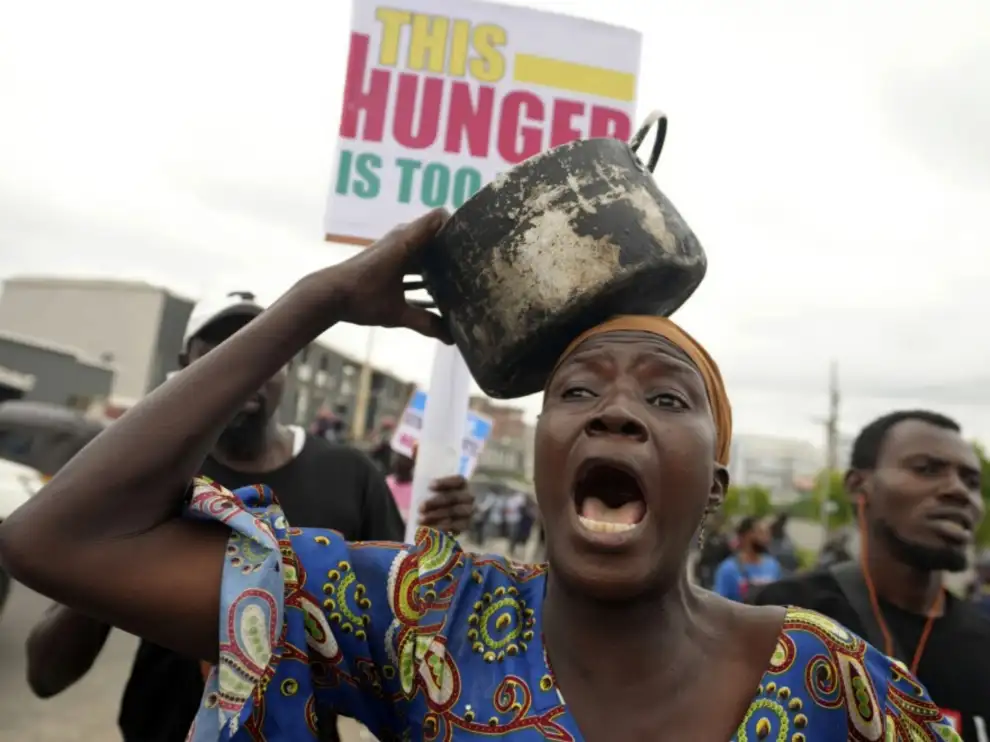
The United Nations World Food Programme (WFP) has warned that nearly 35 million people in Nigeria are going hungry and being forced to make heartbreaking choices just to survive, as growing instability and surging attacks across northern Nigeria drive hunger to levels never seen before, according to the latest Cadre Harmonisé regional food security analysis. It projects that the number of people facing severe food insecurity during the 2026 lean season is the highest ever recorded in the country, with children most at risk in Borno, Sokoto, Yobe and Zamfara states, where malnutrition rates remain critically high.
 Follow us on Google News
The warning was emphasised during an interview with CNBC Africa, where WFP Country Director and Representative in Nigeria, David Stevenson, said the food crisis has expanded beyond the northeast, where conflict-related hunger first prompted the agency’s intervention.
“The World Food Programme came to Nigeria in 2015, really at the request of the government, but also with the support of our member states because of the conflict, particularly in the northeast,” Stevenson said. “That conflict-related hunger has now spread towards the northwest and is even creeping into the middle belt due to increased attacks.”
Stevenson said there was a brief period of optimism when he arrived in Nigeria about three years ago, as attacks declined and communities began returning to farming. He noted that the situation has since reversed, with renewed violence undermining livelihoods and food production.
“I arrived in the country about three years ago when there was a dip in the attacks, when it looked like we could really step into a humanitarian solutions approach, moving people back onto their farms and having peace in production,” he said. “Sadly, the attacks have increased since, and we’re now at record rates of food insecurity.”
He explained that the Cadre Harmonisé shows rising food insecurity across multiple regions, with children bearing the brunt of the crisis. According to him, six million people are food insecure in the northeast, another six million in the northwest, while malnutrition among children remains alarmingly high.
“Nationwide, according to the Cadre Harmonisé, we’re looking at about 35 million Nigerians who are food insecure, up from 33 million a year ago,” Stevenson said. “Most alarming, six million children in the north are malnourished and in need of food assistance.”
The WFP representative also raised concerns about the agency’s ability to sustain emergency food and nutrition support, citing funding pressure caused by multiple humanitarian crises globally and reduced aid budgets.
“We have all heard about the competing demands across Africa and globally, with humanitarian crises in Ukraine, Sudan and Gaza, and the decisions of traditional donor countries to reduce humanitarian and global development assistance,” he said.
Stevenson disclosed that WFP faced a major funding emergency in August, when it was close to running out of food for displaced people living in camps who cannot return to their farms due to insecurity.
“We set out a real alarm in August because we were going to run completely out of food assistance,” he said. “This was for people in displaced camps who simply cannot go back to their farms because it’s not safe.”
He said the situation was stabilised after the United States provided $32 million in emergency funding, alongside other donor support, but warned that another shortfall is approaching.
“Fortunately, our appeal was met predominantly by the United States, which stepped up with $32 million,” Stevenson said. “But we’re about to send out another alarm because in January and February, we’re running out of funds again.”
He added that more than $100 million is needed to sustain operations through June, while WFP continues working with the Nigerian government and partners on longer-term solutions, including collaboration around initiatives such as World Bank AgriConnect, aimed at restoring food systems and self-reliance across affected communities nationwide under fragile security conditions. The agency said insecurity, displacement and funding gaps continue to threaten progress despite ongoing coordination with authorities and humanitarian partners nationwide across northern Nigeria.
Read Also: Apply: Mastercard Agrisiti TAGDev 2.0 Hybrid Digital Training Program