
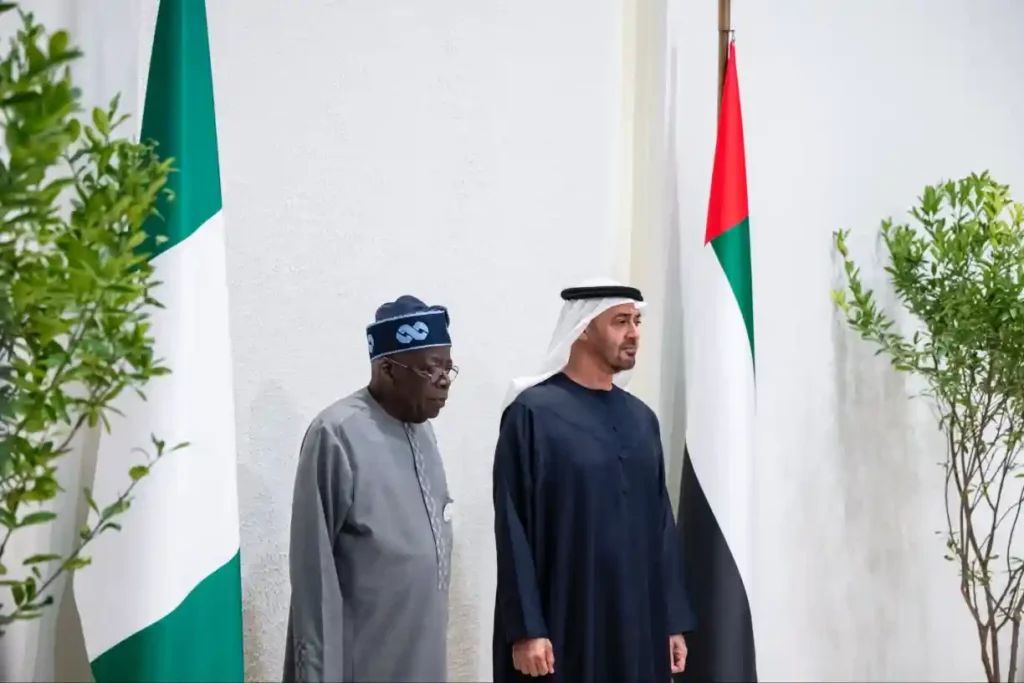
President Bola Tinubu has announced that Nigeria is positioning its newly activated carbon market to generate between $2.5 billion and $3 billion annually over the next decade. The move is part of efforts to mobilise climate finance and support the country’s energy transition plan.
 Follow us on Google News
Tinubu made this known on Tuesday while addressing world leaders and investors at the 2026 Abu Dhabi Sustainability Week, themed “The Nexus of Next: All Systems Go.” He said Nigeria had taken regulatory steps to strengthen climate governance and attract investments into low-carbon projects that align with its national development priorities.
“Nigeria feels at the heart of development opportunity,” the President said. “In this spirit, Nigeria has launched a climate and green industrialisation investment to unlock $20bn to $30bn annually in climate finance.”
He explained that the government’s push in the carbon market is anchored on the National Carbon Market Activation Policy and the launch of the National Carbon Registry, which are aimed at improving emissions reporting, verification and transparency. Tinubu said these measures would make Nigeria’s carbon credits credible and appealing to global buyers.
The President stated that Nigeria approved the National Carbon Market Framework in October 2025, which defines the rules for carbon credit registration, issuance and verification. He added that the Climate Change Fund was operationalised in November, alongside the restoration of the National Council on Climate Change to the federal budget to strengthen institutional capacity and oversight.
Tinubu said the carbon market would support emissions-reduction projects in key sectors such as forestry, renewable energy, clean cooking and agriculture. He added that these efforts would create new income streams for local communities and businesses while contributing to global decarbonisation goals.
Speaking on energy reform, Tinubu highlighted the 2023 Electricity Act, which allows decentralised electricity generation and distribution. According to him, this reform has opened the way for inclusive energy access, especially for rural communities, off-grid health facilities, schools, markets and other underserved areas across Nigeria.
“Nigeria recognises the urgent need to deploy and advance technologies to improve green efficiency, modernise infrastructure, and accelerate the delivery of sustainable energy to underserved areas,” he said.
The President also mentioned several financing initiatives connected to Nigeria’s climate and energy transition agenda. These include a climate investment platform targeting $500 million for climate-resilient infrastructure, a national climate platform aimed at mobilising $2 billion in capital investment, and a $50 billion sub-regional green bond that was oversubscribed by 97.7 per cent.
Tinubu acknowledged the role of international partners in supporting Nigeria’s green efforts. He noted that the World Bank is currently implementing a $750 million programme to expand clean electricity access to over 17.5 million Nigerians.
He further stated that Nigeria’s energy transition plan integrates “climate mitigation, industrial growth, and social development into a single coherent framework,” targeting net-zero emissions by 2060 while ensuring universal energy access.
Tinubu called on developed countries to deepen partnerships with Nigeria through technology transfer, knowledge exchange and innovation. He added that “the adoption of artificial intelligence to optimise efficiency is no longer a matter of the future.”
Nigeria submitted its updated climate commitments to the United Nations in September 2025, reaffirming its plan to use market-based mechanisms, including carbon trading, to meet emissions targets while promoting sustainable economic growth.