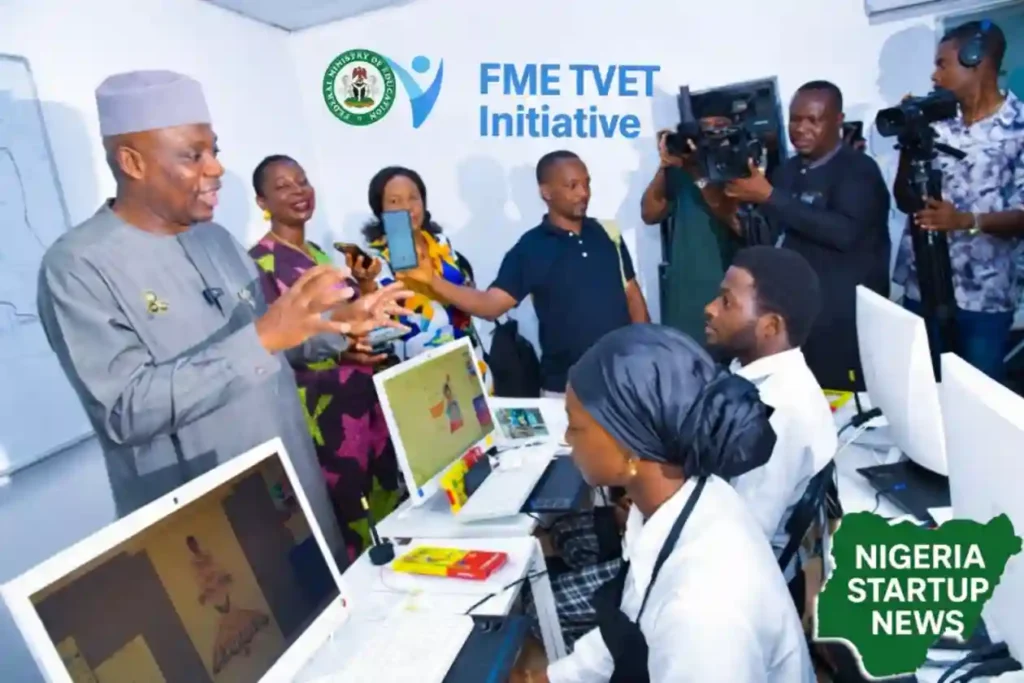
The federal government has disclosed that trainees under the Technical and Vocational Education and Training (TVET) initiative will receive entrepreneurial grants and access to soft loans from the Bank of Industry (BOI) to enable them to start businesses after completing their training.
 Follow us on Google News
The Minister of Education, Tunji Alausa, made this known during an interview on Channels Television, where he explained that the administration is repositioning technical and vocational education to play a central role in job creation, skills development, and economic growth.
“Yes, we’re making technical and vocational education very prestigious now,” the minister said. “Please give me about five minutes to talk about this technical and vocational education, because this is a big part of our agenda.”
He said the renewed focus on TVET was necessary to reduce Nigeria’s dependence on foreign skilled labour and to rebuild a strong local workforce across key sectors of the economy. According to him, many skilled jobs in Nigeria are currently being done by artisans from neighboring countries, a situation the government is determined to reverse.
“Today you go, your tiling, you go to most construction sites, the tilers that you get there from the Republic of Benin, Togo, that should not be the case,” he said. “We have to build this big part of our agenda system. We’re bringing it back, and we’re bringing it back with full force.”
Alausa also compared earnings of skilled workers in developed countries to highlight the economic value of vocational skills. “You go to any UK, US today, a plumber earns more than a doctor. An electrician in England earns more than a doctor,” he said. “So what are you talking here? So we want to now bring this pool of workers back.”
He explained that the government has developed a four-step approach to transform technical and vocational education nationwide. The first step, according to him, is direct financial support for students enrolled in TVET institutions.
“We would pay a student to go to those schools,” he said. “We’ve modeled how much we’re going to pay them when we roll the program out. We’ll be announcing that. We’ll pay them to go to school.”
The second step focuses on funding the institutions themselves. Alausa said schools offering technical and vocational training would receive proper tuition payments to enable them to improve facilities and expand capacity. “The school that they’re actually going to, we will pay them decent tuition fees because we need to really unlock a new value chain in our technical education system,” he said. “They’ll make money from tuition coming to them so that they can expand their workshop and expand their infrastructures.”
The third step, which he described as critical, is the MasterCraft training model that prioritizes hands-on learning. According to him, the government has redesigned the instructional method used in technical colleges.
“We’ve really, 360-degree, changed the education, the instruction,” he said. “What we will be doing with our technical education will just be 20% didactic and 80% hands-on training.”
He added that the MasterCraft model involves artisans and professionals from large, medium, and small industries directly training students. “Say you want to train our students on tiling. We quality assure you that you have the capacity to train them,” he explained. “We’ll ask you, how many students can you train? Ten students. We’ll give you ten students and we’ll pay for each of those students every month.”
To ensure quality, Alausa said the government will recruit 774 performance monitoring officers, one for each local government area. “We will go back to come and check to be sure those students are being taught properly,” he said. “They will go around to ensure those students are getting the right practical training.”
He further disclosed that three categories of instructional centres have been designed under the TVET framework. These include skill training centres, vocational enterprise institutes, and technical colleges at both state and federal levels.
For skill training centres, Alausa said the program will run for six months and target school dropouts and individuals who did not complete basic education. “That will be open to people that drop out from school, people that didn’t finish primary school, people that didn’t complete their JSS,” he said.
He noted that the government conducted labour gap analysis to determine which skills are most needed. “We’ve been very careful and deliberate in the kind of skills we will be training at these schools,” he said.
According to him, emerging sectors such as CNG conversion, renewable energy, mechanized farming, plumbing, electrical works, woodwork, and livestock production are among the priority areas. “We’re going to be training CNG conversion technicians,” he said. “Solar installers and renewable energy technicians to manage, install, and repair.”
Alausa said the number of skills in the national compendium has been reduced from 98 to 26 to focus on relevance. “We’ve cut it down to about 26 that we know are relevant to the needs of our country today,” he said.
He explained that training will be tailored to state-specific needs to avoid unemployment. “If today a labour gap analysis shows that in FCT we need more tilers or plumbers, we will zero in on those training so that we’re not producing people and not have job,” he said.
On the final step, Alausa said graduates will receive entrepreneurial grants to start businesses. “As they’re finishing their training, we will also give them an entrepreneurial grant to start up,” he said.
He added that beneficiaries can also access additional funding through BOI. “Beyond the entrepreneurial grant, if they need more money, we’ve met with the Bank of Industry CEO that they can arrange a top-up credit, single-digit credit,” he said.
Read Also: FG to Link TVET Trainees With Employers Via New Job Portal