
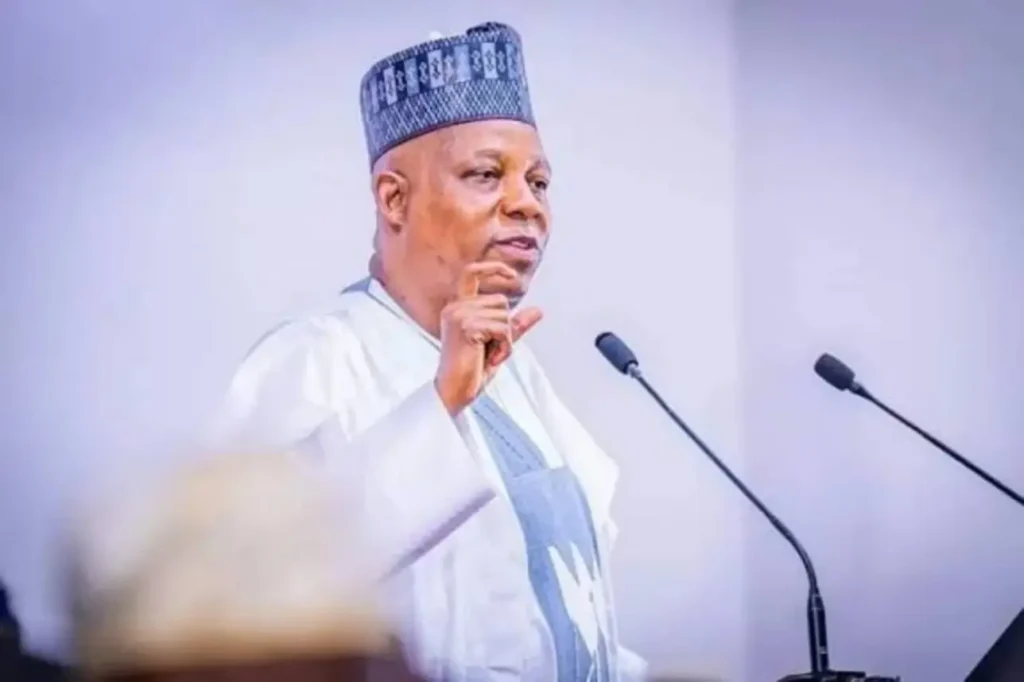
Vice President Kashim Shettima has said Nigeria no longer treats food security as a narrow agricultural matter but as a major macroeconomic, security, and governance priority, as the Federal Government rolls out a broader strategy to protect the country from global shocks.
 Follow us on Google News
He said the government has begun a multi-dimensional agricultural drive aimed at restoring productivity across Nigeria’s food basket regions while strengthening national stability and economic resilience.
The Vice President spoke at a high-level panel titled “When Food Becomes Security” at the Congress Centre during the 56th World Economic Forum meeting in Davos, Switzerland, where he explained that food security now sits at the heart of Nigeria’s policy planning.
“In Nigeria, we don’t look at food security purely as an agricultural issue. It is a macroeconomic, security and governance issue. Our focus is to use food security as a pillar for national security, regional cohesion and stability,” Shettima said.
According to him, Nigeria’s food security framework is built on three key pillars, which include increased food production, environmental sustainability, and deeper regional integration within the West African sub-region.
He explained that shifting global trends and repeated supply chain disruptions have forced Nigeria to look inward and rebuild its agricultural base by developing resilient food systems suited to its different ecological zones.
“Nigeria is a very large country, and there is an incestuous relationship between economy and ecology. In the Sahelian North, we are dealing with desertification, deforestation and drought. In the riverine South and parts of the North Central, flooding is our major challenge,” he said.
To tackle these environmental pressures, the Vice President said the Federal Government is promoting drought-resistant, flood-tolerant, and early-maturing varieties of staple crops such as rice, sorghum, and millet. He added that food systems in flood-prone southern areas are being redesigned to withstand climate-related shocks.
Shettima noted that security challenges remain a major obstacle to food production, particularly because many of Nigeria’s conflict-affected areas also serve as key food-producing zones.
“Most of the food baskets of our nation are security-challenged. That is why we are creating food security corridors and strengthening community-based security engagements so farmers can return safely to their land,” he said.
He disclosed that the Federal Government has launched the Back to the Farm Initiative, a programme designed to resettle displaced farmers. According to him, the initiative provides agricultural inputs, insurance, and access to capital to enable farmers restart food production and regain livelihoods.
Addressing Nigeria’s macroeconomic vulnerabilities, the Vice President identified heavy import dependence and foreign exchange volatility as major contributors to food inflation across the country.
“We largely import wheat, sugar and dairy products, and this has a direct impact on inflation. Our strategy is to accelerate local production and promote substitutes such as sorghum, millet and cassava flour to correct these structural imbalances,” Shettima said.
He explained that the current approach aligns food security with inflation control, national stability, and regional cooperation, positioning agriculture as a frontline response to both economic and security risks.
The Vice President further said Nigeria, often described as the African giant, has “woken up from its slumber” under President Bola Tinubu, adding that the government is working to make “it possible for smallholders and fishers to become investable at scale” within the next 12 months.
Shettima also highlighted the growing importance of intra-African trade, noting that recent global developments have made regional trade almost unavoidable for African economies.
“In Africa, especially in light of global trends, intra-African trade has almost become a necessity, and there have been some alignments,” he said.
He urged African leaders to intensify collaboration under the African Continental Free Trade Area framework to ensure African countries strengthen internal systems and markets.
The Vice President expressed optimism that with the ongoing Renewed Hope Agenda reforms, Nigeria will see climate adaptation efforts move from pilot stages to reality, alongside a significant rise in intra-African trade beyond the current 10.7 percent level.
Read also: Rivers flags off first batch of School to Land agribusiness training scheme