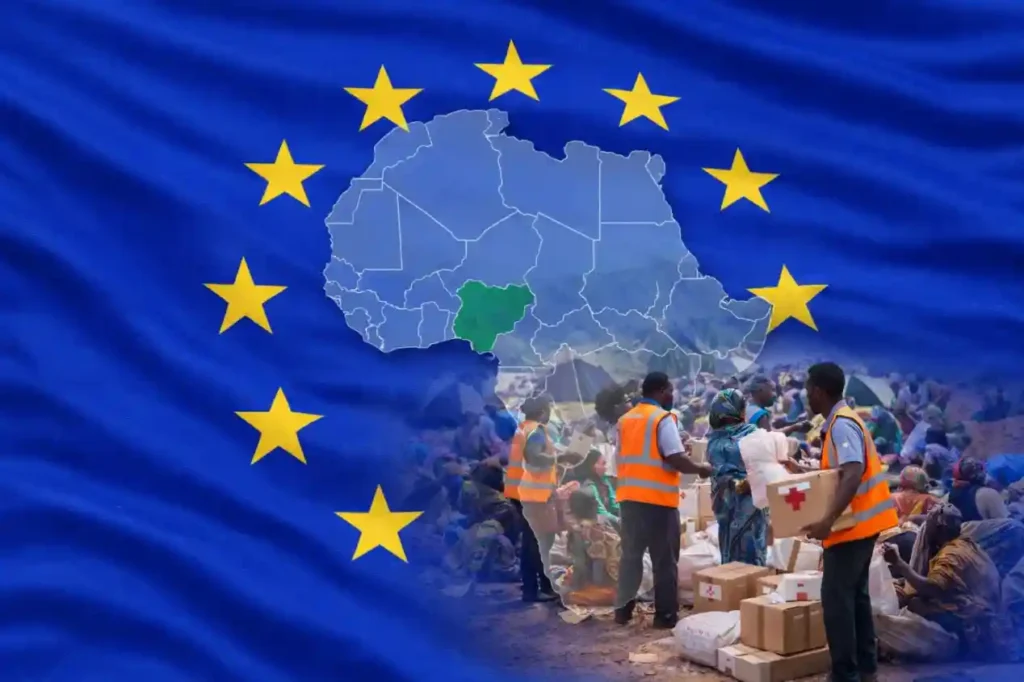
The European Union on Wednesday announced a grant of €557 million in humanitarian aid to African countries for 2026, placing Nigeria’s North-West region among key areas of focus. The amount, which excludes a separate €14.6 million allocated to North Africa, is part of an initial €1.9 billion humanitarian aid budget unveiled by the European Commission for the year.
 Follow us on Google News
The funding announcement comes amid worsening global humanitarian conditions, with an estimated 239 million people worldwide currently in need of assistance. This situation is unfolding at a time when several major international donors are reducing their funding, creating wider gaps between humanitarian needs and available resources. The European Union said its early commitment for 2026 is intended to respond to this growing pressure and sustain support for the most vulnerable populations.
European Commissioner for Equality, Preparedness and Crisis Management, Hadja Lahbib, is bringing the EU’s commitment to Davos, where she is engaging global leaders on ways to mobilise additional resources. The EU said her presence at the global economic forum reflects efforts to attract private sector finance and innovative solutions that can complement public funding and expand the reach of humanitarian assistance.
Humanitarian Needs and EU Commitment
The European Union stated that its humanitarian aid continues to prioritise life-saving assistance in crisis zones, particularly in regions affected by conflict, displacement, climate-related shocks, and economic hardship. The EU emphasised that its approach is guided by humanitarian principles, even as international humanitarian law faces increasing strain.
EU humanitarian assistance focuses on:
- Emergency food assistance and temporary shelter for displaced communities
- Access to critical healthcare services in crisis-affected areas
- Protection and support for the most vulnerable populations
- Education support for children whose schooling has been disrupted by emergencies
The EU noted that while other donors scale back, it remains committed to ensuring aid reaches people in need, wherever they are located.
Breakdown of the €1.9 Billion Allocation
The European Union outlined how the initial €1.9 billion humanitarian aid budget for 2026 will be distributed across regions facing severe and complex humanitarian challenges.
The allocation includes:
- €557 million to West and Central Africa, covering the Sahel, the Lake Chad basin, North-West Nigeria, Central Africa, Southern Africa, the Great Lakes region, and the Greater Horn of Africa
- €448 million to the Middle East, particularly Gaza following last year’s fragile ceasefire, as well as Iraq, Yemen, Syria, and Lebanon
- €145 million to address humanitarian needs in Ukraine, as Russia’s invasion enters its fourth year, with an additional €8 million for humanitarian projects in Moldova
- €126 million allocated to humanitarian needs in Afghanistan, Pakistan, and Iran
- €95 million to Central and South America and the Caribbean, regions affected by armed conflict, violence, political instability, inequality, and environmental challenges
- €73 million to support Southeast Asia and the Pacific, especially in response to the Myanmar crisis and its impact in Bangladesh
- €14.6 million allocated to North Africa, a region facing ongoing political, economic, and social challenges
In addition, more than €415 million has been reserved for responding to sudden-onset emergencies worldwide and for maintaining a strategic humanitarian supply chain.
Mobilising Private Sector Support in Davos
The European Union acknowledged that public funding alone is no longer sufficient to meet record humanitarian needs. Closing the gap between growing demands and limited resources, it said, requires new approaches and broader partnerships.
Commissioner Lahbib is in Davos this week to engage business leaders and investors on how the private sector can contribute innovation, scale, and new financing models to humanitarian responses. The EU believes private sector involvement can help deliver faster, more efficient, and more sustainable humanitarian assistance.
Together with the World Economic Forum, Lahbib will co-host an event titled ‘New Alliances in Aid and Development’ on 22 January. The event will focus on strengthening cooperation between governments, businesses, and development actors. Her full Davos agenda, including bilateral meetings, has been made available through official channels.
Background
The European Union and its Member States remain the world’s leading humanitarian aid donors. The European Commission has provided humanitarian assistance since 1992, supporting operations in more than 110 countries worldwide. Aid is delivered through humanitarian non-governmental organisations, international organisations including United Nations agencies, and specialised agencies within EU Member States.
The European Emergency Response Coordination Centre operates on a 24-hour basis and supports countries affected by major disasters upon request from national authorities or United Nations bodies. The centre ensures rapid deployment of emergency support and serves as a coordination hub linking EU Member States, participating countries, affected states, and humanitarian experts.
Commenting on the funding commitment, Hadja Lahbib said, “The humanitarian system is under unprecedented strain, and public funding alone will not meet the scale of the crisis. Europe is taking action, committing an initial €1.9 billion for 2026. As the largest humanitarian donor, we are taking our political responsibility and leading the global response. That’s why I’m in Davos: to mobilise the private sector to think bigger, move faster, and act together. This is a test of solidarity, and Europe is rising to the challenge.”
Read also: World Bank Group Opens Applications for 2026 WBG Pioneers Internship