Documents have emerged showing that critical eligibility conditions for the Cross River State Youth Empowerment Scheme loan were not disclosed to applicants before ₦13,000 was collected from them, raising questions about transparency, accountability, and whether affected youths will be refunded.
 Follow us on Google News
The loan scheme, promoted under the banner of the Cross River State Youth Empowerment Scheme (CRS-YES), was presented as an accessible financing opportunity for young entrepreneurs in the state. Applicants were directed to process their requests through Zenith Bank and the Bank of Industry (BOI), with an upfront payment of ₦13,000 described as a fee for SEARCH processing and a customised ATM card. For many applicants, the payment was made with the understanding that meeting the listed requirements would make them eligible for the loan.
Questions were first raised publicly about the rationale for collecting the ₦13,000 from applicants who had no certainty of receiving the loan. The concern was not merely about the amount, but about whether full eligibility conditions had been disclosed before the money was taken. Those questions triggered a flurry of responses within private messaging platforms and, later, an official letter that has now put key details in writing.
In a message circulated shortly after the concerns were published, the chairman of the scheme, Kalita Joseph Aruku, appealed to members of a WhatsApp group to publicly defend him. “Please those of you that were there yesterday go and help me clarify that the money was paid to the bank and it was duely explained what it was about,” he wrote, adding that it had been announced applicants who scaled the screening would be reimbursed. In another message, he told the critic, Agba Jalingo, “You are not God… you can never be. Shalom!”
Supporters of the scheme also circulated claims that loans were already available for those who had paid the ₦13,000, while others alleged—without evidence—that the bank had threatened legal action against critics. These claims were later contradicted by subsequent developments, including admissions by scheme officials that the loan conditions were more restrictive than initially presented.
What applicants say they were told at the point of registration was straightforward. According to information circulated by CRS-YES mobilisers, prospective beneficiaries needed CAC registration documents, a BVN, NIN slip, a utility bill, one passport photograph, a TIN, at least six months of bank statements from any active account, and the ₦13,000 registration fee for SEARCH and an ATM card. On that basis, many young people paid the fee believing they had met the requirements.
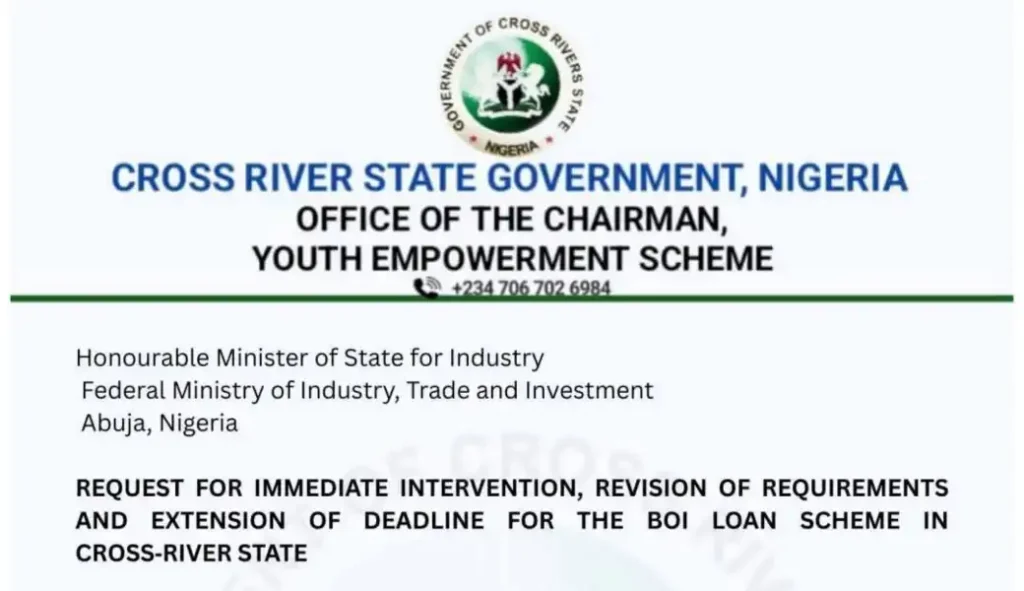
However, the letter now written by the chairman to the Minister of State for Industry paints a different picture. In that correspondence, he acknowledged conditions that were not part of the initial public communication but which substantially narrow eligibility. Among them are restrictions excluding newly registered businesses, requirements for applicants to deposit a percentage of the proposed loan before disbursement, the provision of collateral, and proof of repayment capacity based strictly on existing turnover and transaction history.
The letter further confirms that to access the maximum ₦5 million loan, an applicant must demonstrate an annual turnover of ₦30 million. For those below that threshold, the loan amount is calculated using a turnover-divided-by-six formula. These conditions mean that many of the youths who paid the ₦13,000—particularly start-ups and small enterprises—are unlikely to qualify.
The implications of these conditions are already being felt. Messages within applicant groups show frustration and confusion, with some lamenting that the rules appeared to be “changing every day.” In one message attributed to the chairman, he suggested that some of the conditions were not communicated to him when banks approached his office to mobilise applicants. “They didn’t give me this condition(s) when they approached my office to mobilize people to come benefit the loan,” he wrote, blaming the banks for shifting goalposts.
That claim has itself raised further questions. Loan negotiations between public schemes and development finance institutions typically involve detailed discussions of eligibility criteria, risk assessment, and disbursement terms. Critics argue that if such conditions were indeed unknown to the scheme’s leadership, it points to a troubling lack of due diligence. If they were known but not disclosed, it raises even more serious transparency concerns.
In an apparent effort at damage control, the chairman’s letter appeals for a review or cancellation of some of the conditions and seeks an extension of deadlines. While the appeal suggests recognition that the rules as they stand exclude many intended beneficiaries, it also implicitly confirms that the conditions exist and are currently operative.
Central to the controversy is the fate of the ₦13,000 already collected. Applicants paid the fee before learning of the stricter eligibility requirements. There has been no clear, publicly documented mechanism explaining whether those who fail to meet the undisclosed conditions will be refunded, when such refunds would occur, or who bears responsibility for returning the funds. Initial assurances that successful applicants would be reimbursed do not address the situation of those who are screened out.
The banks named in the process have not publicly clarified their role in collecting or holding the ₦13,000, nor have they issued statements detailing refund procedures. This silence has fuelled speculation and anxiety among applicants, many of whom are unemployed or operating micro-enterprises with limited capital.
The Cross River State Government has also been drawn into the controversy. Supporters of the scheme have argued that the initiative aligns with the administration’s youth empowerment agenda under Governor Bassey Otu. Critics counter that empowerment programmes must be built on clear rules and full disclosure, especially when they require upfront payments from vulnerable groups.
From a policy perspective, the episode highlights a recurring challenge in public-sector credit interventions: balancing access with risk management. Development finance institutions such as BOI are mandated to protect public funds, which explains stringent requirements. But when those requirements are not transparently communicated at the outset, the credibility of the entire programme suffers.
For applicants now caught in the middle, the debate is less about institutional mandates and more about fairness. Many say they would not have paid the ₦13,000 had they known that newly registered businesses were excluded or that collateral and significant turnover were prerequisites. Their demand is simple: clarity and, where appropriate, refunds.
As it stands, the official letter has shifted the discussion from allegation to documentation. It confirms that key conditions capable of disqualifying most applicants were not part of the initial public messaging. It also confirms that the scheme’s leadership is now seeking retrospective adjustments to rules that are already affecting applicants.
The unanswered questions remain stark. What happens to the ₦13,000 paid by applicants who cannot meet the undisclosed conditions? Who is responsible for refunding them—the banks, the scheme, or another party? And what safeguards will be put in place to ensure that future public empowerment programmes disclose all material conditions before collecting money from citizens?
Until those questions are answered with the same clarity now evident in the letter, the controversy surrounding the Cross River State Youth Empowerment Scheme loan is unlikely to fade.
Read also: GEEP Initiative Provides Interest-Free Loans for Nigerian MSMEs