The Nigerian Army Officers’ Wives Association (NAOWA) has equipped 202 youths drawn from military barracks with market-relevant skills in ICT and fashion design, as part of efforts to promote economic self-reliance among young people.
 Follow us on Google News
The gesture was carried out under the NAOWA Youth Empowerment Project, which focuses on boosting confidence, dignity and sustainable livelihoods for youths connected to the military community.
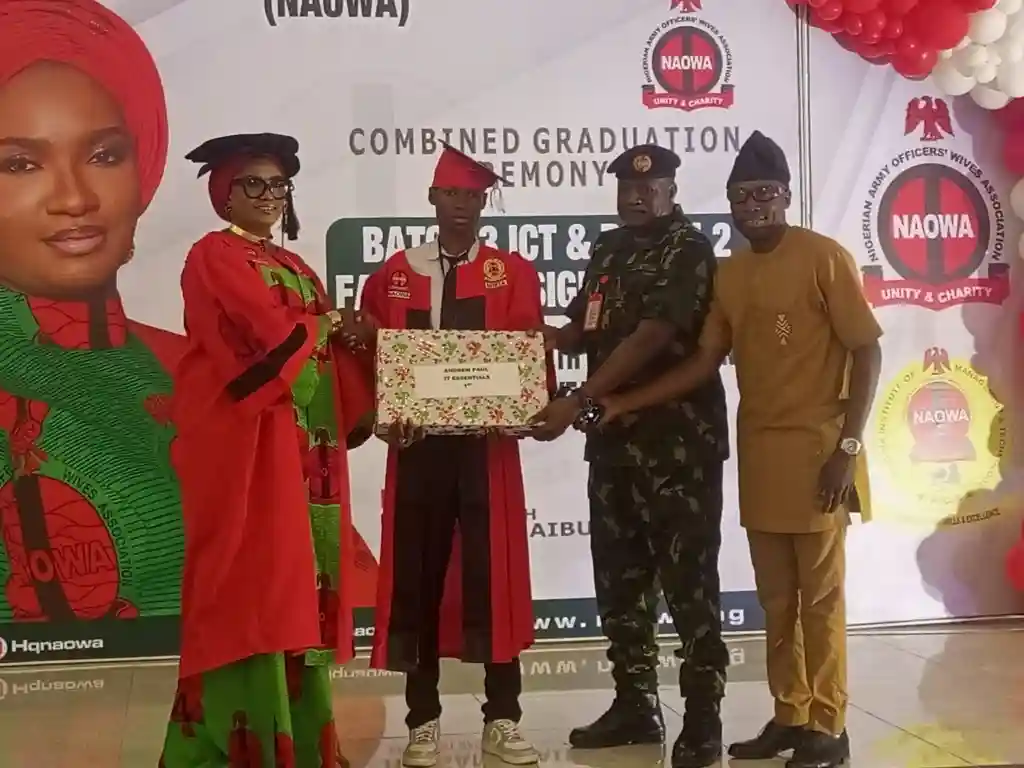
The President of NAOWA, Mrs Safiyyah Shaibu, disclosed this in Abuja at the combined graduation ceremony of Batch 3 ICT and Batch 2 Fashion Design trainees of the NAOWA Youth Empowerment Project.
She described the programme as a strategic investment in the future, explaining that practical and market-relevant skills had a direct impact on families, communities and national development.
“This project goes beyond skills acquisition. It is about giving our youths the tools to chart their own course and become productive members of society,” Shaibu said.
“A total of 202 youths graduated from the programme, which focused on ICT and fashion design, at the Mrs Alero Azazi Event Centre,” she added.
Shaibu commended the Chief of Army Staff (COAS), Lt.-Gen. Waidi Shaibu, for his consistent support for NAOWA initiatives, noting that such encouragement had strengthened the association’s ability to deliver sustainable empowerment programmes.
She said that NAOWA would continue to provide mentorship and post-training support to beneficiaries to enable them translate the skills acquired into sustainable livelihoods.
The COAS, represented by the Chief of Administration (Army), Maj.-Gen. Isa Abdullahi, praised NAOWA for complementing the Nigerian Army’s non-kinetic efforts aimed at youth development and social stability.
He said that skills acquisition remained a key pathway to reducing unemployment, promoting peace and building resilient communities.
According to him, by empowering the youth, the Nigerian Army is contributing to a resilient society, which is critical to sustaining a resilient fighting force.
He explained that the programme formed part of the Army’s broader efforts to build resilient families and empower communities, in line with its transformation agenda to become a professional, adaptable and combat-ready force.
The Rector of the NAOWA Institute of Management and Technology (NIMTA), Abuja, Col. Comfort Adamu, said that the graduation marked the fulfilment of dreams and the unlocking of hidden potentials among the trainees.
Adamu stated that the graduands underwent weeks of intensive training that transformed curiosity into competence and positioned them for opportunities in a technology-driven economy.
She said that the institute equipped participants with practical, income-generating skills in fashion design, tailoring and computer studies to enable them thrive in today’s digital space.
According to her, the training, which commenced on Sept. 22, 2025, produced 202 graduates, comprising 32 trainees in fashion design and tailoring and 170 in ICT.
She added that all beneficiaries were children of serving and retired non-commissioned officers, noting that outstanding trainees would receive awards and undergo a four-week internship to further strengthen their skills and employability.
One of the beneficiaries, Faitha Garba, described the training as impactful and empowering, saying it helped her develop self-awareness, confidence and practical life skills.
“The programme opened my eyes to new opportunities for self-reliance. I can now apply what I have learned to support myself and my family,” she said.
Another student, Gabriel Agboola, said the six-week ICT programme equipped him with valuable digital skills in areas such as cybersecurity, web design, Internet of Things and programming.
Agboola said the facilitators ensured clear understanding before introducing new topics, making the learning process effective and engaging.
He expressed confidence in his ability to apply the knowledge gained, protect himself and others online, and transfer the skills to peers within the barracks and surrounding communities, thereby expanding the impact of the training programme.