Greenplinth Africa, working with its development partners, has announced that its flagship 80 Million Clean Cookstoves Project could earn Nigeria about $5 billion every year from verified carbon credit revenues when fully deployed.
 Follow us on Google News
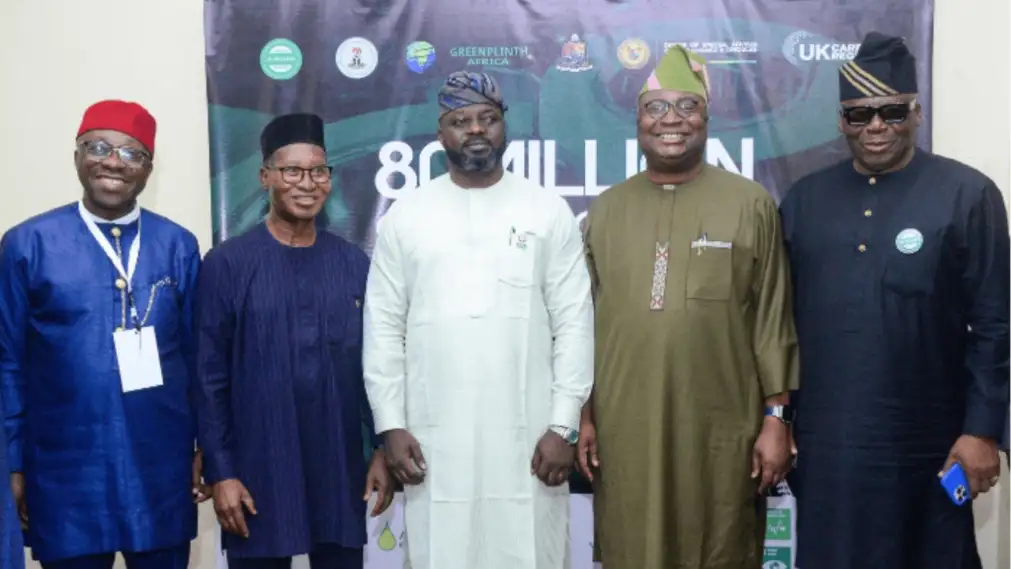
The disclosure was made by Greenplinth Africa’s Vice President, Dr. Victor Fodeke, during a stakeholders engagement held in Lagos on Thursday, January 29. He described carbon as a new global currency and said it now functions as both an asset and a commodity with a current value of about $104 per metric tonne.
According to Fodeke, “for every tonne of carbon you are able to refuse from getting into the space that is causing greenhouse gases, you get $104. This is why we are confident that this initiative of Greenpeace can meaningfully contribute to transforming Nigeria’s economic fortunes. For this single project, we bring every year $5 billion to the coffers of the Federal Government of Nigeria.”
He further revealed that the organisation is currently driving two major sustainability initiatives in the country, namely the 80 Million Clean Cookstoves Project and the 4 Billion Innovative Economic Trees Programme. Both projects, he said, are designed to change how Nigerian households cook and to address the growing challenge of deforestation.
Fodeke stated that the clean cookstoves project represents a major shift in climate and development efforts. “We are here to advance what is, without question, the largest single clean cookstoves project in the world – the 80 Million Clean Cookstoves Project in Nigeria,” he said.
He explained that the initiative goes beyond clean cooking, describing it as an economic, environmental and social transformation programme that places Nigeria at the centre of global climate action, sustainable development and regulated carbon markets.
“At the heart of this initiative is a bold commitment to transform how over 80 million Nigerians, primarily women and children, cook everyday,” Fodeke said.
He highlighted the long-standing impact of firewood dependence, noting that decades of reliance on traditional cooking methods have contributed to massive forest loss, health challenges and poverty. “For decades, Nigeria’s reliance on traditional firewood has resulted in the loss of over 95 per cent of our forest stock, accelerating deforestation and desertification; health crises, and entrenched poverty,” he said.
Fodeke added that many households spend between 30 and 40 per cent of their weekly income on firewood just to cook meals, stressing that the project is designed to permanently change this situation.
Outlining the benefits of the programme, he said it was structured to deliver value across several sectors. According to him, investors will benefit from the carbon market framework, while firewood sellers will be transitioned into briquette distribution enterprises.
He said financial institutions will also be involved by registering beneficiaries to enable seamless monthly disbursements, while the health sector will benefit through improved funding for the National Health Insurance Scheme and better hospital capacity.
Other beneficiaries, he noted, include insurance providers who will offer stove insurance coverage, as well as technology, fintech and telecom companies that will support large scale data integration, cloud services, connectivity and application programming interfaces.
Fodeke said end users stand to gain significantly from reduced household energy costs, improved health outcomes and access to a digital fuel card, which he described as the first of its kind globally, used to confirm briquette delivery.
He explained that each participating household will receive a complete clean cooking solution at no cost. “Each participating household will receive at no cost – a comprehensive clean-cooking solution package,” he said.
This package, he added, includes a thermally optimised clean cookstove, two 15-litre cooking pots, digital metering and GPS tracking to capture cooking activities, real time monitoring of carbon emissions avoided, and continuous online monitoring.
He said the stove only requires substantial heating once and can retain heat for four to five hours, while a single briquette can support cooking for up to five hours.
Fodeke disclosed that households will also receive a monthly N10,000 support under what he called the Paid-to-Cook initiative, free monthly delivery of 40kg of biomass briquettes, and comprehensive health insurance covering up to eight household members.
“This is not charity. It is climate justice delivered with dignity,” he said.
He confirmed that distribution of the clean cookstoves, which began in Makoko, Lagos, last June, will scale up fully this year across Lagos, Niger, Enugu, Nasarawa, Benue, Kebbi, Borno and Delta states.
Speaking on the technical qualities of the stoves, Greenplinth Africa Chief Finance Officer, Babatunde Aina, said the stoves are made of stainless steel and come with two 50-litre pots.
According to Aina, “each one can cook rice in 12 minutes, and each stove saves about 15.4 metric tonnes of CO₂ in a year.”
He added that once fully operational, the project could save up to 1.2 billion tonnes of CO₂ annually. “The whole idea is that we want to reduce deforestation. Firewood is a N300 billion business. We’re not out to stop firewood business, but we’re out to stop the deforestation of Nigeria,” Aina said.
Former Deputy Governor of the Central Bank of Nigeria, Tunde Lemo, also spoke at the event, describing the initiative as a nationally endorsed and scalable intervention.
“It is registered on the UN Framework Convention on Climate Change Global Climate Action Portal aligning Nigeria with international best practices in climate action transparency and accountability,” Lemo said.
He called on governments, development partners, financiers, civil society groups, the media and citizens to support the project, adding that it represents more than cleaner kitchens. “It is about healthier families, empowered women, resilient communities, green jobs, and a sustainable future for our nation,” he said.
Greenplinth Africa also announced that the Green Conference themed “Decarbonising Africa: From Policy Commitment to Scalable Implementation” and the 2026 Projects Implementation Retreat will hold from March 3 to 5, 2026, in Lagos.