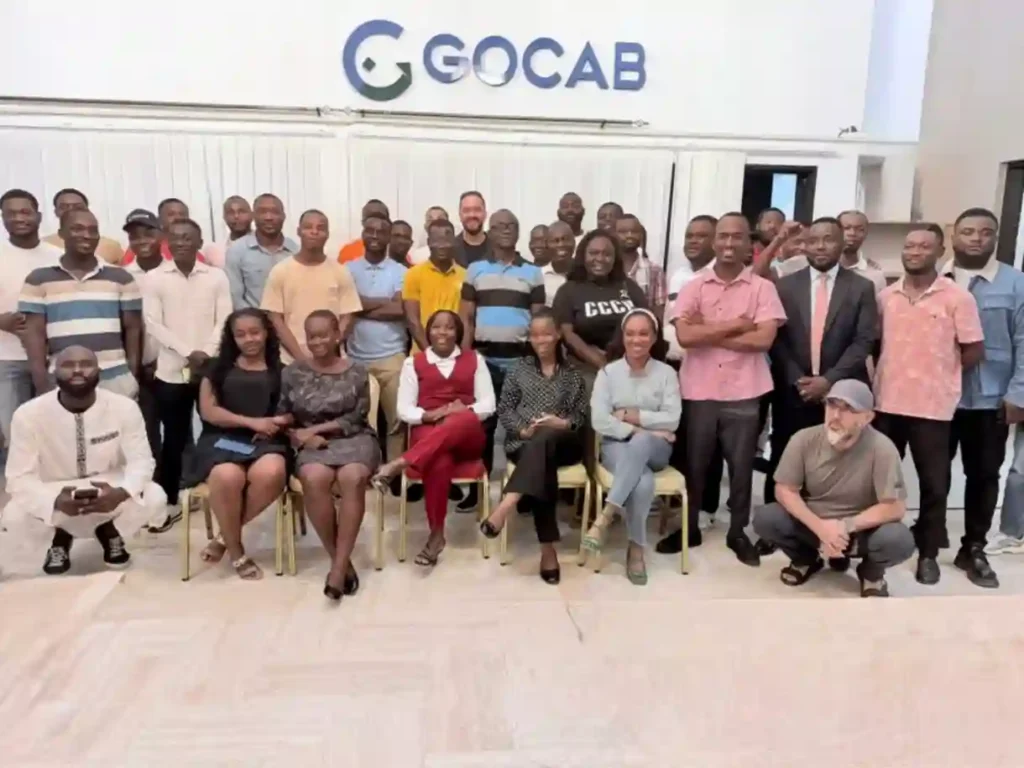
GoCab, a mobility focused fintech that supports ride hailing and delivery drivers through a drive to own vehicle financing model, has raised 45 million dollars in new funding as it reports growing revenue and expanding operations across several markets. The company said it is now generating 17 million dollars in annual recurring revenue, describing the figure as proof that its business model is gaining traction among drivers and investors.
 Follow us on Google News
The seed round includes 15 million dollars in equity and 30 million dollars in debt, placing GoCab’s post money valuation at 51 million dollars. The round was led by E3 Capital and Janngo Capital, with participation from KawiSafi and Cur8 Capital. GoCab said the funding will support fleet growth, technology development, and operational expansion.
GoCab allows drivers to acquire brand new vehicles that they can fully own within three years through daily payments. The model is similar to that used by Moove, which the founders said influenced their approach. Drivers use GoCab’s app to make payments and track their progress toward ownership.
The company currently operates two pricing models. Under the short term rental option, drivers rent a vehicle for seven days but are only charged for five days. Under the drive to own option, drivers pay a higher daily amount that contributes directly to eventual ownership rather than simple rental use.
GoCab began operations in Abidjan, Côte d’Ivoire, where it said it has financed more than 1,000 vehicles. It also operates in Senegal and Chile and recently launched in Morocco. The company said it is considering Nigeria and Ghana but is still developing a working expansion playbook.
Co founder Azamat Sultan said GoCab has more than 5,000 drivers on its waitlist. He said the company’s near term objective is onboarding as many drivers as possible while expanding further across Africa. Sultan said demand remains strong across active markets.
GoCab said it has focused on profitability from the outset, shaping how it runs operations. One example is sourcing vehicles directly from manufacturers instead of dealers to avoid markups and improve pricing for drivers.
The company maintains an in house team of more than 60 mechanics handling repairs and maintenance. Sultan said keeping maintenance in house reduces “margin leakages” and helps control repair timelines that could disrupt drivers’ work.
Beyond leasing, GoCab said it earns revenue from maintenance services and spare parts. It sources parts directly from OEMs in China because the vehicles it provides are not widely used locally.
GoCab said many activities are conducted through licensed partners because it does not yet hold a regulatory licence. It plans to obtain the appropriate licence to operate more independently and offer more credit products.
On its roadmap, GoCab said it plans to introduce buy now pay later services for drivers for items like phones or fuel. It is also testing health insurance for drivers through a partner.
The company said it initially allowed drivers to get cars without deposits but later changed the policy. Sultan linked the change to costs incurred after driver infractions.
In a statement, Janngo Capital Founder and Executive Chair Fatoumata Bâ said the financing gives GoCab the scale to deploy “thousands of productive vehicles” and pointed to a roadmap toward 10,000 active assets and 100 million dollars in recurring revenue.
Separately, GoCab said it is in talks to raise an additional 60 million dollars in Sharia compliant debt. It said 30 million dollars has been raised so far from investors including Cur8 and Cumberland, with discussions continuing.
GoCab’s founders, Sultan and Hendrick Ketchemen, previously planned to launch a private credit fund focused on Africa but pivoted after concluding the market was not large enough. Both have backgrounds in investment management.
As it expands, GoCab said it localises operations and messaging. In Senegal, it switched onboarding to Wolof after finding French onboarding ineffective, saying nearly 70 percent of drivers did not fully understand the value proposition before the change.
GoCab said transparency helps reduce abuse risks linked to drive to own schemes. Sultan said reducing “information asymmetry” strengthens relationships over the three to four year term, adding that operating in a Sharia compliant manner provides an extra guardrail. The company said these measures are important for building long term trust, supporting driver income stability, and ensuring the sustainability of its vehicle financing model across different operating environments going forward