
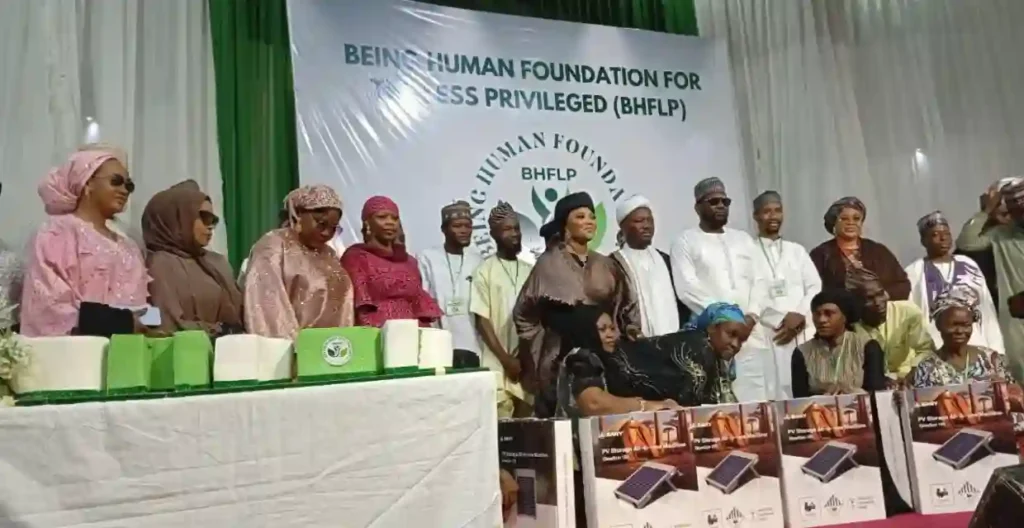
Being Human Foundation for the Less Privileged has distributed solar power systems to selected beneficiaries across the Federal Capital Territory (FCT), Abuja, as part of efforts to promote sustainable empowerment and reduce dependence on unreliable electricity supply.
 Follow us on Google News
Speaking at the distribution event, the founder, Hajia Khadizat Ibrahim, said the move was informed by Nigeria’s persistent power challenges. She stressed that government alone cannot meet all the needs of citizens, especially in the area of stable electricity.
According to her, solar energy provides a sustainable and cost-effective alternative to generators, which are expensive to fuel and maintain, particularly for low-income households. She explained that the foundation decided to focus on solutions that would have long-term impact rather than short-term relief.
“Solar energy offers a sustainable and cost-effective alternative to generators,” she said, noting that meaningful empowerment should prioritise quality and lasting value instead of just increasing the number of beneficiaries.
Hajia Ibrahim disclosed that although the foundation initially planned to reach more people, only 200 solar power units were distributed because of the high cost of the systems. She added that the goal was to ensure beneficiaries received practical tools capable of improving their livelihoods and daily living conditions.
She reaffirmed the foundation’s commitment to supporting the less privileged and complementing government efforts in nation-building.
The Director-General of the Energy Commission of Nigeria, Mr. Mustapha Abdullahi, commended the initiative, describing it as timely and impactful. He said deploying solar solutions aligns with national efforts to tackle one of Nigeria’s most pressing challenges, which is access to reliable electricity.
Mr. Abdullahi noted that electricity remains central to economic growth and human development. He added that solar energy provides a cleaner, greener and more affordable alternative to conventional power sources.
He also recalled President Bola Ahmed Tinubu’s pledge that every Nigerian should have access to 24-hour electricity by 2030, stressing that government cannot achieve this goal alone and calling for stronger collaboration with non-governmental organisations and other stakeholders to advance the President’s renewable energy agenda.