The Green Skills and Upcycling Training is equipping women with practical skills to transform waste materials into sources of income and improved livelihoods in Chika, a suburb of Abuja in the Federal Capital Territory.
 Follow us on Google News
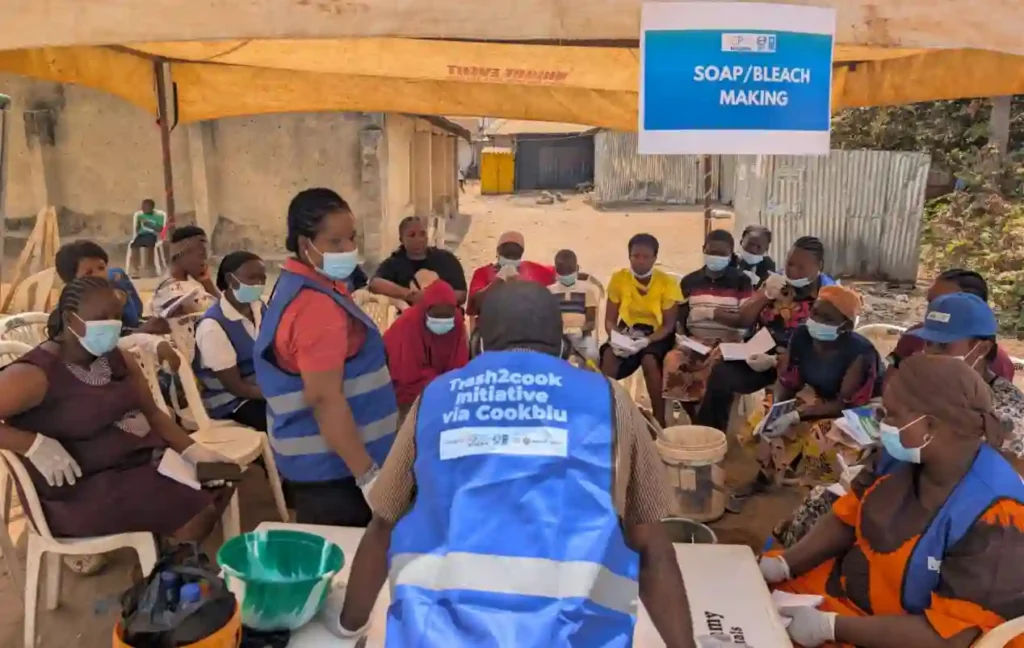
The community-driven environmental initiative was organised by Trash2cook Initiative through Cookblu in partnership with the GEF Small Grant Programme. It drew women and youths from across the community for hands-on sessions in urban gardening, textile upcycling, shoe making and the production of household cleaning products.
Project Coordinator of Community Excellence and Development Initiative (CEDI), Princess Odiaka, said the programme was born out of concern over mounting waste and its impact on public health in Chika.
“We saw drains clogged with waste and rising cases of illness linked to the environment,” she said. “So we decided to turn the challenge into an opportunity by empowering women with green and upcycling skills.”
As part of the training, participants planted 15 oil palm seedlings in recycled tyres. The seedlings are expected to be transplanted to permanent locations as they grow.
Odiaka explained that subsequent sessions would focus on teaching women how to grow vegetables such as peppers and tomatoes in used tyres. According to her, this approach is designed to support household food supply and promote healthier diets within the community.
The initiative builds on an earlier “Waste to Wealth” campaign launched in 2023, which has registered more than 100 women. Odiaka said the new phase aims to move beyond waste collection into active participation in the circular economy.
She noted that participants are now being trained to convert old textiles into tote bags, purses and footwear, creating practical products that can be sold for income.
Odiaka also emphasised the role of traditional leadership in the success of the project. “The chief and council members were involved from the beginning. Some facilitators are from within the community because we want Chika to build its own capacity,” she said.
Facilitator Abdul Abdul Abubakar led sessions on producing liquid soap, disinfectant, bleach and air freshener. He said earlier editions of the training had already produced small-scale entrepreneurs within the area.
“Some participants from the last training have started businesses. You can begin with small quantities at home and expand gradually,” he said. He called for greater government and NGO support to scale up similar initiatives and engage idle youths productively.
Participants also expressed interest in seeing the programme expanded to reach more women.
Gladys Musa, who took part in the shoe-making class, said she had learnt how to measure, cut patterns and assemble shoes manually. She expressed hope that beneficiaries would receive tools to help them transition from training to full-scale production.
“If we get the equipment, we can make shoes locally and even train other young girls,” she said.
Rosemary Akinyemi, a participant in the soap-making session, said the knowledge gained would help her reduce household expenses and potentially generate income.
“Now I know what to mix to get a good result. I can use it at home or start a business,” she said.
Village Head of Chika Airport, Chief Istifanus Shekwoza, appealed to the organisers to extend similar trainings to other communities. He said skill acquisition was essential to community development and restoring hope to households.
“Without skills, you cannot go anywhere,” he said. “This programme will help people avoid idleness, earn income and make Chika a model for other communities.”
Organisers expressed optimism that the initiative would not only clean up the environment but also create a ripple effect of enterprise and self-reliance across neighbouring communities in the FCT.