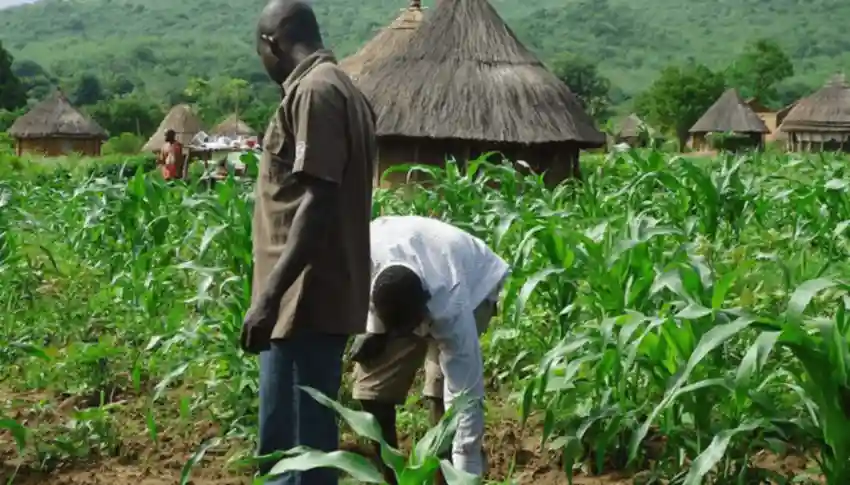
The Nigerian Meteorological Agency (NiMet), in partnership with Tomorrow.io and its affiliates, as well as MTN, has signed an agreement to support 100,000 Nigerian smallholder farmers with digital climate advisory service (DCAS) across the country’s six geopolitical zones.
 Follow us on Google News
The initiative, launched in Abuja on Thursday, is designed to provide farmers with weekly weather-driven advisories to guide planting, fertiliser application, pest control and harvesting decisions as part of broader efforts to strengthen food security.
Speaking at the workshop, Charles Anosike, director-general of NiMet, described the initiative as a transformative innovation in climate service delivery. He explained that the programme is built on collaboration and practical engagement with farmers and other stakeholders.
“The decision tree is not merely a technical tool. It reflects the co-design principles that underpin our work,” he said.
“Through inclusive engagement with end-users, policymakers, and technical experts, we ensure that the system is practical and adaptable.”
Anosike said the system integrates data expertise, advanced analytics and user-centric design to provide tailored guidance not only in agriculture but also in aviation, disaster management and other sectors. He added that the collaboration with Tomorrow.io highlights the impact of combining global innovation with local expertise to solve real challenges facing farmers.
Brian Miranda, chief executive officer (CEO) of the US-based TomorrowNow, said the digital climate advisory will support farmers throughout the entire farming cycle, from planting to harvest.
“Every single day, the first question farmers ask is when will the rains come?’ Ninety percent of farmers across Africa are rain-fed,” Miranda said.
“They depend entirely on the weather. If you plant too early or too late, even by a few weeks, you can suffer a 10 to 20 per cent yield penalty.”
Miranda noted that changing weather patterns are worsening food insecurity in Nigeria because rainfall is no longer predictable.
“The weather that farmers are experiencing today is not as predictable as it was five, 10 or 20 years ago,” he said.
“Yet many farming practices have not adjusted to this reality. If you do what you’ve done every season and expect the rains haven’t changed, you will not have a great season.”
He disclosed that TomorrowNow has already reached nearly six million farmers in Kenya and close to one million in Malawi, recently expanded into Zambia and is now entering Nigeria with an ambitious target.
“Our vision is 100 million weather-resilient farmers across Africa. We are starting this pilot with about 100,000 farmers in multiple states, but we expect this to grow into tens of millions of farmers across Nigeria,” Miranda added.
“We are moving to Nigeria to work with you all to help localise a food institution to help smallholder farmers to be more productive. What we’re looking to do is help unlock the potential of smallholder farmers.”
According to him, the project will initially deploy SMS-based advisories before expanding to voice services and strengthening extension agents with high-quality forecast information.
Ifeoma Ebede, general manager of public-private partnership (PPP) at NiMet, said the workshop marked a critical step toward finalising documentation for a nationwide rollout.