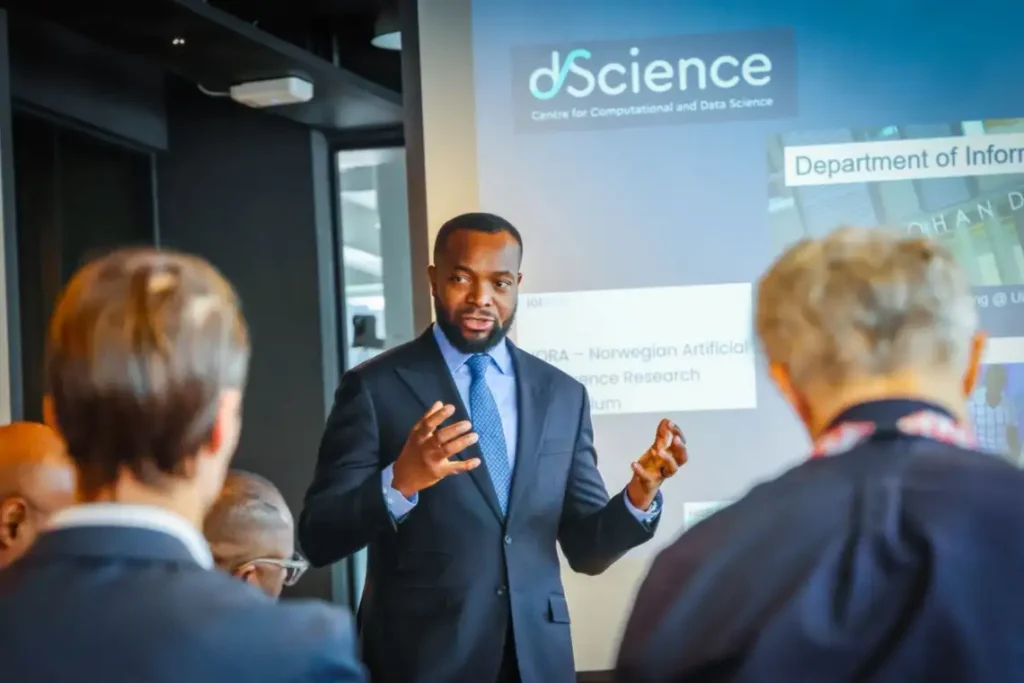

Bosun Tijani, Federal Minister of Communications and Digital Economy, has said Nigeria must act quickly to turn its growing youth population into an economic advantage rather than a national challenge.
 Follow us on Google News
Speaking yesterday in Oslo during the European roadshow for Project BRIDGE, Tijani said his engagements with NORAD, NORFUND, the University of Oslo, SINTEF and PRIO pushed him to reflect not only on infrastructure but on Nigeria’s future.
He said PRIO’s research on Nigeria’s youth bulge was “sobering and reassuring at the same time.”
“Nigeria is one of the youngest nations on earth and millions of young people enter working age every year. That energy can become our greatest blessing or it can become a source of strain,” he said.
According to him, “Demography is not destiny. It is direction shaped by policy, discipline and investment.”
He noted that PRIO observed that Nigeria today sits roughly where South Korea stood in the 1970s, when its youth population was strategically harnessed for transformation. “That comparison is not about imitation. It is about possibility,” he explained.
Tijani stressed that “the difference between dividend and disruption is structure,” adding that the government’s agenda is structural and interconnected.
He described Project BRIDGE as an effort to build the backbone that allows young Nigerians to create, work and compete globally. He said NUCAP, the rural tower programme, is designed to ensure that children in riverine and remote communities are not excluded from opportunity because of geography.
“Our satellite investments strengthen national resilience and extend connectivity to every corner of our country,” he said.
The minister added that 3MTT is preparing the workforce at scale, while the national AI strategy positions Nigeria’s youth to become creators in the next technological wave.
However, he said infrastructure and skills alone are not enough. “We are expanding the digital economy so that there is real demand for talent, more startups, more innovation and more export capacity,” he stated.
He also said the government is driving e-governance reform to make public services more efficient, transparent and digitally accessible, thereby lowering friction for entrepreneurs, reducing cost of compliance and building trust in institutions.
“There are not many investments capable of converting a youth bulge into a demographic dividend. Connectivity at scale. Skills at scale. Institutional reform. Digital public infrastructure. Policy coherence,” he said.
Drawing a comparison with natural resources, Tijani said, “Like oil, demography can bless or destabilise. Norway reminds us that resources become prosperity only when governed wisely.”
Reflecting on his experience, he said, “My years building CcHUB showed me that talent is abundant in Nigeria and my time in public service has reinforced that infrastructure, institutions, and policy determine whether that talent finds expression.”
He acknowledged that some may not immediately see the value in laying fibre across tens of thousands of kilometres, connecting remote communities, investing early in AI or digitising public services.
“But demographic windows are time-bound. If we do not build the rails now, the pressure will build elsewhere,” he warned.
“I am resolved to stay focused. To ensure that this moment of service is used to lay the foundations that will allow Nigeria’s youth bulge to become a blessing,” he said.
“History will not judge us by noise. It will judge us by whether we engineered the dividend. And I intend to stand and be counted.”