The Abia State Government has unveiled plans to comprehensively inspect, grade and classify hospitality and tourism facilities across the state in line with global best practices, as part of efforts to reposition the sector for growth, visibility and increased economic returns.
 Follow us on Google News
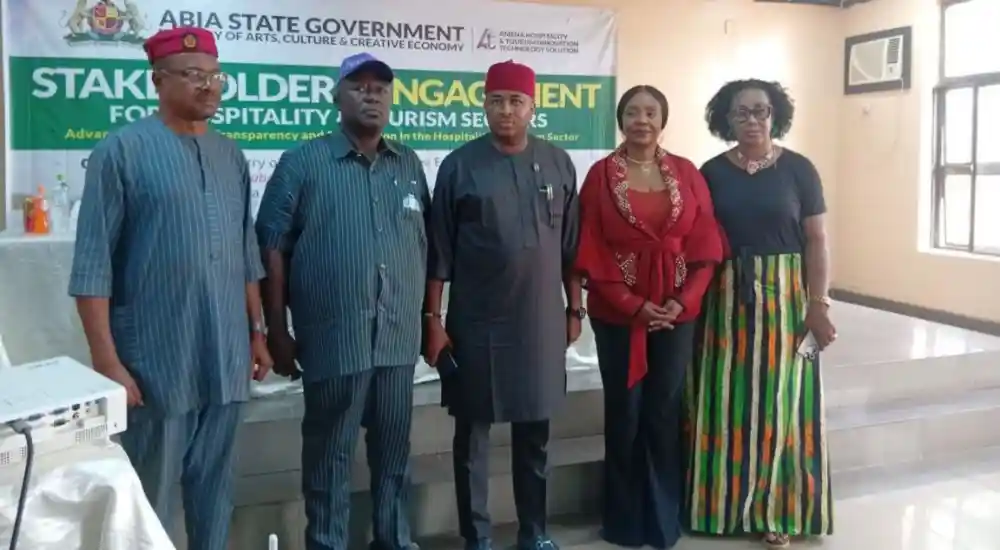
The initiative was disclosed on Wednesday during a stakeholders engagement for operators in the hospitality and tourism sector, organised by the Ministry of Arts, Culture and Creative Economy. The meeting was attended by hotel owners, industry players, consultants and government officials.
Speaking at the event, the Managing Director of Amena Hospitality and Tourism Innovation Technology Solution, Mr. Edosa Eghobamien, said the administration of Governor Alex Otti had taken a strategic decision to upgrade standards in the sector, recognising tourism as one of the highest employers of labour globally.
“The Abia State Government has thought it wise to upgrade the standards of its hospitality and tourism destinations. Tourism and socialisation is one of the highest employers of labour, not just in Nigeria but globally,” Eghobamien said.
According to him, all hotels, lounges, bars, restaurants and recreational centres operating in the state will undergo inspection and classification based on international benchmarks, with technology deployed to enhance transparency and global visibility.
“Every hospitality establishment in the state will be inspected, graded and classified according to best global practices. Technology will be infused into this programme, and when that is done, it creates visibility.
“The world will see you, notice you and recognise you as a five-star or four-star destination worth visiting,” he explained.
Eghobamien described the initiative as a “win-win” for both government and operators, noting that grading would encourage proper maintenance, improve customer satisfaction and drive repeat patronage.
“One of the greatest challenges in this industry is maintenance. Through grading, defects are identified, recommendations for upgrades are made, and facilities are rated accordingly. What you represent is exactly what the customer will see,” he said.
He added that the technology to be deployed would also allow users to share their experiences, stressing that poorly maintained facilities would inevitably suffer revenue losses.
“If customers are unhappy, they won’t return. It’s only happy, repeat customers that sustain a business. This initiative will directly impact revenue, profitability and long-term sustainability,” Eghobamien noted.
He commended the Ministry of Arts, Culture and Creative Economy and its leadership for driving continuous engagement with stakeholders, describing the programme as “Abia hospitality and tourism to the world.”
“Something good has come to Abia State and it has come to stay. Abia wants to lead Nigeria on this new trajectory, and we are calling on all stakeholders to join hands with government so that everyone becomes a winner,” he said.
Earlier, the Commissioner for Arts, Culture and Creative Economy, Chief Matthew Ekwuribe, said the hospitality classification exercise was aimed at bringing order, fairness and professionalism to the industry, while aligning Abia with emerging global standards.
“Our ministry will not be left behind. One of the things we are trying to achieve is to give the hospitality industry better organisation and structure,” Ekwuribe said.
He disclosed that the enumeration of hotels and hospitality facilities would commence in the coming weeks, involving physical inspections, facility assessments and detailed questionnaires, after which establishments would be graded.
“This is not a desk exercise. We will visit facilities, ask questions based on what you have, and at the end of the exercise, you will be graded.
“Hotels will also be put online so people can book directly from their websites,” he said.
Ekwuribe noted that the grading system would also address long-standing complaints about blanket taxation and levies, ensuring that hotels pay according to their size, capacity and classification.
“Through proper classification, a small hotel will pay what it can afford, while bigger facilities will pay accordingly. We want to stabilise standards and ensure fairness across the board,” he explained.
The commissioner also emphasised the importance of staff training, citing poor customer handling as a major weakness in the sector.
“One of the problems we have is the lack of well-trained hotel managers and front-desk staff. Simple hospitality etiquette like knocking before opening doors or properly engaging guests is often ignored. Training will be a key component of this reform,” he said.
He added that accessibility, security and inclusiveness, including facilities for persons with disabilities, would form part of the new standards.
“We want to bring major events and activities to Abia, but the question is: are we ready to welcome people? This programme is to ensure that we are ready,” Ekwuribe stated, calling on operators to cooperate fully with government.
Also speaking, the Permanent Secretary of the Ministry, Mrs. Chibuzo Ehiemere, underscored the critical role of private sector operators in achieving the ministry’s mandate of repositioning tourism as a major economic driver in the state.
“You are critical stakeholders. Nothing can happen in the tourism industry without you being part of it. Visitors will sleep in hotels, eat in restaurants and relax in recreational centres – that is where you come in,” she said.
Ehiemere explained that the classification and grading exercise was designed to align Abia’s hospitality sector with international best practices, boost confidence among visitors and address persistent concerns about fees and standards.
“This engagement is an opportunity to ask questions, understand the process and add value. It is surprising that many operators are absent, yet we complain about excessive fees and challenges. This is the time to sit down and correct those issues,” she noted.
She reaffirmed the state government’s commitment to sustaining the initiative, stressing that lack of immediate buy-in would not derail the reform.
“The government is determined to make the tourism industry one of the best. This is about exposure, international standards and opening Abia to the world,” Ehiemere said.
The stakeholders’ engagement concluded with assurances that the grading, classification and continuous training programme would be implemented in phases, with periodic reviews, as part of a broader strategy to improve tourism, transportation, hospitality standards and the overall wellbeing of the Abia people.