
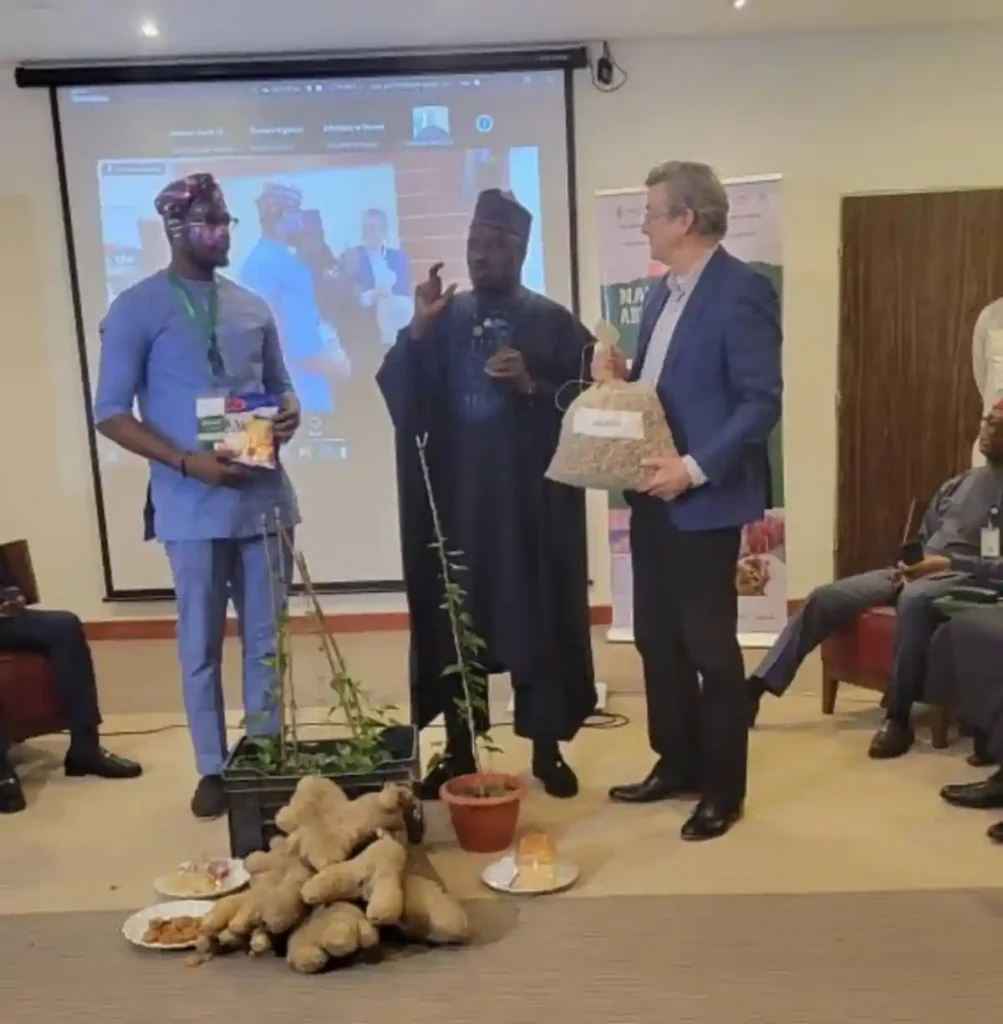
The Federal Government has announced the transformation of the former Root and Tuber Expansion Programme (RTEP) into the Root and Tuber Industry and Export Development (RTIED) Programme, as part of efforts to reposition yams and other root crops for stronger policy backing and export growth.
 Follow us on Google News
The Minister of State for Agriculture and Food Security, Aliyu Abdullahi, made this known in Abuja at the National Yam Advocacy Summit organised by the International Institute of Tropical Agriculture (IITA) in collaboration with the Federal Ministry of Agriculture and Food Security.
“Accordingly, I wish to inform this summit that the old Root and Tuber Expansion Programme has now been transformed into the Root and Tuber Industry and Export Development Programme under the Federal Department of Agriculture.
“Yam, along with the various root and tuber crops, are in the process of getting the desired policy attention and actions,” the minister said.
He explained that the reform aligns with the Renewed Hope Agenda of President Bola Tinubu, which prioritises food security and agricultural transformation across the country.
Abdullahi disclosed that Nigeria produces 67.2 million metric tonnes of yams annually, accounting for about 67 per cent of global output. However, he said the country still faces a domestic supply gap of over 50 million metric tonnes when compared with an estimated national demand of 120 million metric tonnes.
He described yams as a Tier-1 crop under the ministry’s “Ramping Up Staple Crops Production for Renewed Hope Food Security” programme. According to him, the government is targeting an increase in yields from 10 metric tonnes per hectare to 30 metric tonnes per hectare, while reducing post-harvest losses from 40 per cent to 25 per cent by 2027.
Also speaking at the summit, IITA’s Deputy Director General (DDG), Partnerships for Delivery and Scaling, Dr Tahirou Abdoulaye, said the Institute was proud to champion yam research and seed system innovations across Africa.
He described IITA as a non-profit institution that generates agricultural innovations to tackle hunger, malnutrition and poverty in sub-Saharan Africa.
“Yam is our crop and only we can work, defend it and ensure it is always available for our people. Yam is among IITA’s mandate crops, and the Institute has extensive research findings on the crop across the entire value chain, from breeding to agronomy and value addition,” he said.
Abdoulaye said that with support from the Bill & Melinda Gates Foundation, now the Gates Foundation, IITA had implemented major seed system improvement initiatives. These include the Yam Improvement for Income and Food Security in West Africa (YIIFSWA I and II) and the ongoing Programme for Seed System Innovation for Vegetatively Propagated Crops in Africa (PROSSIVA).
He noted that years of research had dispelled the myth of low multiplication rates in yam production. He cited innovations such as the Single-Node Cutting (SAH) and leaf-bud cutting technologies as breakthroughs that can rapidly multiply high-quality seed yams.
“These technologies are easy to implement, adaptable to various conditions, and require minimal input. They quickly multiply high-quality seed yams and are recommended for use by national agricultural research institutes and commercial seed companies. Producing yams for export and processing will further enhance its value. Just meeting the needs of our brothers and sisters in the diaspora will be a huge undertaking. Markets also exist in the Caribbean, with potential for demand growth,” he said.
The DDG added that IITA is collaborating closely with the Ministry to share technical expertise and expects the government to leverage research innovations to strengthen the yam value chain.
“The National Yam Advocacy Summit is a good example of collaboration aimed at utilising the seed system to promote development in the yam value chain,” he said.
On his part, Senior Program Officer at the Gates Foundation, Lawrence Kent, said the presence of top officials at the summit underscored the importance of yams to Nigeria and Africa.
“The fact that you are here really signifies the recognition of high-level officials of the importance of yams to this country, to Africa, to your farmers. We’re particularly excited about the use of new technologies as game changers to allow smallholder farmers to improve their productivity. What this team has done, IITA working with the government, has developed a new technology for the production of yam planting material that, for me, is almost a miracle,” he said.
Kent described the leaf-bud cutting system, derived from tissue culture, as “magical,” explaining that it produces disease-free, nematode-free seed yams capable of doubling farmers’ yields.
“Farmers who have the courage to buy them are seeing this doubling in yield, which is wonderful for them, but also wonderful for the nation. As yams’ productivity goes up, opportunities for processing and exports will come into place. We have an opportunity now to double yam productivity and do something wonderful for Nigeria,” he added.