
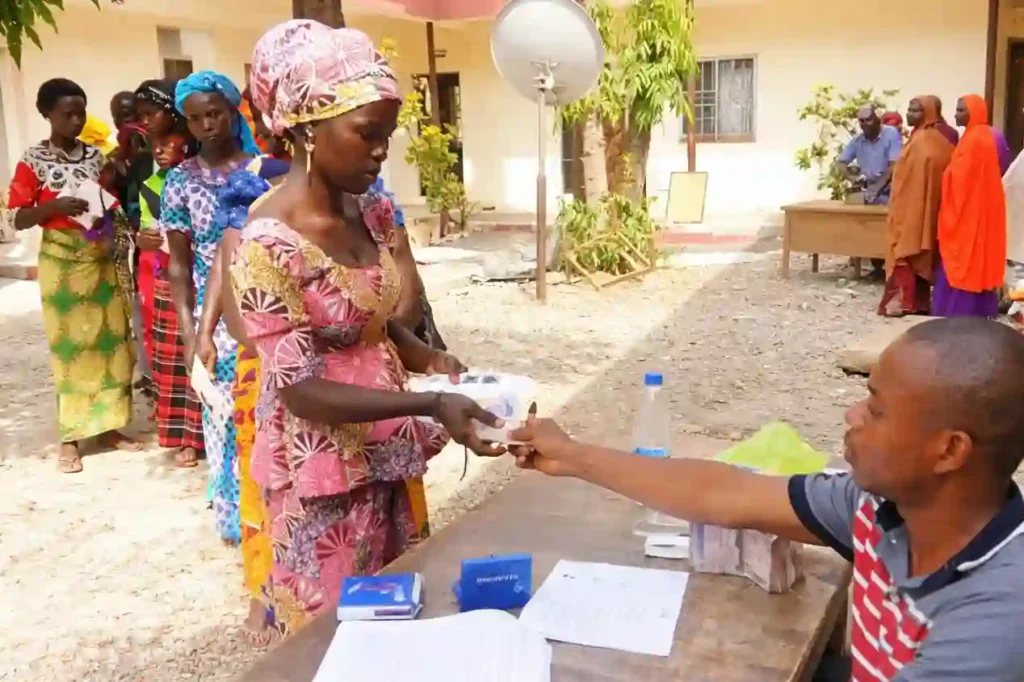
The Federal Government has disclosed plans to expand the National Social Register to capture more vulnerable and affected households across the country and integrate them into structured social protection systems.
 Follow us on Google News
This was made known on Thursday during the flag-off of the distribution of multi-billion naira food items to vulnerable households in Benue State. The Minister of Humanitarian Affairs and Poverty Reduction, Dr. Bernard Doro, said the expansion is part of a broader reform agenda aimed at ensuring that humanitarian support goes beyond temporary relief.
According to him, the ongoing intervention under the Presidential Initiative for Food and Nutrition Assistance demonstrates the resolve of President Bola Ahmed Tinubu’s administration to stand with communities affected by displacement, insecurity, communal conflicts, and livelihood disruptions.
He assured Nigerians that no citizen will be left behind, especially during periods of hardship.
Speaking on the situation in Benue State, Doro noted that the state, popularly known as the “Food Basket of the Nation,” has faced serious humanitarian pressures in recent years. He listed armed violence, farmer–herder conflicts, displacement, and destruction of farmlands as major factors that have weakened agricultural productivity and disrupted food systems.
These challenges, he said, have placed enormous strain on thousands of households, particularly women, children, the elderly, persons with disabilities, and internally displaced persons.
He acknowledged that global humanitarian systems are currently facing funding constraints, including reduced support from some traditional donor partners. However, he stressed that the Federal Government remains resolute.
“We will not allow humanitarian gaps to widen, and we will not abandon vulnerable citizens in their time of need,” he said.
The Minister explained that the current food distribution exercise is strategic and deliberate. According to him, it is not just about addressing immediate food shortages but about creating an entry point into a more transformative system of support.
He revealed that the Ministry is driving a flagship reform initiative known as the One Humanitarian—One Poverty Response System (OHOPRS). The initiative, he said, is built on the principle that affected populations must not receive only one-off support.
Rather than limiting assistance to emergency relief, the government plans to ensure that humanitarian aid serves as a bridge into structured social protection and sustainable poverty-exit pathways.
In practical terms, this means that families receiving food and nutrition support today should not return to vulnerability tomorrow. Instead, they will be linked to national social protection interventions such as conditional cash transfers, livelihood support programmes, skills development initiatives, micro-enterprise support, and other poverty-reduction mechanisms.
“This is how we break the cycle of repeated humanitarian dependency,” Doro said.
Central to this reform is the expansion and strengthening of the National Social Register. The Minister explained that the Register is being expanded to ensure that vulnerable and affected populations across the country are properly identified, documented, and integrated into structured social protection systems.
By widening the Register, more households will become visible within national data systems and eligible for Federal Government interventions.
He assured that the Ministry will work closely with the Benue State Government to ensure that affected communities across the state are adequately captured in the ongoing expansion exercise.
“Once captured, they become eligible for a range of Federal Government social protection interventions and poverty-reduction programmes,” he said.
Doro described this shift as a move from emergency response alone to a continuum of care that links relief, recovery, resilience, and poverty exit.
“Our vision is clear: humanitarian support must transition into structured inclusion within national systems. No household should fall through the cracks. No vulnerable citizen should remain invisible,” he added.
He further maintained that the distribution of food items in Benue State is not a one-off intervention. Instead, it is part of a broader national reform agenda aimed at building a responsive, resilient, and people-centred humanitarian and poverty-reduction system.
In his remarks, the Permanent Secretary of the Federal Ministry of Humanitarian Affairs and Poverty Reduction, Mr. Olubunmi Olusanya, described the initiative as a direct response to the evolving humanitarian situation across crisis-affected communities.
He said it demonstrates the Federal Government’s commitment to protecting vulnerable populations, strengthening shock-responsive social protection, and supporting early recovery efforts.
According to him, the intervention is being implemented under the Presidential Initiative for Emergency Food and Nutrition Support as part of the reform priorities of President Tinubu’s administration.
He noted that these reforms emphasise data-driven targeting, expansion of the social register, improved transparency, and effective last-mile delivery to ensure assistance reaches those most in need.
Olusanya also highlighted the humanitarian situation in Benue State as a priority concern. He said recurrent armed attacks and communal violence have displaced many families, disrupted agricultural livelihoods, and increased vulnerability across several local government areas.
He added that overcrowded displacement settings continue to strain basic services, while women, children, older persons, and persons with disabilities face heightened protection risks. Loss of farmlands and climate variability are also contributing to the risk of malnutrition, particularly among children and pregnant women.
In response, he said, the Federal Government is working closely with the Benue State Government and partners to strengthen humanitarian coordination, improve support to displaced and host communities, and advance durable solutions that promote recovery, stability, and resilience.
Also speaking at the event, Governor Hyacinth Alia of Benue State expressed gratitude to President Tinubu and the Ministry for the intervention, describing it as timely and strategic.
He said Benue State has continued to face severe humanitarian pressures arising from persistent insecurity and communal conflicts, particularly farmer–herder clashes, which have disrupted farming activities and rural livelihoods.
According to him, several communities have been attacked, leading to loss of lives, destruction of homes, and the displacement of thousands of citizens into Internally Displaced Persons camps and host communities.
The governor listed key indicators of the crisis in the state, including large-scale internal displacement across multiple local government areas, destruction of farmlands, reduced agricultural productivity, rising food prices due to disrupted supply chains, increased cases of malnutrition among children and pregnant women, heightened poverty levels, and overcrowded IDP camps.
He said these realities have significantly weakened household resilience and deepened food insecurity in many parts of the state.
Describing the Federal Government’s initiative as a lifeline for thousands of vulnerable households, Alia said the food and nutrition items being distributed would help stabilise affected families, prevent severe acute malnutrition, and restore a measure of dignity and hope.
He assured that the Benue State Government has put in place mechanisms to ensure transparency, accountability, and equitable distribution to targeted beneficiaries, especially IDPs, widows, orphaned children, and low-income households in severely affected communities.
He also urged community leaders, local government officials, and implementing partners to uphold the highest standards of integrity throughout the exercise.
Beyond emergency relief, the governor said the state government remains committed to peacebuilding, agricultural recovery programmes, livelihood restoration, and strengthened social protection systems to reduce vulnerability and promote sustainable resilience.
The renewed focus on expanding the National Social Register signals a shift in Nigeria’s humanitarian and poverty-reduction strategy. By ensuring that vulnerable households are properly identified and integrated into structured social protection systems, the Federal Government aims to create a more coordinated and sustainable response to poverty, food insecurity, and humanitarian crises across the country.
Through data-driven targeting, stronger collaboration with states, and linkage to long-term support mechanisms, the expansion of the Register is expected to play a central role in ensuring that vulnerable Nigerians are not only reached in times of crisis but supported on a clear pathway toward stability and self-reliance.