
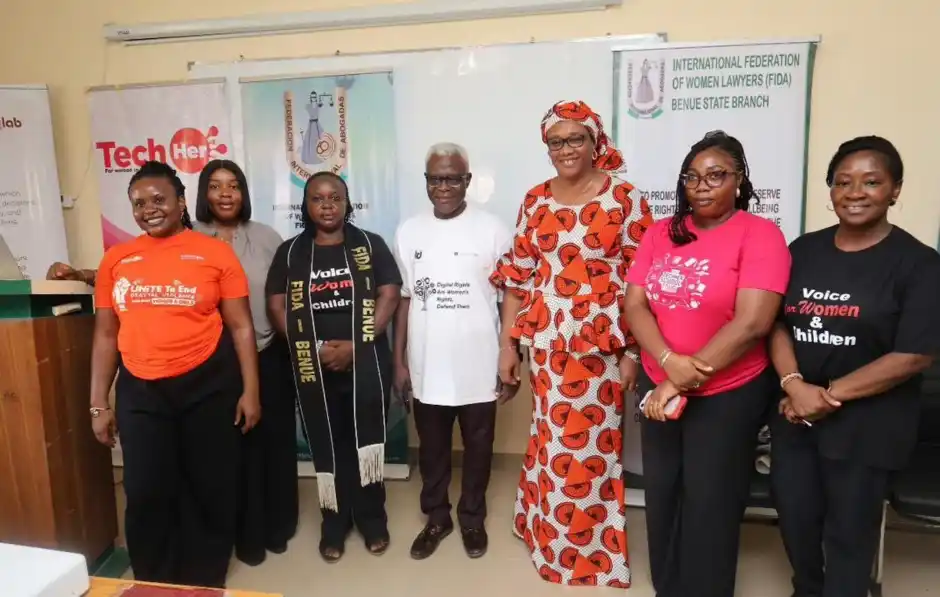
TechHer, in partnership with Accountability Lab Nigeria and the International Federation of Women Lawyers (FIDA), Benue State Branch, has empowered 300 female students in Benue State with digital safety skills, knowledge of cyber laws, and the confidence to report online abuse and protect their rights.
 Follow us on Google News
The empowerment initiative was delivered through a Campus Sensitisation and Awareness Programme on Cyber Laws and Digital Safety, held across two tertiary institutions in Makurdi — Rev. Fr. Moses Orshio Adasu University (MOAUM) and Joseph Sarwuan Tarka University (JOSTUM). The programme focused on equipping young women with practical tools to navigate the digital space safely while understanding the legal protections available to them.
Through structured sessions, participants were trained on online safety, cybercrime prevention, digital footprints, and ethical online behaviour. More importantly, they were introduced to the concept of digital rights and how these rights connect to existing legal frameworks in Nigeria.
The organisers positioned the programme as a direct response to the growing risks young women face online, especially as internet access and digital participation continue to expand. Despite this growth, many users still lack the awareness needed to identify violations or take action when harmed.
Speaking during the programme, Chairperson of FIDA Benue State, Blessing Ityohuun, stressed that digital spaces are no longer separate from real life. “The digital space has become an extension of society itself. The protection of digital rights is inseparable from the protection of human rights. At the same time, responsible digital conduct is essential for social order, justice, and peaceful coexistence,” she said.
Her remarks reinforced the programme’s core message — that empowerment in the digital age must go beyond access to include knowledge, responsibility, and accountability.
A major part of the training focused on helping participants understand Nigeria’s legal framework around cyber activities. During a session on cybercrime laws and digital rights, Ihechi Olanrewaju explained that online rights are grounded in the country’s constitutional provisions and supported by laws such as the Cybercrimes Act.
“While cybercrime is a growing global threat that requires strong legal protections, enforcement must always respect fundamental rights. Everyone has a role to play in creating a safe digital space,” she said.
By breaking down these laws into simple, relatable explanations, the programme helped students see how legal systems can protect them, while also showing their role in maintaining safe online communities.
Another key area of empowerment was addressing Technology-Facilitated Gender-Based Violence (TFGBV). This session highlighted the specific ways women and girls are targeted online, including cyberstalking, harassment, impersonation, blackmail, and the non-consensual sharing of private images.
Project Officer at TechHer, Gladys Omenefu, explained that these forms of abuse often thrive on silence and lack of awareness. She noted that many victims do not recognise these actions as violations or do not know where to seek help.
She pointed out that early awareness is critical. When individuals can identify harmful behaviour quickly, they are better positioned to respond, seek help, and prevent further harm.
Beyond awareness, the programme placed strong emphasis on practical action. Participants were guided step by step on how to report digital abuse, document evidence, and access available support systems.
Esther Etokudo introduced Kuram, TechHer’s online reporting platform, along with its Volunteer Lawyer Network. She explained how these tools are designed to support victims through both legal and psychosocial channels.
“Reporting is the bridge between being a target and becoming a survivor with an advocate. By documenting abuse and seeking support, survivors help create the evidence needed for action and accountability,” she said.
This practical approach shifted the focus from fear to action, showing participants that they are not powerless in the face of online abuse.
Monitoring and Evaluation Officer at Accountability Lab Nigeria, Alfred Ijeloesa Agu, observed a clear shift in how participants responded to the training. According to him, the programme did more than just pass information.
“What we observed was not just increased awareness, but a shift toward agency. When young women understand how digital harms connect to legal protections and reporting systems, they are more likely to act,” he said.
This shift toward agency reflects the deeper goal of the initiative — building confidence alongside knowledge.
For many of the students, the impact was immediate and personal. Deborah, a 300-level Mass Communication student at MOAUM, shared how the programme changed her perspective on everyday online behaviour.
“Before this programme, I didn’t realise that many of the things we normalise online are actually violations of our rights. I now understand what digital rights mean and how to report abuse rather than remain silent,” she said.
Her experience highlights a common gap the programme aimed to address — the normalisation of harmful online practices due to lack of awareness.
Similarly, Terver, a 200-level Computer Science student at JOSTUM, spoke about the importance of learning clear reporting steps.
“What stood out for me was learning that reporting is power. Knowing that there are clear steps to document evidence and seek support has given me confidence to protect myself and also guide my friends,” she said.
These responses reflect the programme’s success in turning knowledge into confidence and practical readiness.
The sessions were delivered through interactive workshops, panel discussions, legal literacy classes, and advisory clinics. This structure allowed participants to engage actively, ask questions, and relate the lessons to real-life situations.
By combining legal education, digital safety training, and practical reporting tools, the initiative created a well-rounded empowerment experience. It not only informed participants but also equipped them to take control of their digital lives.
Organisers also noted that insights gathered during the programme, including patterns of abuse and reporting gaps, will support future advocacy efforts and policy engagement.