The Federal Government is set to commence the full rollout of a $552.18m education reform programme, in partnership with the World Bank and the Global Partnership for Education, to strengthen Nigeria’s basic education system.
 Follow us on Google News
The initiative, anchored on the HOPE for Quality Basic Education for All (HOPE-EDU) and HOPE-Governance (HOPE-GOV) programmes, is designed to address long-standing structural weaknesses in the sector, improve learning outcomes, and expand access to quality education across the country.
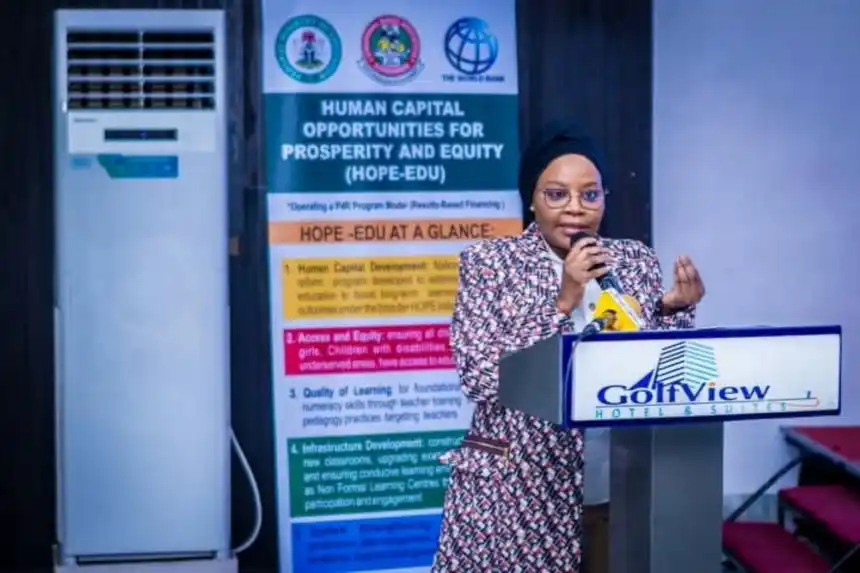
Executive Secretary of the Universal Basic Education Commission, Aisha Garba, disclosed this on Wednesday during the opening of a three-day sensitisation workshop held in Ikeja, Lagos, with Commissioners of Education, Chairmen of State Universal Basic Education Boards, and heads of implementing departments in attendance.
Garba described the programme as a major national intervention that will directly impact over 29 million children, empower 500,000 teachers, and support the construction of 13,000 classrooms nationwide, while also targeting the reintegration of millions of out-of-school children into the education system.
She noted that the reform is not only about funding, but about transforming the entire foundation of basic education delivery in Nigeria through improved governance, accountability, and performance-driven implementation.
In December 2025, the Federal Government, in collaboration with the World Bank, had earlier unveiled the Human Capital Opportunities for Prosperity and Equity–Governance programme, a broader initiative aimed at strengthening financial and human resource management in both basic education and primary healthcare systems.
According to Garba, the education-focused components under HOPE-EDU and HOPE-GOV represent a critical step towards reversing years of underperformance and systemic inefficiencies at the sub-national level.
She emphasised that while the Federal Ministry of Education and UBEC would provide strategic direction, funding, and technical support, the success of the programme would depend largely on state governments and local stakeholders.
“The Federal Ministry of Education and UBEC will channel resources and technical support to your states, but the real work happens at the grassroots. You will lead needs assessments, community mobilisation, and on-the-ground execution,” she said.
Garba added that the initiative would significantly improve the availability and quality of teaching and learning materials, strengthen teacher capacity through continuous development, and enhance measurable learning outcomes across schools.
“Aligned seamlessly with President Bola Tinubu’s Renewed Hope Agenda, this initiative targets the heart of our challenges in basic education by improving learning outcomes for over 29 million children, empowering 500,000 teachers, constructing 13,000 classrooms, and bringing millions of out-of-school children back to school nationwide,” she stated.
Nigeria currently has one of the highest numbers of out-of-school children globally, a challenge compounded by inadequate infrastructure, insufficient teaching personnel, and weak financial management systems at the state level.
Garba stressed that the reform would prioritise inclusivity, with a deliberate focus on girls, children with special needs, vulnerable populations, and those in conflict-affected areas.
“Their education is not charity; it is the cornerstone of our democracy and economy,” she said, urging stakeholders to adopt inclusive strategies that ensure no child is left behind.
The rollout of the programme is being implemented in phases across the country. The first phase, covering South-South and South-East states, was held in Uyo, Akwa Ibom, while the current phase in Lagos is engaging stakeholders from the South-West and North-Central regions. A third phase is scheduled for North-West and North-East states in Kano.
UBEC further explained that the HOPE-EDU programme would operate on a result-based financing model, where states are incentivised based on the achievement of clearly defined and verifiable performance indicators.
The three key focus areas of the programme include improving the quality of education, expanding access to basic education, and strengthening institutional systems for sustainable delivery.
States that meet agreed targets under disbursement-linked indicators will receive funding support, a mechanism designed to promote accountability and ensure efficient utilisation of resources.
Garba also underscored the importance of transparency and collaboration in the implementation process, noting that digital dashboards would be deployed to track financial flows, activities, and milestones in real time.
She called for stronger partnerships among federal and state governments, local authorities, civil society organisations, parents, and the private sector to drive collective ownership of the reform.
“As we embark on this sensitisation journey today, I call on each of you to discuss, deliberate, and depart with concrete action plans. Share your challenges openly so we can co-create solutions,” she said.