
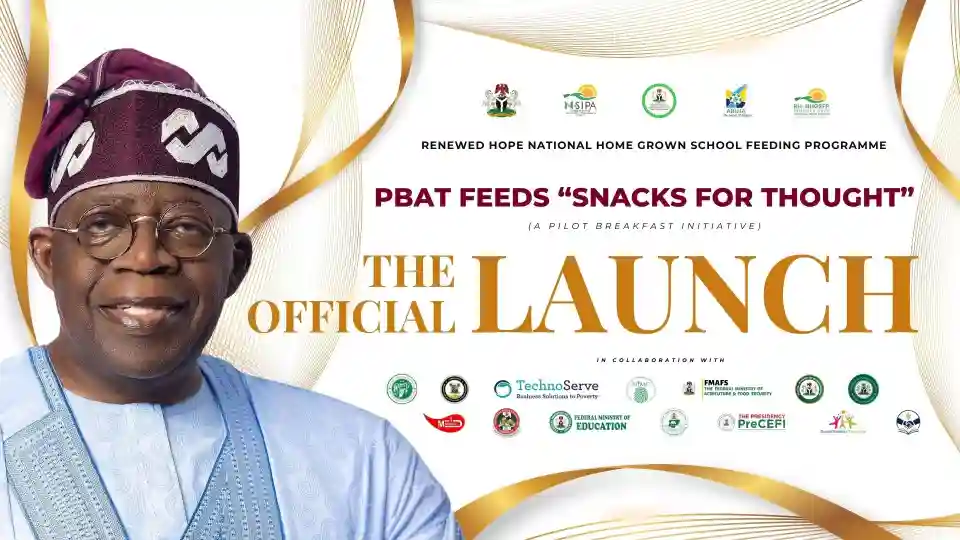
The Federal Government has launched “Snacks for Thought” (PBAT FEEDS), a breakfast initiative under the Renewed Hope National Home-Grown School Feeding Programme (RH-NHGSFP), to tackle hunger and improve learning outcomes among school children.
 Follow us on Google News
The initiative is designed to provide nutritious morning meals to pupils before the start of academic activities, addressing what officials describe as a major barrier to effective learning in classrooms across the country.
Unveiled at the Office of the Secretary to the Government of the Federation in Abuja, the programme is positioned as a strategic intervention to ensure that children begin their school day nourished and ready to learn. It complements the existing school feeding structure by shifting attention to the critical early hours of the day when many pupils arrive at school on empty stomachs.
The National Programme Manager of the scheme, Dr Aderemi Adebowale, said the initiative is rooted in the understanding that hunger significantly limits a child’s ability to concentrate and perform academically.
“The more developed your knowledge base is, the smarter you are, but you cannot be smarter than your knowledge base,” Adebowale said.
She noted that the programme goes beyond basic feeding, describing it as a targeted effort to link nutrition directly with education outcomes and productivity. According to her, children who are properly nourished at the start of the day are more likely to participate actively in lessons and retain what they are taught.
Adebowale said “Snacks for Thought” is structured to improve concentration, cognitive performance, school attendance and retention among pupils, while also contributing to broader national development goals.
She said the initiative reflects a policy direction that prioritises child welfare as a foundation for long-term growth.
“Today, Nigeria made a decision that no child should sit in a classroom hungry.
“A decision that learning must begin with nourishment, and a decision that the future of this nation will no longer be built on empty stomachs,” she said.
The programme is also expected to stimulate local economic activities through its supply chain model. Adebowale explained that structured procurement under the initiative would strengthen local agricultural value chains and create opportunities for women, youth and smallholder farmers involved in food production and distribution.
“The programme is expected to improve student concentration and cognitive performance, increase school attendance and retention, strengthen local agricultural value chains through structured procurement, and empower women, youth and smallholder farmers,” she added.
Also introduced at the event was the “Adopt-a-School” platform, which provides an avenue for government institutions, private sector organisations and development partners to support and expand the reach of the feeding initiative nationwide.
The launch attracted ministers, members of the National Assembly, heads of government agencies and development partners, reflecting what organisers described as a coordinated national effort to improve education outcomes through nutrition.
A highlight of the event was the presence of school children holding meal packs, symbolising what stakeholders described as a growing commitment to ensuring that no child is forced to learn on an empty stomach.