
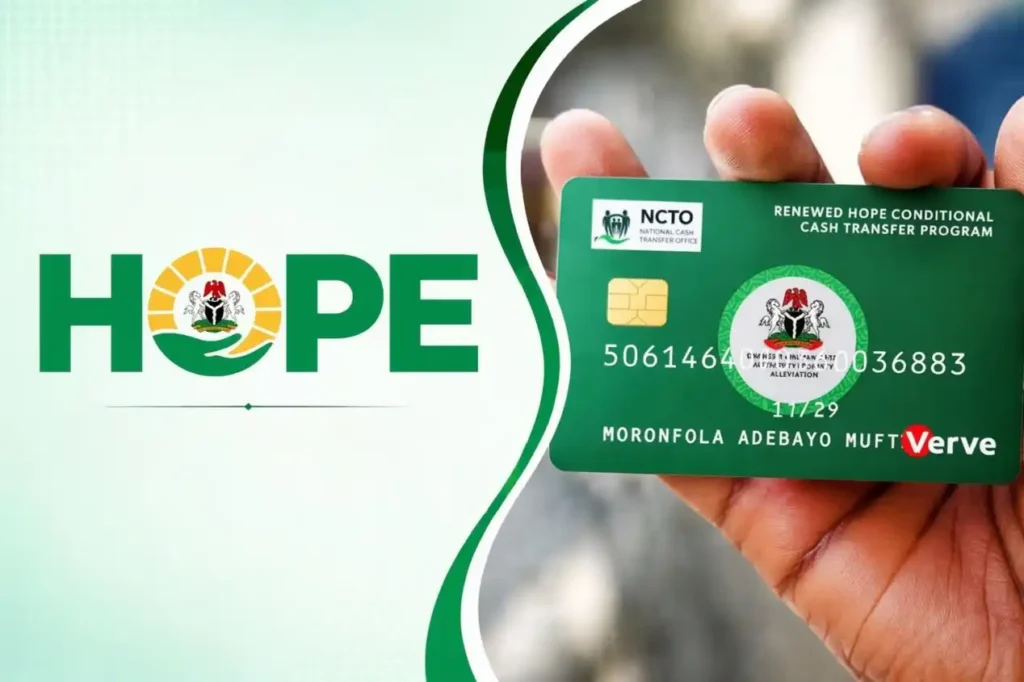
The Federal Government is set to expand its cash transfer programme to 15 million Nigerians, following the disbursement of about ₦688 billion to 9.2 million beneficiaries within two years, as part of efforts to strengthen social protection and support vulnerable households amid ongoing economic reforms.
 Follow us on Google News
This was disclosed by the Minister of Humanitarian Affairs and Poverty Reduction, Dr Bernard Doro, during the HOPE-CT implementation update and press conference held in Abuja. The expansion marks a significant scale-up of the Household Prosperity and Empowerment Cash Transfer Programme, one of the government’s flagship interventions targeted at low-income Nigerians.
Doro said the government has now set a clear target to increase coverage beyond its current reach, noting, “We have set a target to move the Household Prosperity and Empowerment Cash Transfer Programme from the current 9.2 million to 15 million Nigerians.” The move, according to him, reflects the administration’s broader policy direction under ongoing economic adjustments.
The programme, anchored on the National Social Register, is designed to cushion the effects of recent reforms, particularly on vulnerable households facing rising living costs. It is being implemented in collaboration with multiple agencies, including the National Identity Management Commission, the National Social Safety Nets Coordinating Office, the National Cash Transfer Office, and the National Social Investment Programme Agency.
So far, available records show that no fewer than 9.2 million Nigerians have benefited from the initiative, with approximately ₦688 billion disbursed within a two-year period spanning November 2023 to February 2026. Beneficiaries receive ₦75,000 in three tranches as part of the intervention structured to provide immediate financial relief.
Explaining the broader intent behind the expansion, Doro said the programme is evolving beyond temporary assistance into a more structured national framework. “Under the Renewed Hope Agenda of President Bola Tinubu, our approach to social protection is evolving. We are moving beyond short-term humanitarian responses toward building a credible, transparent, and sustainable national social protection system that Nigerians can trust,” he stated.
He emphasised the real value of the support to beneficiaries, particularly those at the lower end of the economic ladder. “A sum of ₦75,000 is indeed a lot of money to Nigerians, and there are many things they could do with it. To the elite, you could view this as insignificant in terms of your personal income. But to the poor and vulnerable, it means a lot,” the minister said.
While acknowledging that the cash transfers provide immediate relief, Doro stressed that the long-term objective is to create lasting economic stability for households. “While the programme provides immediate relief, the long-term vision is to create pathways toward sustainable household prosperity,” he added.
The initiative was originally introduced as a shock-response mechanism aimed at supporting low-income Nigerians amid macroeconomic pressures. However, with the planned expansion, it is increasingly positioned as a central pillar of the government’s social protection strategy.
To ensure transparency and accountability, the government has tied the programme to strict verification processes. All beneficiaries must be captured in the National Social Register and verified using either a National Identification Number or Bank Verification Number. This integration is intended to reduce leakages and improve targeting efficiency.
Supporting this, the Director-General of the National Identity Management Commission, Dr Abisoye Coker-Odusote, noted that identity verification has played a critical role in strengthening the credibility of the programme. She said the use of verified identity systems ensures that assistance reaches the intended recipients.
Also speaking, the Minister of Information and National Orientation, Mohammed Idris, represented by Dr Suleiman Haruna, said the intervention reflects the government’s commitment to inclusive support. According to him, the programme is about showing citizens, especially those at the grassroots, that “their government sees, hears and is actively working to improve their lives.”
Further reinforcing this position, the Minister of State for Humanitarian Affairs and Poverty Reduction, Dr Yusuf Tanko Sununu, said the scheme has been structured to stabilise vulnerable households while improving resilience. He noted that the integration of digital payment systems has enhanced delivery and expanded financial inclusion among beneficiaries.
On funding, the Programme Manager of the National Cash Transfer Office, Abdullahi Alhassan, disclosed that the initiative is backed by an $800 million facility from the International Development Association of the World Bank. He added that the beneficiary target has now been officially reviewed upward, stating that it has moved “from 10.4 million to 15 million vulnerable Nigerians.”