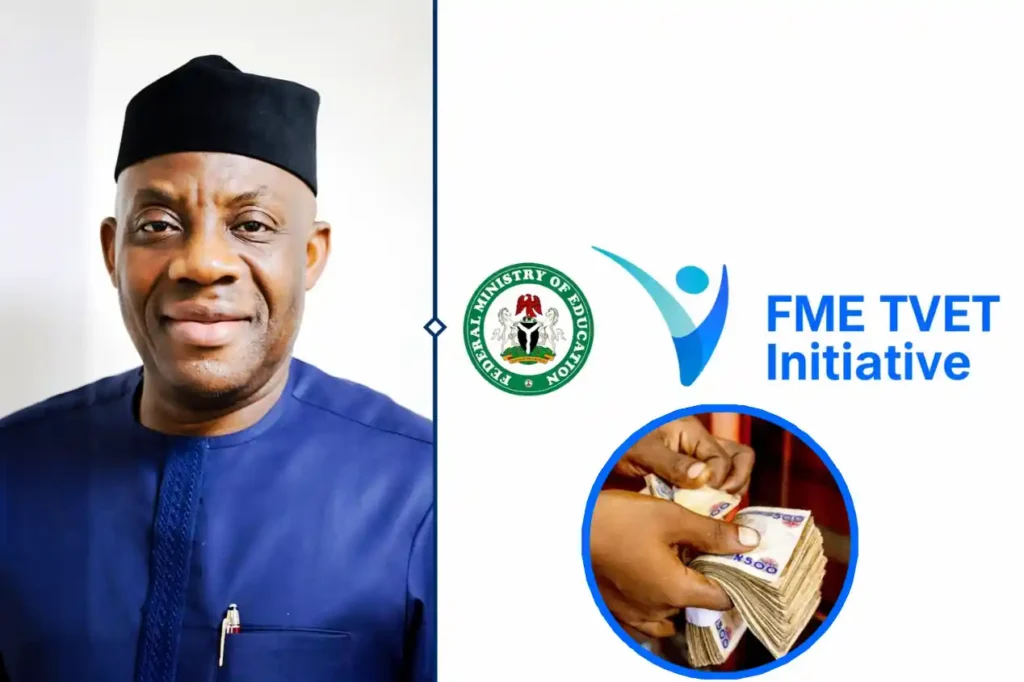
The Federal Government has disclosed that over N30 billion has been disbursed directly to trainees under the Technical and Vocational Education and Training (TVET) programme nationwide, as part of ongoing efforts to reposition skills development and youth empowerment.
 Follow us on Google News
Minister of Education, Tunji Alausa, made this known on Thursday while addressing students at the University of Abuja during the Renewed Hope Conversations – University of Abuja Edition, held at the institution’s main campus, recently renamed Yakubu Gowon University.
Alausa said the disbursement reflects a shift towards practical, skills-based education, noting that beneficiaries of the TVET initiative receive hands-on training alongside starter packs to establish small businesses in trades such as fashion, solar installation and other technical fields.
He stated that the programme is part of broader reforms introduced under the administration of Bola Tinubu, aimed at aligning education with market demands and reducing unemployment among graduates.
“Skills are the future,” the minister said, emphasising that the government is prioritising initiatives that equip young Nigerians with competencies required in a rapidly evolving global economy.
Beyond vocational training, Alausa disclosed that tertiary institutions are now embedding entrepreneurship-focused programmes, including innovation hubs, incubation centres and venture capital schemes designed to support student-led enterprises.
According to him, some of the funding opportunities available to students can reach up to N50 million, providing early-stage capital for scalable ideas and encouraging a culture of innovation within campuses.
Addressing a hall filled with students, the minister urged young Nigerians to take a long-term view of governance and support policies that prioritise sustainable development.
He argued that the current administration inherited longstanding infrastructural deficits and systemic challenges within the education sector, noting that while reforms may take time to yield full results, measurable progress is already being recorded.
“On education, let me be clear: we are reforming the system to ensure relevance and impact. Students are encouraged to pursue courses that are aligned with market needs. Some programmes that do not provide practical value will be phased out. Education must equip you for the real world,” he said.
Alausa further highlighted ongoing curriculum reforms, including the integration of emerging fields such as artificial intelligence and data science across multiple levels of learning.
“We are also transforming the curriculum to align with global standards. Artificial Intelligence (AI) and data science have been integrated into learning from primary school to university level. The world is changing rapidly, and Nigeria must not be left behind. Skills development is central to our strategy,” he added.
On access to education, the minister referenced the Nigerian Education Loan Fund (NELFUND), reiterating that beneficiaries would only begin repayment after securing gainful employment, a structure he described as critical to easing financial barriers for students.
He also assured students of improved academic stability, noting that efforts are underway to address recurring disputes with academic unions to ensure that degree programmes are completed within stipulated timelines.
“We have introduced a student loan scheme to ensure that no willing student is denied access to education due to financial constraints. Repayment only begins after securing a decent job,” he said.
Alausa maintained that the broader objective of the reforms is to produce graduates who can create jobs rather than depend solely on existing opportunities.
“We are building an education system that prepares you not just for today, but for the future. The goal is to produce job creators, not job seekers,” the minister stated.
He subsequently encouraged students to support leadership and policies that, in his view, would secure long-term national growth, linking ongoing reforms to future economic competitiveness.
Also speaking at the event, Minister of State for Regional Development, Uba Maigari Ahmadu, outlined efforts to rebuild educational and community infrastructure in regions affected by conflict and underdevelopment.
Similarly, Minister of Arts, Culture and the Creative Economy, Hannatu Musa Musawa, highlighted policies aimed at expanding opportunities within Nigeria’s creative sector, including funding initiatives and frameworks to strengthen intellectual property protection for young creatives.
The event brought together policymakers and students to deepen engagement on national issues, with a focus on showcasing government interventions targeted at youth empowerment, education reform and enterprise development.