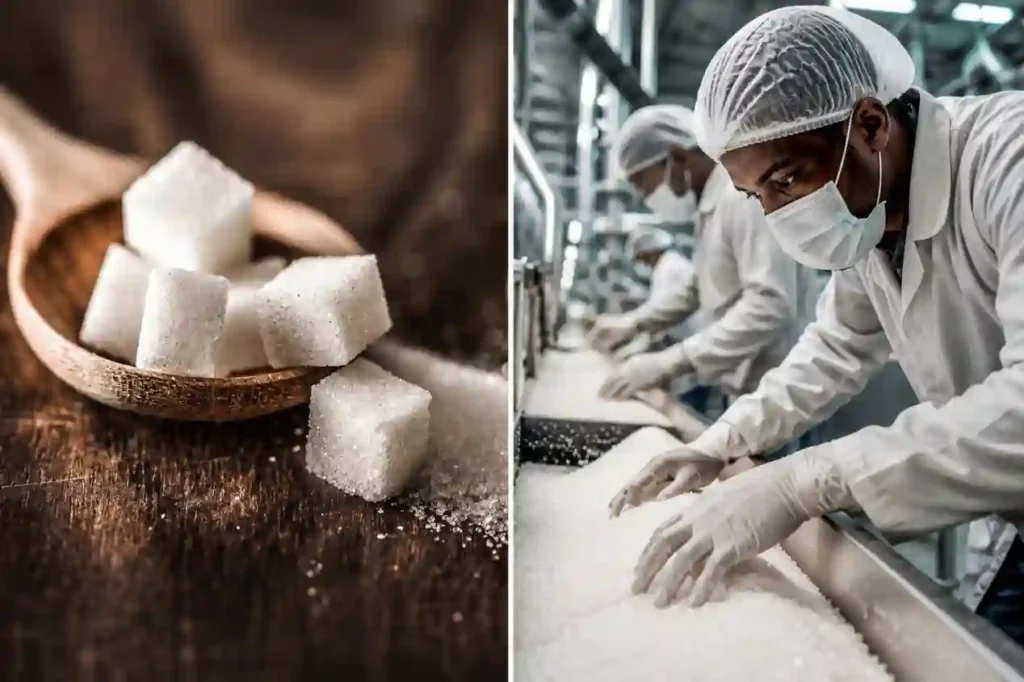
The National Sugar Development Council (NSDC) has said Nigeria’s sugar industry could create up to one million jobs if the country fully develops its local sugar production capacity and reduces dependence on imports.
 Follow us on Google News
The Executive Secretary of the NSDC, Kamar Bakrin, disclosed this during a strategic meeting with the Nigeria Customs Service (NCS) at the Customs headquarters in Abuja.
Bakrin said the sugar sector has the potential to generate 250,000 direct jobs and another 750,000 indirect jobs across the value chain in about 12 states if ongoing reforms under the National Sugar Master Plan II (NSMP II) are successfully implemented.
According to him, the industry can become a major driver of rural economic development while also helping Nigeria tackle insecurity through large-scale youth employment.
“If Nigeria succeeds in developing a proper sugar sector, one of the things we would do is convert an annual outflow of over one billion dollars into jobs, security, and industrialisation,” Bakrin said.
“The sector can create 250,000 direct jobs and an additional indirect 750,000 jobs across its value chain, primarily across about 12 states. The beauty of it is that these are rural jobs, not city jobs.”
He explained that most of the jobs linked to sugar production would be created in rural communities where large sugar estates and processing facilities are located, helping to reduce unemployment and economic pressure in those areas.
Bakrin also linked the development of sugar projects to improved national security, saying stable employment opportunities for young people would reduce their exposure to criminal activities and violent groups.
“When you have sugar projects, you don’t have unrest or any security challenge because you create so many jobs for the youths,” he said.
The NSDC boss further highlighted the energy potential of integrated sugar estates, noting that many modern sugar projects generate electricity from biomass and can supply excess power to the national grid.
“A sugar estate provides its own power; it does not rely on the national grid. As a matter of fact, it contributes to the national grid,” he stated.
“A sugar estate consumes only about 50 per cent of the energy it produces, while the rest can be injected into the national grid. And we are talking about 400 megawatts. That is enough to power at least a small modern city or community.”
Bakrin said Nigeria currently spends over one billion dollars annually on sugar imports, adding that successful implementation of the NSMP II would redirect that spending into local investments capable of creating jobs, supporting industrialisation, and developing rural infrastructure.
He disclosed that Nigeria has more than one million hectares of land suitable for sugar cultivation, although only around 200,000 hectares would be required for the country to achieve sugar self-sufficiency.
According to him, investors are willing to commit billions of dollars into sugar production projects, but they need confidence that government policies, fiscal incentives, and import regulations will be implemented consistently.
Bakrin described the Nigeria Customs Service as one of the most important institutions supporting the success of the NSMP II, especially in areas such as quota administration, import regulation, anti-smuggling enforcement, and implementation of industry incentives.
Responding during the meeting, the Comptroller-General of Customs, Bashir Adeniyi, said the service fully supports efforts to transform the sugar industry and unlock its economic benefits.
“The potential for job creation, security, rural development, and the added value in terms of energy that we can use speaks directly to Nigeria’s economic priorities,” Adeniyi said.
He assured the NSDC of stronger collaboration in intelligence sharing, quota enforcement, operational support, and data transparency to ensure effective implementation of the NSMP II.
Both agencies also agreed to strengthen cooperation in five major areas, including market stability, sugar import data transparency, quota allocation, incentives implementation, and anti-smuggling operations.
Adeniyi further called for regular review meetings between both institutions and proposed joint updates to President Bola Tinubu on the progress of reforms within the sugar sector.