
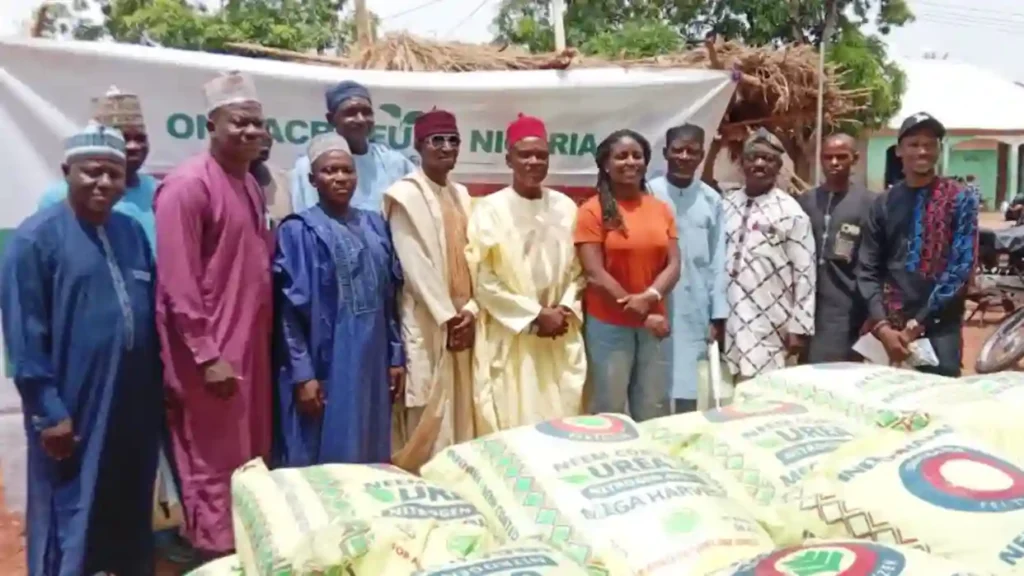
One Acre Fund Nigeria has commenced the distribution of agricultural inputs to 88,000 smallholder farmers across Nasarawa, Niger, Kwara and Plateau states as part of its 2026 farming season support programme.
 Follow us on Google News
The organisation said the initiative is aimed at helping farmers improve crop yields during the rainy season while reducing the financial pressure associated with purchasing farm inputs.
The distribution exercise was officially flagged off in Abioga community, Obi Local Government Area of Nasarawa State, where farmers began receiving fertilisers, improved seeds, masks, gloves and other farming materials through a credit-based support system.
One Acre Fund Nigeria is a non-governmental organisation focused on supporting smallholder farmers with access to farm inputs, financing, training and agricultural services designed to improve productivity and strengthen rural livelihoods.
Speaking during the launch, the Trees Lead for One Acre Fund Nigeria, Zainab Haruna, said many smallholder farmers struggle to access quality farm inputs and proper agricultural training due to financial limitations.
According to her, the programme allows farmers to enrol with a smaller amount instead of paying the full cost of inputs upfront.
“They can use a small amount to enrol in the programme, access the inputs, and then over the course of the next five to six months, they are able to slowly pay back their loan,” Haruna said.
She explained that the organisation also provides training for participating farmers to help them improve productivity and maximise output during the farming season.
“It ensures that they are able to continue running their farming enterprise. They have access to training because we also make sure that all our farmers are trained, and that way we ensure that their yield for the season is improved,” she added.
The Communications Specialist for One Acre Fund Nigeria, Kazi Nanyah, disclosed that the organisation is distributing about 9,000 metric tonnes of agricultural inputs on credit across the four states.
He said the intervention is designed to address major challenges affecting smallholder farmers, including rising farming costs, poor access to agricultural finance and weak distribution systems in rural communities.
“As Nigeria enters the 2026 planting season, the country’s food system continues to face structural constraints, including rising input costs, limited access to agricultural finance and persistent inefficiencies in distribution at the community level,” Nanyah said.
“For millions of smallholder farmers who produce the bulk of Nigeria’s food, these constraints directly translate into lower productivity and heightened vulnerability.”
Nanyah noted that although the intervention may not cover the entire national demand for agricultural support, it represents an important effort towards improving food production and strengthening smallholder farming operations across participating states.
The flag-off event also attracted government officials, development partners, community leaders, farmer representatives and security agencies, with discussions centred around soil health, farmer resilience, tree planting and innovations in agricultural service delivery.