The Federal Government is continuing efforts to expand the Nigeria Social Register (NSR), a database used to identify poor and vulnerable households for social protection programmes, including cash transfers and other support.
 Follow us on Google News
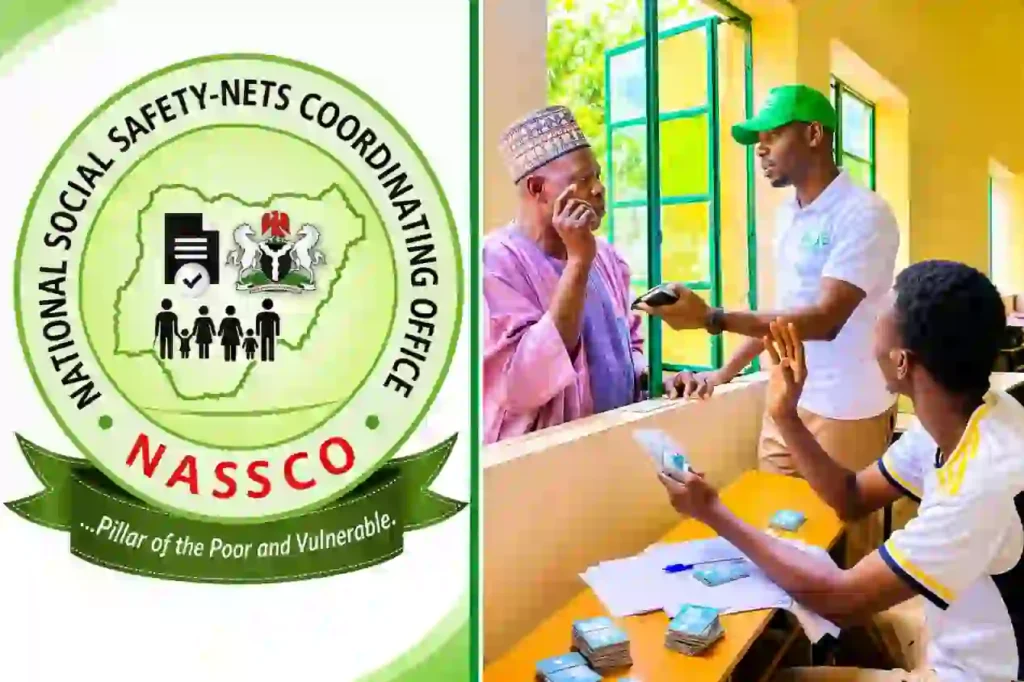
The National Social Safety-Nets Coordinating Office (NASSCO) coordinates the register with State Operations Coordinating Units (SOCUs), which work with communities to identify eligible households. The exercise includes household visits, collection of socio-economic information and community validation.
Recent activities in Bayelsa State show how the process works. Bayelsa SOCU officials visited Nembe Creek Community in Nembe Local Government Area on Thursday, November 5, 2026, to monitor the integration of National Identification Numbers (NIN) with the NSR and the expansion exercise.
The team travelled by boat to reach households in the riverine community. The Paramount Ruler, Chief Agent Anthony, commended the exercise and said some residents had already benefited from cash transfers after being listed in the register. The team later briefed NASSCO National Coordinator, Dr Funmi Olotu, and Bayelsa State Coordinator, Eric Bibowei Okoriye. Enumerators were expected to continue directly in another Nembe community.
What does the register offer?
The NSR is not limited to cash transfers. Government agencies and development partners can use it to identify households for interventions in livelihoods, health, education, agriculture and humanitarian assistance. Inclusion does not automatically guarantee payment; each programme has its own eligibility checks.
Is ₦75,000 guaranteed?
The announcement does not confirm a ₦75,000 payment for every registered household. Cash support depends on the specific programme. The National Cash Transfer Office (NCTO) administers the Household Uplifting Programme–Conditional Cash Transfer (HUP-CCT), while other interventions have separate rules.
How to be registered
There is no general public online form to claim cash transfers through the NSR. Identification is conducted through community-based targeting and household enumeration by authorised state teams. Residents should cooperate with verified SOCU enumerators, provide accurate information and avoid anyone demanding payment.