
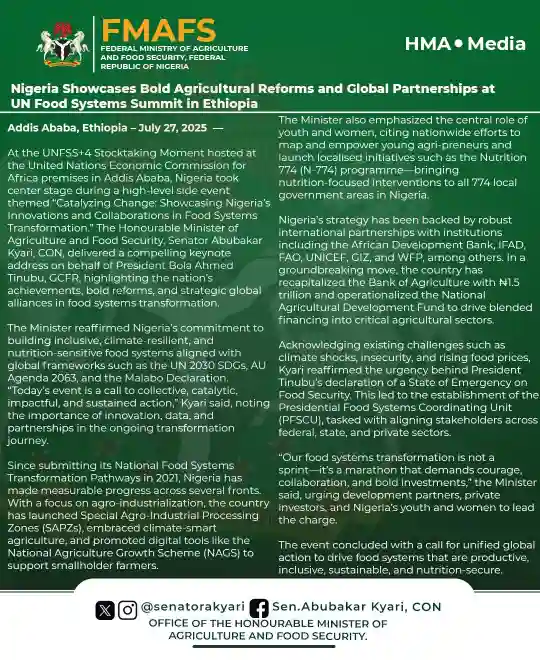
Addis Ababa, Ethiopia – July 27, 2025 – Nigeria made a strong impression at the UNFSS+4 Stocktaking Moment held at the United Nations Economic Commission for Africa headquarters in Addis Ababa. During a key side event titled “Catalyzing Change: Showcasing Nigeria’s Innovations and Collaborations in Food Systems Transformation,” the Honourable Minister of Agriculture and Food Security, Senator Abubakar Kyari, CON, represented President Bola Ahmed Tinubu, GCFR, delivering a keynote address that focused on Nigeria’s achievements and future plans in food systems reform.
 Follow us on Google News
In his remarks, Kyari emphasized that Nigeria is fully committed to building food systems that are inclusive, climate-resilient, and nutrition-sensitive. These efforts align with global goals such as the United Nations 2030 Sustainable Development Goals (SDGs), the African Union Agenda 2063, and the Malabo Declaration.
“Today’s event is a call to collective, catalytic, impactful, and sustained action,” he said, stressing the importance of innovation, reliable data, and strong partnerships in driving progress.
The Minister highlighted the tangible progress Nigeria has made since submitting its National Food Systems Transformation Pathways in 2021. Among the most notable efforts are the launch of Special Agro-Industrial Processing Zones (SAPZs), the adoption of climate-smart agriculture, and the use of digital platforms like the National Agriculture Growth Scheme (NAGS) to help smallholder farmers increase productivity and income.
Kyari pointed out that women and young people play a key role in this transformation. “We have begun mapping and empowering young agri-preneurs across the country,” he noted. He also mentioned the implementation of the Nutrition 774 (N-774) programme, which brings nutrition-specific projects to all 774 local government areas in Nigeria.
Nigeria’s agricultural strategy is being strengthened through strong international collaborations. Partners include the African Development Bank, IFAD, FAO, UNICEF, GIZ, and the World Food Programme (WFP).
The government has recapitalized the Bank of Agriculture with N1.5 trillion and launched the National Agricultural Development Fund to support blended financing options for key agricultural projects. These steps are expected to attract agribusiness investment and improve food security across the country.
Kyari acknowledged ongoing challenges like climate shocks, insecurity, and increasing food prices. He cited President Tinubu’s declaration of a State of Emergency on Food Security, which led to the formation of the Presidential Food Systems Coordinating Unit (PFSCU). This body is responsible for harmonizing actions among federal and state governments and the private sector.
“Our food systems transformation is not a sprint—it’s a marathon that demands courage, collaboration, and bold investments,” Kyari said. He encouraged youth, women, private investors, and development partners to stay involved in advancing Nigeria’s agricultural future.