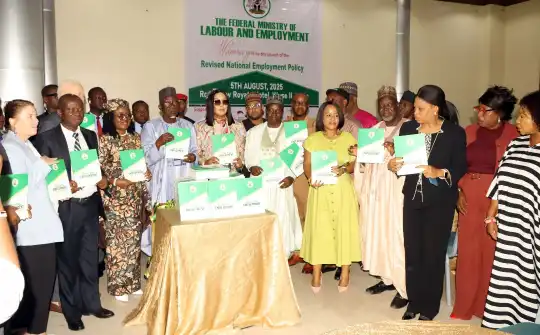
The Federal Government has described the Revised National Employment Policy (NEP) as a vital part of its plan to reduce poverty and create more job opportunities in Nigeria.
 Follow us on Google News
This was made known by the Minister of Labour and Employment, Muhammad Maigari Dingyadi, during the official launch of the Revised National Employment Policy 2025 in Abuja on Tuesday. He explained that the updated policy is aimed at offering bold, inclusive, and forward-thinking solutions to Nigeria’s employment issues.
Dingyadi said, “The revised policy offers a bold, inclusive and future-fit solution to the nation’s employment challenges.” He stressed that the NEP will help build a labour market that supports inclusive growth, fairness, productivity, and sustainability for all Nigerians.
The Minister highlighted that the review of the policy became necessary due to rising levels of youth unemployment, underemployment, informal sector growth, gender gaps, and regional job differences across the country. He also noted that the COVID-19 pandemic made these issues even more visible and urgent.
He said, “The recent COVID-19 pandemic further exposed Nigeria’s vulnerabilities, and the need for proactive, adaptive, and progressive employment policies.” Dingyadi pointed out that other global factors like automation, climate change, digitisation, demographic changes, and political instability have made it important to shift away from outdated methods and adopt modern strategies.
He added, “The NEP 2025 is not a stand-alone policy. It is a strategic compass aligned with Nigeria’s National Development Plan (2021–2025), ECOWAS Labour and Employment Protocols, the African Union’s Agenda 2063, the Sustainable Development Goals, and the International Labour Organisation’s Future of Work Initiative.”
Dingyadi explained that the new employment policy is in full support of President Bola Ahmed Tinubu’s Renewed Hope Agenda. “At the heart of the Renewed Hope Agenda is a national commitment to lift millions of Nigerians out of poverty through job creation, youth empowerment, enterprise development, digital innovation, and inclusive growth,” he said.
He added that the policy would help achieve these aims by improving access to decent work, formalising informal jobs, improving people’s skills, and supporting fast-growing sectors with high job potential.
The Minister stated that employment is not just an economic target but a means of achieving social justice, peace, and long-term growth.
He said the NEP gives a clear direction for all job-related programmes under the current administration and encourages collaboration among government bodies to ensure goals are met. It also ensures that youth, women, and people with disabilities are not left behind.
According to Dingyadi, the updated NEP includes measurable targets and a timeline to help track progress and make sure the policies are implemented effectively. He added that the policy also looks into modern sectors of the economy.
“The NEP 2025 significantly recognises the evolving shape of the Nigerian economy, integrating emerging sectors such as the Digital Economy, Blue Economy, Green Economy, and Orange Economy,” he said.
He also pointed out that the policy supports remote work. “The Policy also recognises Remote Work (Telework) as an increasingly viable and flexible mode of employment, especially for persons with disabilities, women with care responsibilities, and others facing mobility constraints.”
The Minister urged all stakeholders to join hands to make the NEP work. He said this would require political commitment, stable funding, strong institutions, and effective partnerships. He encouraged state governments to adopt the policy and adjust their job creation plans to match the national direction.
Finally, Dingyadi called on the private sector to work together with the government to develop skills training programs that respond to the real needs of the labour market.