

 Add us on Google
The National Association of Artificial Intelligence Practitioners (NAAIP) on Wednesday allayed fears over possible job losses arising from the growing use of artificial intelligence (AI), saying the technology will create more employment opportunities rather than render Nigerians jobless.
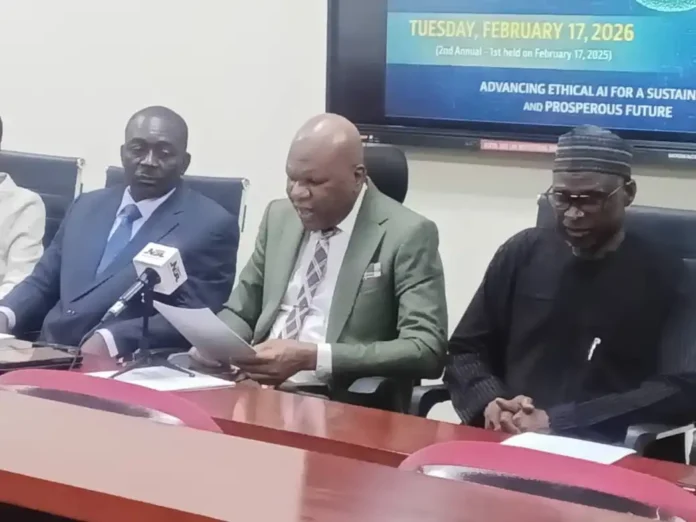
The assurance was given at the 2026 AI Awareness Day held in Abuja, where experts and stakeholders gathered to discuss the future of AI in the country.
The association, founded by former Acting Vice Chancellor of Lagos State University, Prof Peter Okebukola, said Nigeria must move from being mere consumers of foreign AI tools to producers of indigenous data and solutions that reflect local realities.
Addressing journalists, the NAAIP President, Prof Eyitope Ogunbodede, dismissed speculations that AI would lead to mass unemployment.
“AI will not render some people jobless as speculated by some people. It’s just like when we used typewriters in those days, and then computers came along. It didn’t render anybody jobless,” he said.
He explained that the real risk lies in refusing to adapt to new technology.
“If you are not in tune with developments in AI, the person will become jobless. In fact, AI is creating more jobs. For those who move with AI and are conversant with what is going on, they will continue to retain their job.
“Today, some entrepreneurs and users of social media are sitting in the comfort of their rooms and earning a lot of money using AI. So, it’s creating more jobs.”
Ogunbodede, however, expressed concern over Nigeria’s heavy reliance on foreign data to power AI systems used in the country.
“However, we rely solely on data that is actually harvested from outside the country. That’s why NAAIP is creating awareness and insisting that as a nation, we have to generate our own data,” he said.
He pointed out that widely used AI tools are driven by background data that may not fully represent Nigerian realities.
“Even the common ones we are using now like the Chatbot and ChatGPT, the background data driving is essentially not our own. And that’s why you find that some of the information coming out of it may not really apply directly to us.
“So we are calling on all Nigerians to work with us to ensure that we are not just consumers but also people who will innovate and generate our own.
“So we have the data to be able to do that. But we simply need the support of our own people. And we need your own support to be able to do that. We have the wherewithal to do it. We just simply need the support.”
He also noted a growing gap between students and lecturers in the use of AI tools in higher institutions.
“In most Nigerian universities now, virtually all the students use AI. On the other hand, it’s not all the lecturers who can use AI,” he said.
Also speaking, the Vice-Chancellor of the National Open University of Nigeria, Prof Uduma Orji Uduma, who was represented by Prof Monioluwa Olaniyi, said AI usage in Nigeria had grown significantly.
“The current data provided by Google says that 93 per cent of Nigerians who have access to smartphones are active users of artificial intelligence.
“It is also said that 80 per cent of the users are deploying it to solve complex topics. Whether we like it or not, virtually everybody is actively using AI. So it means artificial intelligence is now popular in Nigeria and also makes us one of the largest markets for it.”
In his remarks, NAAIP Vice-President (North-West), Prof Nasiru Maiturare, urged stakeholders to take ownership of Nigeria’s AI development.
“We have a responsibility through the association and stakeholders to ensure that we develop and direct our own AI intelligence transformation in Nigeria.
“Otherwise, we’ll end up being victims. Some other people will plan it and then deploy it in a manner that will be detrimental to our own interests,” he said.

