

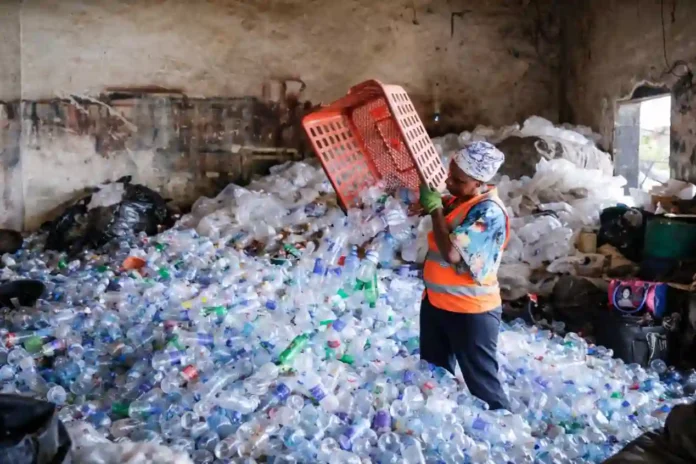
Alex Ekwueme Federal University, Ndufu-Alike Ikwo, Ebonyi State, has commenced the training of staff and students on plastic production and waste management, following sponsorship by the French embassy. The initiative is aimed at converting plastic waste into useful products while promoting environmental sustainability within the university community.
The institution is one of five universities across the country selected by the French embassy to participate in a programme focused on turning plastic waste into economic value. The project combines skills development, environmental awareness, and practical production of plastic items that can be used or sold.
Speaking during the training held on Wednesday at the university premises, the Project Coordinator of the plastic waste management project, Robert Onyeneke, said the university has acquired several machines and tools to ensure effective implementation. He disclosed that the institution has also procured 130 plastic waste bins to support proper collection of plastic materials on campus.
“We have our crushing machine, injection moulding machine and other equipment because you see plastic waste bin collection is scattered everywhere on campus and the essence is to tell you that you don’t need to be throwing your plastic around,” Onyeneke said.
He added that the number of waste bins already deployed shows the commitment of the university to environmental sustainability. “We have about 130 of the plastic waste bin and that tells you the commitment of the university on the environmental sustainability and we are thankful to the management of the university,” he stated.
Onyeneke further praised the university leadership for supporting the project and ensuring timely delivery. “The University has shown great support to this project to see that we are on time on the delivery,” he said.
He also expressed appreciation to the French embassy for funding the initiative, describing the collaboration as long-standing. “We are also thankful to the French embassy of Nigeria for providing the funds to implement this project in this university. Our partnership with the embassy is a long one, it has started before now,” Onyeneke said.
According to him, the relationship between the university and the French embassy dates back to 2019 and 2020 when the embassy supported climate change projects and assisted in equipping the university’s fabrication laboratory. “They also helped the University in equipping our FAB lab. The FAB lab is under the center for adaptive research and fabrication,” he noted.
One of the facilitators of the programme, Okechukwu Pius, a Professor of Engineering Geology and Director of Human Resource Development at the university, explained that the project was approved after the French embassy reviewed a proposal submitted by the institution.
“This project started when Professor Robert Onyeneke who is the Dean of Agriculture in the university wrote a proposal to the French embassy the need to manage plastic wastes we have,” he said. He added that the embassy assessed the proposal and considered its potential impact. “The French embassy scrutinized the proposal and thought it wise that the project will have a lot of benefit within the university community and those who will take the message round town and into the society,” he stated.
Pius said plastic waste collected on campus would be converted into finished products and warned against reusing plastic materials for food consumption due to health risks. “It is not good to reuse plastic because when you talk about contamination or pollution, there are three aspects of them. We have what is called physical contamination, there is also chemical aspect of it and there is also biological contamination,” he said.
He explained that washing plastic may remove some contaminants but not all. “You may tackle washing which may end up removing the physical, the chemical. What about the biological? So, it is difficult to say that you are wasting plastic to reuse it. You have not completely dealt with the contaminant. What we advocate is to recycle it, melt it completely,” Pius said.
Also speaking, the Lead Researcher of the waste management project and Head of the Department of Biotechnology, Nwagu Ekene, announced that the university would begin producing plastic spoons this week. He explained the process involved. “We have our site where we dump different plastic. We get them, we separate them based on type of plastic. After the separation, the next thing we do, we need to crush,” he said.
Ekene added that after crushing, the plastics are upcycled into finished products. “If we are done with the crush, we now do the upcycling and the upcycling means converting that plastic wastes to a finished product. One of the project we designed to produce there in our site is plastic spoons because it is very marketable. We are producing the spoons this week,” he said.
Read also: Sahara Foundation, Plan International expand recycling program for girls

