
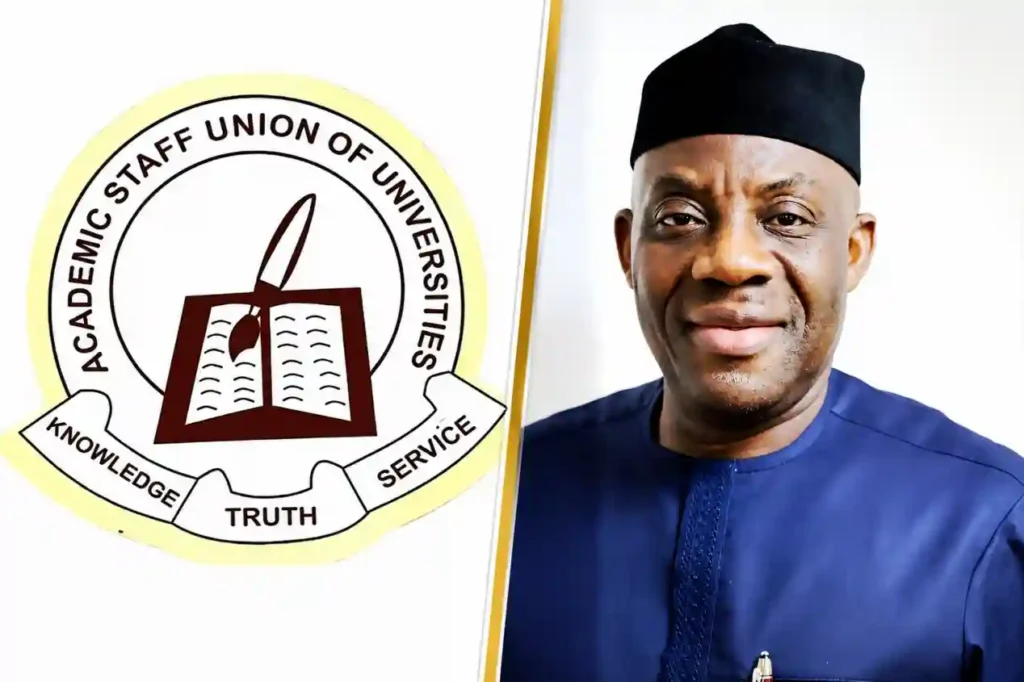


Academic Staff Union of Universities has warned that Nigeria’s public university system could witness another round of industrial action if the Federal Government and state governments fail to fully implement the 2025 agreement reached with the union.
The warning followed the union’s National Executive Council (NEC) meeting held at Modibbo Adama University on May 9 and 10, 2026, where ASUU reviewed the implementation of the agreement signed with the Federal Government in December 2025.
In a statement issued on Monday by ASUU President, Chris Piwuna, the union expressed dissatisfaction with what it described as a “distorted and uncoordinated” implementation process across federal and state institutions.
According to the union, it had remained silent since the official presentation of the agreement in January 2026 in the hope that governments and university authorities would comply with the terms agreed during negotiations.
“This interactive session was called to present the outcome of our review of the implementation of the signed agreement and other outstanding issues following the NEC meeting held at Modibbo Adama University, 9th–10th May, 2026,” the statement said.
ASUU noted that the progress recorded after the unveiling of the 2025 FGN-ASUU agreement is gradually fading due to delays and inconsistencies in implementation.
“The momentum generated with the unveiling of the 2025 FGN-ASUU Agreement on 14th January, 2026 is fast waning and may soon be lost if government’s promise to fully implement the agreement is not kept,” the union added.
The union blamed part of the problem on the failure to inaugurate the Implementation Monitoring Committee, which was expected to supervise and coordinate the execution of the agreement across universities.
ASUU also accused some federal university administrators of selectively implementing certain components of the agreement, especially the Consolidated Academic Allowances, Earned Academic Allowances, and Professorial Allowances.
According to the union, those allowances were expected to be fully integrated into the Consolidated Academic Salary Structure instead of being treated separately.
The lecturers’ union further criticised some state governments for allegedly ignoring the agreement despite taking part in negotiations that lasted between 2017 and 2025.
The latest warning comes barely two months after Minister of Education, Tunji Alausa, declared that the era of strikes in Nigerian tertiary institutions had ended permanently.
Speaking at an event in Lagos in March 2026, the minister assured students, parents and the public that universities and polytechnics would remain open for uninterrupted academic sessions.
However, ASUU maintained that several welfare-related issues remain unresolved, including salary arrears, promotion arrears, unremitted deductions, salary shortfalls linked to the Integrated Personnel and Payroll Information System (IPPIS), and withheld salaries from the 2022 strike period.
The union also raised concerns over delays in pension payments for retired lecturers, especially in state-owned universities, while accusing the National Pension Commission of slowing down pension benefit harmonisation.
ASUU additionally faulted the Federal Government’s proposed National Research Council and the National Research and Innovation Development Fund, arguing that the plans do not align with provisions of the 2025 agreement, which recommends at least one per cent of Nigeria’s GDP for research, innovation and development funding.