

 Add us on Google
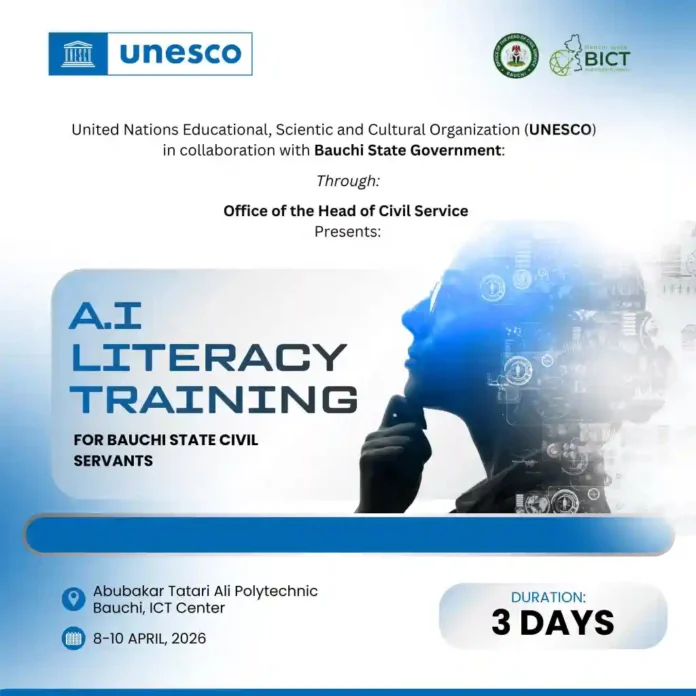
The Office of the Head of Civil Service has announced plans to host a three-day Artificial Intelligence (AI) Literacy Training for civil servants in Bauchi State, in collaboration with the United Nations Educational, Scientific and Cultural Organization and the Bauchi State Government.
The training is scheduled to commence on April 8, 2026, and will take place at the ICT Centre of Abubakar Tatari Ali Polytechnic, Bauchi. It is expected to run through April 10, 2026.
According to organisers, the initiative is designed to equip civil servants with practical knowledge and skills in artificial intelligence and other emerging digital technologies. The programme is part of broader efforts to modernise public service operations and improve efficiency in government institutions.
Officials stated that the training will expose participants to the fundamentals of AI, its real-world applications, and its relevance to governance and public administration. It will also focus on how technology-driven solutions can enhance decision-making processes and service delivery across ministries, departments, and agencies.
The collaboration with UNESCO underscores the importance of global partnerships in building digital capacity within the public sector. It reflects ongoing commitments to align Nigeria’s civil service with international best practices in innovation and digital transformation.
Participants are expected to benefit from hands-on sessions, expert-led discussions, and practical demonstrations tailored to the needs of government workers. The organisers noted that the training will also promote awareness of ethical considerations and responsible use of AI in public service.
The Bauchi State Government reaffirmed its commitment to strengthening institutional capacity through continuous learning and adoption of modern technologies. It added that initiatives such as this are critical to preparing the workforce for the evolving demands of governance in a digital era.
The AI literacy programme is expected to attract civil servants from various departments, with a focus on building a more responsive, efficient, and technology-driven public service in the state.

