

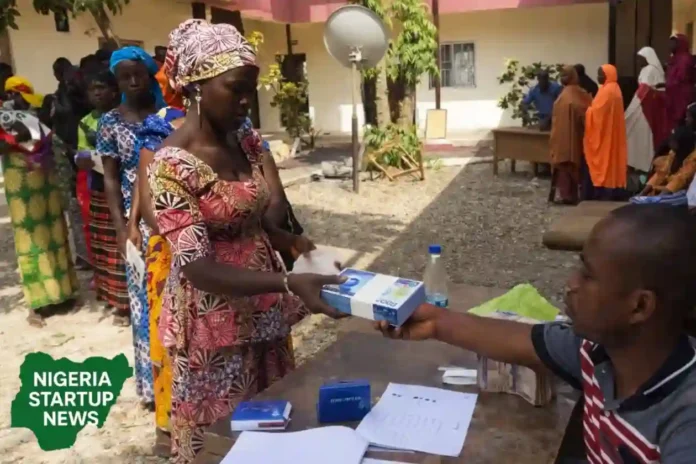
Residents of Borno and Adamawa states enrolled in a new social protection programme could receive between ₦150,000 and ₦200,000 on average as Action Against Hunger and its partners roll out a major cash-based intervention targeting vulnerable households affected by conflict and insecurity in Nigeria’s Northeast.
The programme, launched in Abuja on Tuesday, is being implemented by Action Against Hunger in partnership with the German Federal Ministry for Economic Cooperation and Development, the European Union, and the Deutsche Gesellschaft für Internationale Zusammenarbeit. It is designed to support about 1.4 million vulnerable people across the two states through a mix of cash assistance and institutional strengthening.
The project was unveiled during an opening ceremony attended by government officials, development partners, and members of the humanitarian community, marking the start of what organisers described as a coordinated effort to strengthen social protection systems while providing direct relief to affected communities.
Speaking at the event, the Country Director of Action Against Hunger, Nigeria, Thierno Diallo, represented by his Deputy, Andwalem Fekadu, said the initiative would focus on building the resilience of communities whose livelihoods have been severely disrupted by prolonged conflict and insecurity in the region.
According to Fekadu, the project will provide cash-based support to vulnerable households while working closely with state governments to reinforce existing social protection frameworks in line with Nigeria’s broader development objectives.
“As indicated earlier, the project is expected to benefit approximately 1.4 million people across both states. The primary focus of the project is on community members who have been affected by the protracted conflict and whose livelihoods have been severely disrupted by the ongoing security crisis. Therefore, the project will primarily target these members of the community,” he said.
He explained that the intervention is structured to complement government-led initiatives by strengthening the capacity of institutions responsible for social protection and ensuring that assistance reaches those most in need.
Fekadu disclosed that about €1 million has been earmarked specifically for the expansion of the Social Cash Transfer component of the programme, adding that accountability and transparency mechanisms have been built into the project’s design.
He said Action Against Hunger and other implementing agencies would work closely with state-level monitoring and evaluation departments, alongside their internal teams, to track progress and ensure that resources are delivered to intended beneficiaries.
“We will be working very closely with the state governments from the beginning of implementation to the end of the project to make sure we are aligned and on the same page,” Fekadu said.
Providing clarity on expected individual benefits, the Action Against Hunger official said participants enrolled in the cash components of the programme could receive between ₦150,000 and ₦200,000 on average, depending on the specific component and phase of implementation.
“Regarding the specific question about the amount of resources that will go specifically to individuals, well, you know, the project has different components. So it has different stakes. So the amount of allocation is not uniform at all stages,” he said.
“Well, on average, I would say individuals will benefit around ₦150,000 to ₦200,000,” Fekadu added.
He noted that the programme is currently planned as a one-year intervention, with the possibility of expansion depending on the availability of additional funding from donors.
While acknowledging that several states across the Northeast, Northwest and North-Central regions are facing similar security and humanitarian challenges, Fekadu said funding limitations have made large-scale expansion difficult at this stage.
Despite these constraints, he expressed optimism that continued engagement with development partners would create opportunities to extend similar social protection programmes to other affected states in the future.
Fekadu also highlighted Action Against Hunger’s long-standing involvement in strengthening social protection systems in Nigeria, citing over a decade of engagement in states such as Jigawa and Kano, as well as previous interventions in Borno and Yobe.
Borno and Adamawa states have experienced years of conflict and insecurity, leaving millions of residents vulnerable and struggling to meet basic needs. Many households have lost stable sources of income, increasing dependence on humanitarian support.
The new programme aims to combine direct cash assistance with efforts to strengthen state social protection systems, helping affected communities rebuild resilience, stabilise livelihoods, and gradually recover from the impacts of prolonged insecurity.

