

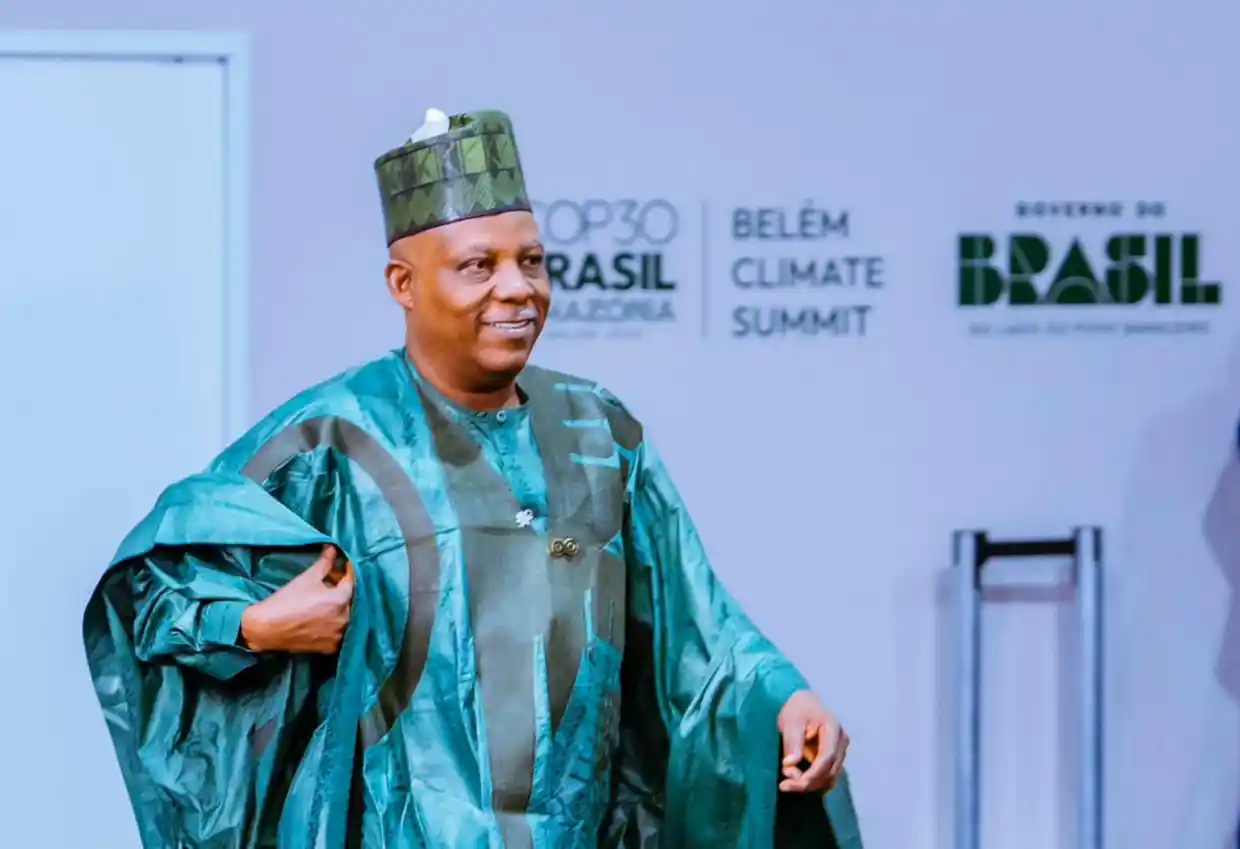
Vice President Kashim Shettima has called on world leaders to take concrete steps beyond making promises in addressing climate change and its global impact. Speaking at the Leaders’ Climate Summit during the 30th Conference of the Parties of the UNFCCC (COP 30) in Belém, Brazil, Shettima said the world must shift from “pledges to performance” and from “dialogue to delivery.”
“Let COP30 be remembered as the moment when the world moved from pledges to performance, from ambition to action, and from dialogue to delivery,” the Vice President said.
Representing President Bola Ahmed Tinubu, Shettima reaffirmed Nigeria’s commitment to cutting greenhouse gas emissions by 32% by 2035. He explained that the move follows the introduction of the National Carbon Market Framework and the Climate Change Fund, which are aimed at attracting billions of dollars in clean energy investments.
According to the Vice President, the initiatives are designed to strengthen Nigeria’s climate finance system and promote sustainable development. “Nigeria’s renewed climate agenda represents not just an aspiration, but a solemn national commitment to preserve the planet for future generations,” he said.
Shettima emphasized that the world must move from talk to tangible results to prevent further natural disasters. “The Earth speaks in the language of loss and warning. It tells us that our survival is tied to its well-being. These are the cries that have compelled us to gather, from one city to another, in pursuit of one shared purpose — to save the only home we have,” he said.
He noted that no country can achieve its climate goals through goodwill alone. “No nation can finance climate ambition with goodwill alone. We need a reliable and equitable architecture that recognises the realities of developing nations and empowers them to deliver on global commitments,” he added.
The Vice President also stated that Africa must take the lead in renewable energy, forest conservation, and carbon capture. “I hereby say without absolute certainty that we are not the problem; we are an integral part of the solution. This is why, at COP30, we hope to demonstrate that Africa can lead in carbon capture through forests, in renewable energy expansion, in digital monitoring of emissions, and in regional cooperation that translates ambition into prosperity,” he said.
Shettima reaffirmed that Nigeria is ready to work with other nations to achieve a fairer and greener planet. “Nigeria is ready to work with all nations to build a fairer, greener, and more resilient world, one where our children inherit not the ruins of our indifference, but the fruits of our collective resolve,” he stated.
He disclosed that the National Carbon Market Framework will enable Nigeria to generate, trade, and retire carbon credits in line with Article 6 of the Paris Agreement. The proceeds from these activities, he said, will be channelled into the Climate Change Fund to support communities affected by floods, droughts, and desertification.
Shettima added that Nigeria has developed a five-year Carbon Market Roadmap to establish an Emissions Trading System and a Carbon Tax Regime, backed by fiscal incentives to encourage clean industrial innovation.
Highlighting the country’s broader strategy, he said Nigeria’s Third Nationally Determined Contribution (NDC), validated and submitted in September 2025, covers energy, agriculture, transport, waste, and industry. He further explained that the Decade of Gas Strategy remains central to Nigeria’s energy transition, balancing natural gas use with solar and off-grid electrification for rural development.
On the global stage, UN Secretary-General Antonio Guterres warned that the world has failed to stay within the 1.5 degrees Celsius limit set under the Paris Agreement. He urged leaders to adopt a new approach to reduce emissions faster.
“I cannot agree more, and the real truth is that we have failed to remain below 1.5 degrees, and science now tells us that the temporary overshoot between the 1.5 limit, starting at the latest in the early 2030s, is inevitable,” Guterres said.
He called for a paradigm shift to reduce the scale and duration of the overshoot. “We therefore need a paradigm shift to limit these overshoots magnitude and duration and quickly drive it down. Given the temporary average overshoots and their thematic consequences, it could push ecosystems and expose billions of people to unliveable conditions and amplify threats to peace and security,” he added.
The UN chief said the consequences of inaction would be severe, especially for poorer nations. “Every fraction of a degree means more hunger, displacement and loss especially for those least responsible. This is more of failure and deadly negligence. The world metrological service has indicated that emissions will begin to increase this year and the 1.5 degrees is a red line for humanity,” he said.
Guterres appealed to world leaders to act urgently to make the overshoot as small as possible and bring global temperatures back below 1.5 degrees Celsius before the end of the century.
Also speaking, Brazil’s President, Lula Inacio Da Silva, said the fight against climate change requires collective effort from all sectors. He emphasized that combating climate change must be a top priority for every government and individual.
“We will need to overcome the mismatch of lack of connection between diplomatic dialogue and the actual world. It will take a collective effort, listening to indigenous communities and those bearing the brunt of climate change in order to take a global approach to the challenge,” President Da Silva said.
He explained that the slogan “Collective Efforts” was adopted for COP 30 to encourage climate action worldwide, involving civic societies and grassroots organizations.
“Climate change is the result of the same dynamics that, during centuries, has broken our societies between rich and poor. Climate justice is aligned with fighting hunger and poverty, the struggle against racism and gender inequality,” he added.
Prince William, representing King Charles at the plenary, said it was time for his generation to take responsibility for preserving the environment. “Our children and grandchildren will stand on the shoulders of our collective action. Let us use these inspiring surroundings here in the heart of the Amazon to rise to meet this moment, not with hesitation, but with courage; not with division, but with collaboration; not with delay, but with decisive commitment,” he said.

