

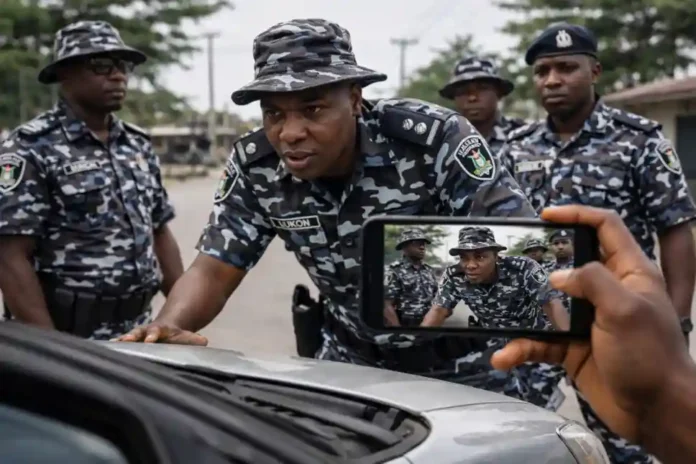
A Federal High Court sitting in Warri has ruled that Nigerians have the right to record police officers while they carry out their duties in public, declaring that officers must clearly identify themselves with name tags or valid identification.
The judgment, delivered by Honourable Justice H. A. Nganjiwa, addresses a long-standing concern over stop-and-search operations carried out by officers without proper identification, often leaving citizens unsure of who they are dealing with.
The case, filed by Maxwell Nosakhare Uwaifo, centred on the legality of police officers conducting operations without visible name tags or force numbers, and whether citizens have the right to record such encounters for accountability.
According to the court, “citizens have the right to record police officers performing their duties in public,” reinforcing that such actions fall within lawful civic engagement and do not constitute an offence.
The ruling further makes it clear that police officers must not operate anonymously. By law, officers are required to wear name tags or carry proper identification that can be verified during interactions with members of the public. This, the court held, is essential to transparency and trust in law enforcement.
In practical terms, the judgment draws a firm line against common practices where individuals claiming to be officers stop citizens without any visible means of identification. The court declared such conduct unlawful, stating that “faceless or anonymous policing is unlawful.”
Equally significant is the court’s position on citizens who choose to document these encounters. It held that police officers do not have the authority to harass, intimidate, arrest, or seize the phones of individuals simply because they are recording. As noted in the ruling, “police cannot harass, intimidate, arrest, or seize your phone because you are recording.”
The case highlights widespread public experiences where attempts to film police activities are met with resistance or threats. By clarifying the legal position, the court has provided a framework for both citizens and law enforcement officers on acceptable conduct during public interactions.
Uwaifo, who brought the suit in the interest of the Nigerian public, described the issue as one that affects everyday life. “You are stopped by armed men claiming to be police officers, but they have no name tags, no force numbers,” he stated, pointing to the uncertainty and risk such situations create.
The court granted all the reliefs sought in the application and awarded ₦5,000,000 as damages and ₦2,000,000 as the cost of litigation, underscoring the seriousness of the violations raised.
By affirming the right to record and insisting on proper identification, the ruling sets a clear legal standard for police conduct in public spaces and strengthens mechanisms for accountability.

