

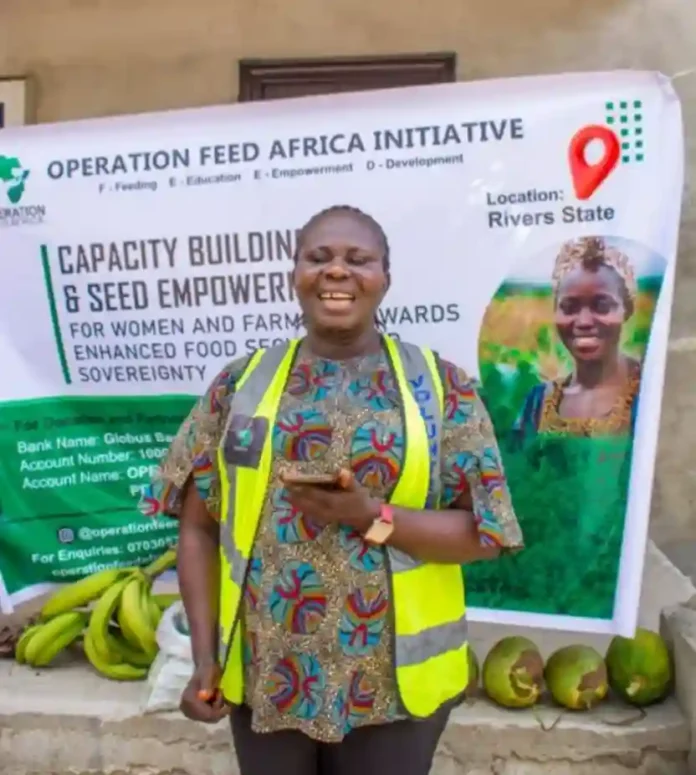
The Operation Feed Africa Rivers programme is supporting farmers and women with training, seeds, and practical skills to improve food production and strengthen food security across rural communities in Rivers State. However, the initiative is now facing growing challenges, including crop theft, fertiliser shortages, and climate-related disruptions that threaten the progress already made.
Launched as part of efforts to strengthen agricultural productivity and empower rural farmers, the programme introduced a series of capacity-building workshops under the theme, “Capacity Building and Seed Empowerment for Women and Farmers Towards Enhanced Food Security and Sovereignty.” The initiative focuses on equipping farmers with modern farming knowledge, improving post-harvest practices, and expanding opportunities for women in agriculture.
According to organisers, the workshops have already recorded strong participation from rural farmers, with women making up about 60 per cent of the participants. Through the training sessions and farmer field schools, participants received practical guidance on sustainable farming methods, improved seed use, and value addition to agricultural produce.
One of the programme facilitators explained that the goal is not just to increase food production but also to strengthen local resilience. “When farmers understand better farming techniques and how to add value to their produce, it improves household income and reduces waste after harvest,” the facilitator said.
Despite these gains, farmers involved in the programme say several challenges are slowing down their progress. One of the most pressing concerns is the increasing rate of crop theft, particularly during harvest periods.
A participating farmer said the situation has become discouraging for many producers. “You work for months on your farm and when it is time to harvest, people come at night and steal the crops. It affects our income and discourages farmers from expanding production,” the farmer said.
Farmers also point to the high cost and limited availability of fertiliser as a major obstacle to improving yields. Many smallholder farmers still depend on traditional farming practices and struggle to access the inputs needed to improve soil fertility.
Climate variability has added another layer of difficulty. Irregular rainfall, flooding in some areas, and prolonged dry spells have created uncertainty around planting and harvesting cycles.
An agricultural extension officer involved in the programme noted that these conditions are becoming more common. “Climate change is already affecting farming patterns. Farmers now face unpredictable seasons, which makes planning and production more difficult,” the officer said.

