

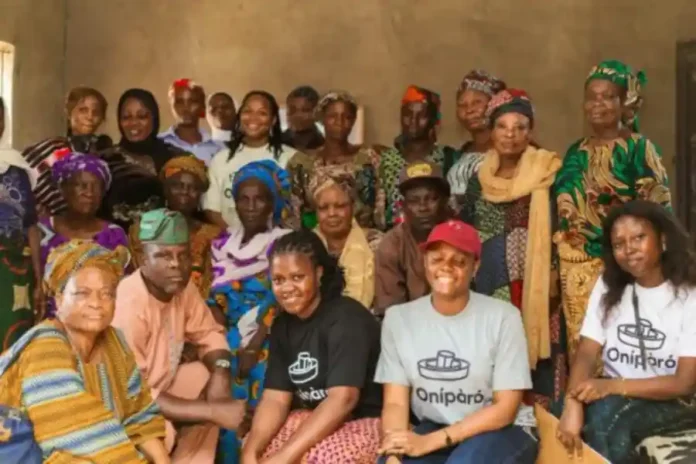
EcoSmart Club, a youth-led grassroots organisation focused on climate action, has launched a nine-month initiative called the Oniparo Project to reduce textile waste in Nigeria and highlight the critical role played by women who collect and resell second-hand clothing.
The project, which will run from March to October 2026, aims to raise awareness about the growing problem of fast fashion waste while promoting sustainable clothing practices across communities. It also seeks to bring recognition to the women known locally as Oniparo, whose work has long supported clothing redistribution and waste reduction.
Founder of EcoSmart Club, Hannah Omokhaye, said the initiative is designed to spotlight the environmental and economic importance of these women within Nigeria’s informal circular economy.
“The Oniparo women are not only pioneers of the circular economy in Nigeria, they are also providing affordable clothing for low-income communities while sustaining their families through this trade,” Omokhaye said.
According to her, the project will focus on telling the stories of these women, documenting their contributions, and encouraging broader conversations about sustainable fashion and responsible clothing consumption.
The Oniparo trade, a Yoruba term referring to women who move from house to house collecting used clothes in exchange for money or household items such as buckets or basins, has existed for generations. These women play a key role in extending the life cycle of clothing by collecting garments that might otherwise end up as waste and redistributing them through resale markets.
EcoSmart Club says this long-standing system of reuse and redistribution aligns closely with the principles of the circular economy, which encourages materials to remain in use for as long as possible.
However, the organisation notes that despite their contribution to waste reduction and community livelihoods, Oniparo women are rarely recognised in discussions around environmental sustainability or informal economic systems.
“There is little to no documentation or advocacy around the work of Oniparos,” Omokhaye explained. “Yet they are actively preventing textile waste and helping communities access affordable clothing.”
Project Manager of the Oniparo Project, Oluwatoyin Ajao, said the initiative will combine storytelling, advocacy and community engagement to highlight these contributions while encouraging Nigerians to rethink their clothing habits.
“This project will spark conversations around textile waste, sustainable fashion, and the need for policy inclusion of women who are already driving circular economy practices at the grassroots level,” Ajao said.
She added that the project will showcase local solutions to global environmental challenges, particularly the growing impact of fast fashion.
Globally, textile waste has become a major environmental concern. According to the United Nations Environmental Programme (UNEP), about 92 million tonnes of textile waste are generated every year worldwide. Much of this waste ends up in landfills or incinerators, contributing significantly to environmental pollution.
Fast fashion, which encourages rapid production and disposal of clothing, has accelerated the problem, increasing pressure on waste systems and natural resources.
Through the Oniparo Project, EcoSmart Club hopes to encourage more sustainable clothing choices while drawing attention to grassroots systems that have already been practising reuse and recycling for decades.
“This initiative is about recognising the people who are already doing the work,” Ajao said. “By telling their stories and highlighting their impact, we hope to strengthen the conversation around sustainable fashion and waste reduction in Nigeria.”

