

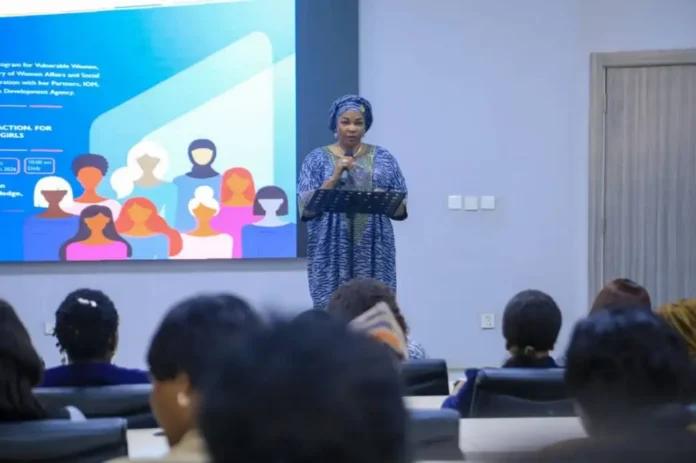
The Edo State Government, with support from the German Agency for International Cooperation (GIZ) and the International Organization for Migration (IOM), has begun a three-day entrepreneurship and digital marketing training programme for vulnerable women to help them start and grow sustainable businesses.
The capacity-building programme is being organised by the Edo State Ministry of Women Affairs and Social Development and is taking place at the John Odigie Oyegun Public Service Academy (JOOPSA). The training focuses on the “Start and Improve Your Business” (SIYB) model alongside practical digital marketing skills designed to help participants improve their livelihoods.
Speaking at the opening ceremony, the Coordinator of the Office of the Edo State First Lady, Mrs. Edesili Okpebholo Anani, represented by the Special Adviser to the Governor on Special Duties, Mrs. Betty Okonobo, said the initiative reflects the government’s commitment to empowering women with practical skills that can improve their economic independence.
She stressed that women play a critical role in strengthening families and communities when they have access to knowledge, opportunities and financial independence.
According to her, “Empowering women with practical business knowledge and skills is essential for building stronger communities. When women succeed economically, families are more stable and communities become more resilient.”
She encouraged participants to take full advantage of the training by actively engaging in the sessions and applying the lessons learned to their businesses and personal development.
Also speaking, the Commissioner for Women Affairs and Social Development, Mrs. Eugenia Abdallah, described the training as part of the state government’s broader efforts to expand economic opportunities for women, particularly those in vulnerable groups.
She explained that the programme was organised as part of activities marking the 2026 International Women’s Day celebration, themed “Rights. Justice. Action. For All Women and Girls.”
According to Abdallah, the theme highlights the importance of ensuring that women and girls have equal access to opportunities, protection and resources needed to thrive.
“This training programme is a practical demonstration of our government’s commitment to empower vulnerable women with the knowledge, skills and support they need to improve their livelihoods and contribute meaningfully to their families and communities,” she said.
She added that when women are empowered economically and socially, they become strong agents of development and positive change within society.
Abdallah further explained that the training sessions have been structured to provide participants with practical knowledge that will help them start, formalise and manage businesses successfully.
Participants are receiving lessons on entrepreneurship development, business planning, financial literacy and strategies for building and sustaining customer relationships.
The training also covers business registration and licensing processes to help women formalise their businesses and operate within recognised regulatory frameworks.
She urged participants to participate actively in the training sessions and make use of the opportunity to develop skills that can transform their economic situation.
“We expect that the knowledge gained here will not only transform your lives but also inspire you to become role models within your communities,” Abdallah stated.
The commissioner also appreciated development partners including IOM and GIZ for supporting the initiative, noting that collaboration with international organisations continues to strengthen programmes aimed at empowering women across Edo State.
During the training sessions, representatives from Genius Hub, Adesua Amadi-Emma and Destined Omo, delivered presentations on e-commerce and digital marketing strategies.
They explained how entrepreneurs can use digital platforms to promote their products and services, reach wider audiences and attract customers in the digital marketplace.
The facilitators demonstrated practical approaches for building online visibility and using digital tools to grow businesses.
They also emphasised that small businesses can scale faster when entrepreneurs take advantage of online platforms to market their products, communicate with customers and expand their reach beyond their immediate communities.

