

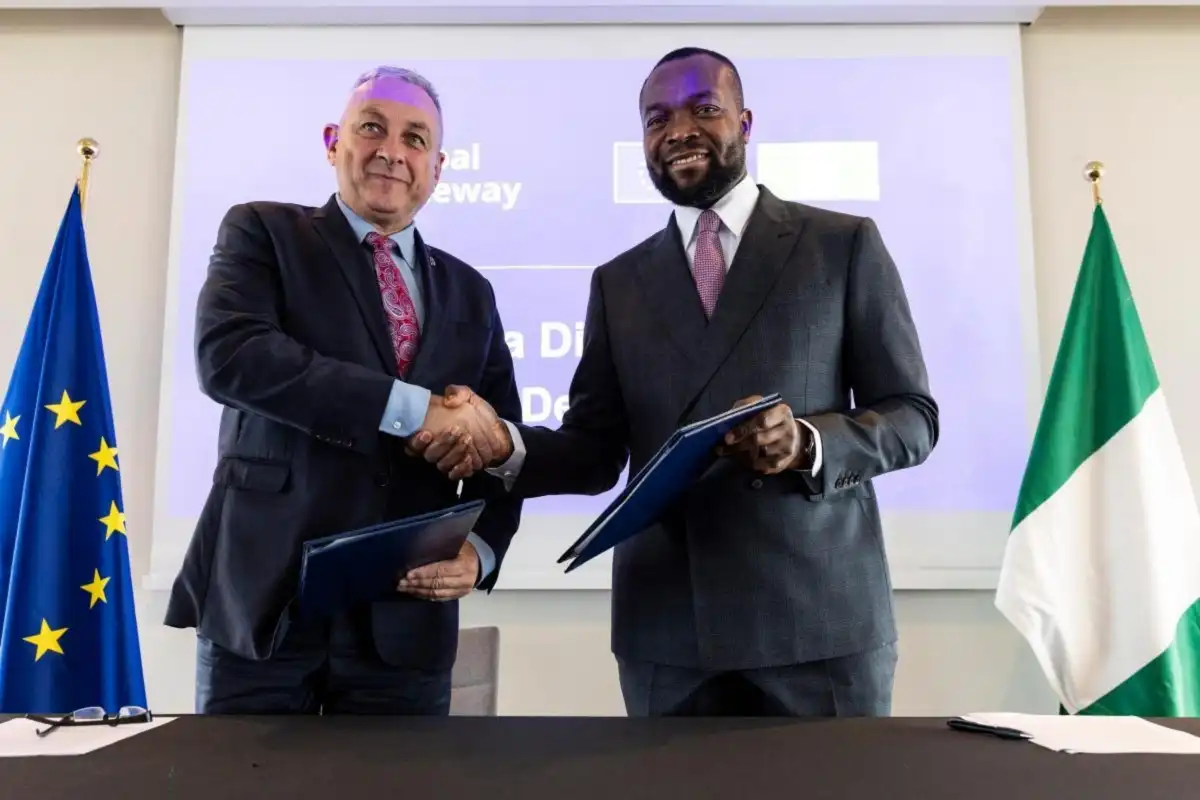
A new €45 million programme completing the EU Digital Economy Package for Nigeria has been signed at the EU-Nigeria Digital Open Day in Brussels. The agreement was finalized between Nigeria’s Minister of Communications, Innovation and Digital Economy, Bosun Tijani, and the European Commissioner for International Partnerships, Jozef Síkela. The investment is expected to deepen cooperation between both sides in the digital sector and strengthen Nigeria’s long-term digital transformation goals.
Speaking at the signing, Jozef Síkela said the partnership represents a major step in creating new opportunities. He explained that the EU’s focus is on a digital approach built around skills-transfer, open standards, data protection, privacy and security. According to him, “Global Gateway is about delivering new opportunities, and the EU-Nigerian cooperation in the digital area has a very strong potential to do exactly that. Our approach to digitalisation is based on skills-transfer, open standards, data protection, privacy and security. This way, we make sure that technologies truly enrich human lives. The new package will take our efforts even further by supporting modern e-public services and investing in the skills that will prepare Nigeria’s youth for the digital future.”
Minister Bosun Tijani said the cooperation aligns with Nigeria’s push for a technology-driven economy. He noted that digital transformation should help improve productivity and create new economic opportunities. He said, “The EU–Nigeria digital economy cooperation reflects our shared belief that digital transformation must provide a platform for growth in productivity driven by technology. As part of this, Project Bridge provides a commercially sustainable entry point for European investors and suppliers to participate in deploying an open-access fibre network at scale. Combined with our leadership in Artificial Intelligence, Digital Public Infrastructure and programmes such as 3 million Technical Talents, Nigeria offers European businesses a market where talent, demand and policy alignment converge to support long-term investment and expansion.”
The programme signed includes a major Global Gateway support to Project Bridge, which aims to deploy 90,000 km of fibre-optic backbone across Nigeria. This rollout is described as the country’s most ambitious digital infrastructure investment and is backed by loans from the European Bank for Reconstruction and Development, the World Bank and the African Development Bank. The newly signed €45 million grant will support the preparation of the project by providing technical assistance, equipment and support for network design, local skills development and supply chain deployment involving the EU private sector.
Part of the programme will help modernise Nigeria’s public administration by improving secure and user-friendly digital services. It will also support Nigeria’s efforts to expand digital-skills training nationwide. This includes training technicians, engineers and IT specialists who can maintain and operate the new infrastructure. Officials noted that large-scale digital projects can only succeed when the local workforce has the right capacity to innovate and manage new technologies.
The EU-Nigeria Open Digital Day was organised to give European investors and suppliers a clearer understanding of opportunities within Nigeria’s digital sector. Project Bridge was a major highlight, presented as a promising area for collaboration between EU tech companies and Nigeria. With a total value of €1.7 billion, the flagship project is expected to extend Nigeria’s fibre network to 125,000 km, which represents a 70 percent increase. When completed, it would become the third-longest terrestrial fibre-optic system in Africa, behind Egypt and South Africa.
Digitalisation is already a key part of the partnership between Nigeria and the EU. In 2022, the EU launched an €820 million Digital Economy Package under the Global Gateway strategy. This cooperation covers connectivity, digital skills, entrepreneurship, governance and public service development. Nigeria’s growing digital economy has been highlighted as one of the most promising in Africa, with Lagos standing out as a major hub for innovation. The country also has the continent’s largest e-commerce market, with 87 platforms that employ around 2.9 million people. Nigeria leads the African start-up space as well, with six of the continent’s eight unicorns.
The Global Gateway strategy aims to reduce global investment gaps by supporting clean, secure and smart connections in digital, energy and transport sectors, as well as stronger health, education and research systems. The strategy brings together the EU, its Member States and European development finance institutions under the Team Europe approach with a goal to mobilise up to €300 billion in public and private investments between 2021 and 2027.

